Landlords: 4 Tenant Qualification Checks and Required Documents
29 de agosto de 2026
16 min de lectura
Defensible tenant screening for landlords: four checks, required documents, scripted reference questions and a ready scoring template.
Every solid tenant qualification comes down to four checks: proof the rent is affordable (usually 2.5 to 3 times the annual rent in income, or roughly 30% of gross pay), a credit and background check, verified identity, and a genuine reference from a previous landlord. The principle that ties them together matters more than any single check: apply the same written criteria to every applicant, every time, and keep a record of why each decision was made.
TL;DR:
Verifiable income should be at least 2.5 to 3 times the annual rent or 30% of gross pay, confirmed through payslips, bank statements, or employer letters.
Credit reports reveal past credit issues but do not indicate current affordability, so they should be weighed alongside income and references.
Contact only official references using independent verification methods, and scrutinize vague or evasive answers as potential warning signs.
Using a weighted scoring system that considers financial stability, rental history, employment, and references ensures objective, defensible tenant decisions.
International applicants require fair adjustments, like certified translations and consideration of foreign income evidence, to avoid bias and improper rejection.
What are the essential tenant qualification criteria?
A good checklist does one job well: it turns a gut feeling into a set of pass or fail answers you can defend later. Landlords who skip this step tend to make decisions based on who seemed nicest at the viewing, which is exactly the kind of subjective judgement that gets you into trouble. Build your criteria around these items and apply them without exception.
Income and affordability. Require verifiable income at a multiple of the annual rent commonly used by landlords, or a rent-to-income ratio of around 30% of gross monthly pay, backed by payslips, bank statements or an employer letter.
Credit and background check. Run a credit report through a recognised referencing service and flag any County Court Judgments (CCJs), Individual Voluntary Arrangements (IVAs), or bankruptcy history for closer review rather than automatic rejection.
Identity verification. Confirm the applicant is who they say they are with a passport or driving licence, and where the checks apply in your jurisdiction, follow the official right-to-rent process rather than an informal photocopy request.
Previous landlord reference. A direct reference from the last landlord or letting agent, not a friend or relative posing as one, confirming rent was paid on time and the property was left in good condition.
Occupancy and suitability. Set a clear maximum occupancy per bedroom and a written pets policy, applied the same way for every applicant rather than decided case by case.
Guarantor trigger point. Decide in advance what triggers a guarantor requirement, such as income falling short of the threshold or a thin credit file, so you are not inventing the rule on the spot.
None of these checks is decisive on its own. A clean credit report doesn't confirm affordability, and a strong income doesn't rule out a history of property damage. The value comes from running all four checks and weighing them together, which is also the approach most professional referencing guides recommend rather than relying on a single gatekeeping test.
How do you verify income, employment and affordability in practice?
Paper promises are cheap. What you want is evidence that the money exists and moves in a pattern consistent with stable employment. That means going slightly further than most landlords bother to.
Request three months of bank statements and the most recent payslips. This gives you both the stated salary and proof it actually lands in the account each month.
Call the employer directly, using a number from the company website rather than one supplied by the applicant, and confirm job title, salary, and contract type.
For self-employed applicants, ask for two years of tax returns (or the equivalent SA302 summary), plus a letter from their accountant confirming average income.
Calculate affordability properly for variable income. Average the last six to twelve months rather than taking the best month, and apply the same 2.5 to 3 times rent multiple you'd use for salaried applicants.
Check for red flags in the bank statements: a persistent overdraft, repeated shortfalls before payday, or frequent gambling transactions are all signals worth a follow-up conversation before you commit.
Where income comes from benefits or multiple sources, verify each stream individually. A tenant with housing benefit plus part-time work isn't automatically riskier than one with a single salary, but each component needs its own paper trail.
Pro Tip:Ask for bank statements as PDFs downloaded directly from the banking app rather than screenshots. Screenshots are trivially easy to edit; exported statements carry metadata that's much harder to fake convincingly.
Self-employed and gig-economy applicants deserve a slightly longer look, which is covered in more detail further down, but the short version is: don't ask for more paperwork out of suspicion, ask for paperwork that actually proves the number they've quoted you.
What do credit and background checks actually tell you?
A credit report shows CCJs, IVAs, bankruptcy history, and how an applicant has managed credit commitments over recent years. What it will not show you is their current bank balance, so a clean credit file is not the same as proof they can afford the rent, and a poor one doesn't automatically mean they'll be a bad tenant.
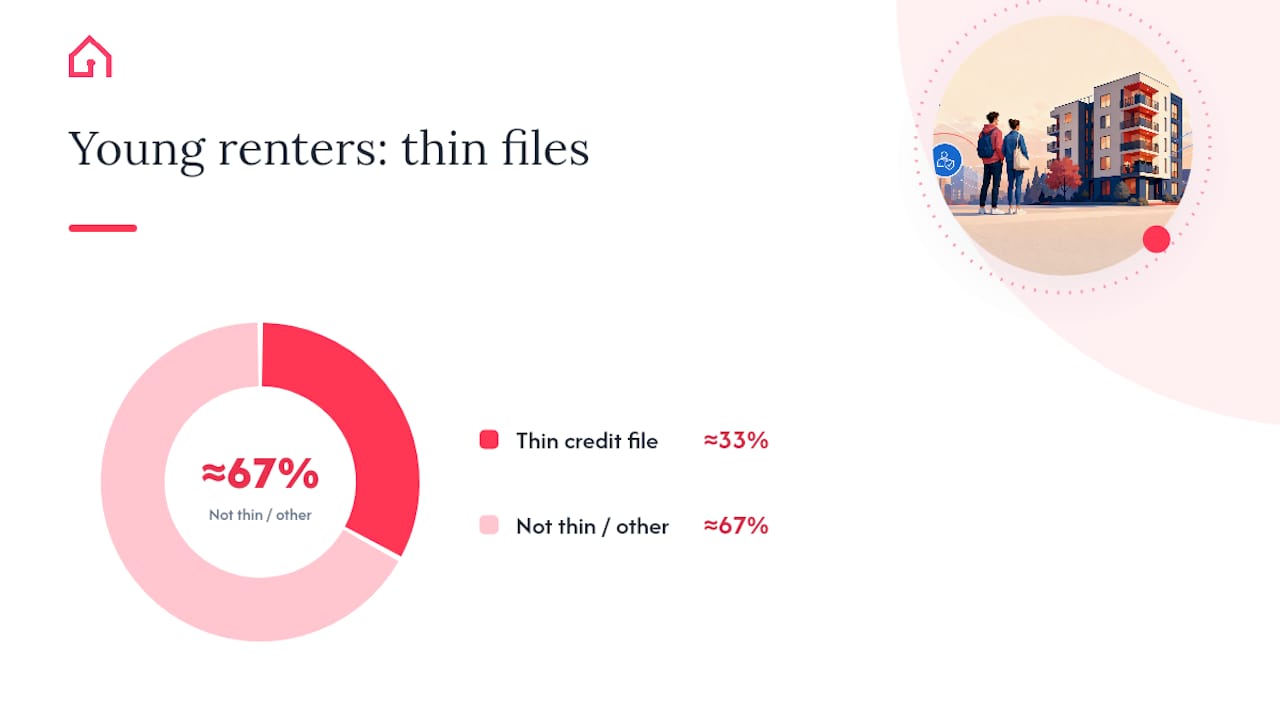
Roughly a third of younger renters carry what's known as a thin credit file simply because they haven't built up enough credit history yet, not because they're financially unreliable. Treating a thin file the same as a poor one is a common and avoidable mistake.
When you're reading a credit report, apply some judgement rather than a blanket rule:
Old, satisfied CCJs (settled two or more years ago, with a clear explanation) are a much weaker signal than a recent, unsettled one.
A single missed payment on a utility bill is not comparable to a pattern of defaults across multiple accounts.
Thin files need corroboration through bank statements, guarantors, or a stronger-than-usual landlord reference rather than instant refusal.
Recent adverse entries, especially anything from the last six months, warrant a direct conversation with the applicant before you decide either way.
Credit checks work best as one input among several, weighed against affordability and references rather than used as a single pass or fail gate. A landlord who rejects on credit score alone, ignoring a strong income and glowing references, is often turning away a perfectly good tenant over a data point that doesn't tell the whole story.
How do you check references without getting fooled?
A reference is only as good as your ability to verify the person giving it. Fabricated references (a friend pretending to be a previous landlord) are more common than most first-time landlords expect, so treat verification as part of the process, not an afterthought.
Ask for the previous landlord's or agent's contact details, then verify independently. Search the property address or the letting agent's name yourself rather than relying solely on the number the applicant provided.
Ask specific, scripted questions: Did they pay rent on time every month? Was the property left in good condition at the end of the tenancy? Were there any complaints from neighbours? Would you rent to them again?
Listen for vague or evasive answers. A referee who won't confirm rent payment dates, or who answers every question with a generic "they were fine," is a weaker signal than a specific, detailed response.
Cross-check the story. If the applicant claims two years at a previous address but the reference only covers eight months, ask why before you proceed.
References carry real weight precisely because they're hard to fake convincingly when you verify properly, as guidance on scripted reference questions makes clear. Treat a lukewarm or reluctant reference as a flag worth investigating, not something to wave through because everything else on the application looked fine.
When should you require a guarantor or offer a conditional approval?
A guarantor isn't a punishment. It's a sensible middle ground for applicants who don't quite clear your affordability bar but otherwise look solid, such as students, recent graduates, or someone between jobs with strong references.
Set the guarantor's own income threshold, typically 3 times the annual rent, and run the same credit check on them that you'd run on the tenant.
Use a written deed of guarantee rather than a verbal agreement. It should name the guarantor, the tenancy, and the extent of their liability, and it needs to be enforceable in the jurisdiction where the tenancy sits.
Consider alternatives to outright refusal before you reject an application outright: a shorter initial tenancy term, or adding a second authorised signatory to share liability, can solve the same problem without shutting the door.
Don't charge banned fees. Where referencing or guarantor administration fees are prohibited by tenant fee legislation in your jurisdiction, charging them anyway exposes you to penalties that far outweigh the saving.
Treat the guarantor route as a genuine option, not a box to tick before rejection. A borderline applicant with a guarantor in place is often a lower risk than a marginally stronger applicant with no safety net at all.
What legal and fairness limits apply to tenant screening?
Objective, written criteria aren't just good practice, they're your main defence if a rejected applicant ever challenges your decision. Screening that relies on impressions rather than documented standards is where discrimination claims tend to gain traction, deliberately or not.
Apply the same criteria to everyone. Under Equality Act principles, refusing a tenant because of a protected characteristic, even indirectly through a blanket policy, is unlawful. A blanket "no benefits" policy is a common example that falls foul of this.
Collect only what you need. Data protection rules require that you gather the minimum information necessary for the decision, get clear consent for how it will be used, and store it securely rather than in an open spreadsheet or unencrypted inbox.
Follow official guidance for identity checks. Where right-to-rent style checks apply, Gov sets out exactly how to inspect documents or use an approved digital verification service, and deviating from it weakens your legal position.
Document every decision and the reason behind it. A one-line note explaining why an applicant was rejected, tied to your written criteria, is what protects you if that decision is ever questioned.
Landlords must avoid blanket bans on applicants in receipt of benefits and instead assess affordability on the facts of each application. Treating housing benefit as an automatic disqualifier is one of the most common routes into an indirect discrimination claim.
A criminal record raises similar questions. It's rarely a lawful automatic bar on its own, and the specifics matter considerably, as explored in this legal breakdown of criminal records and housing applications. Judge relevance and recency rather than applying a blanket rule.
How do you turn all these checks into one decision?
Running four or five separate checks is only useful if you can combine them into a single, defensible answer. A simple weighted scoring framework does exactly that, and it's particularly useful when you're comparing several applicants for the same property rather than assessing one in isolation.
A workable starting point looks like this:
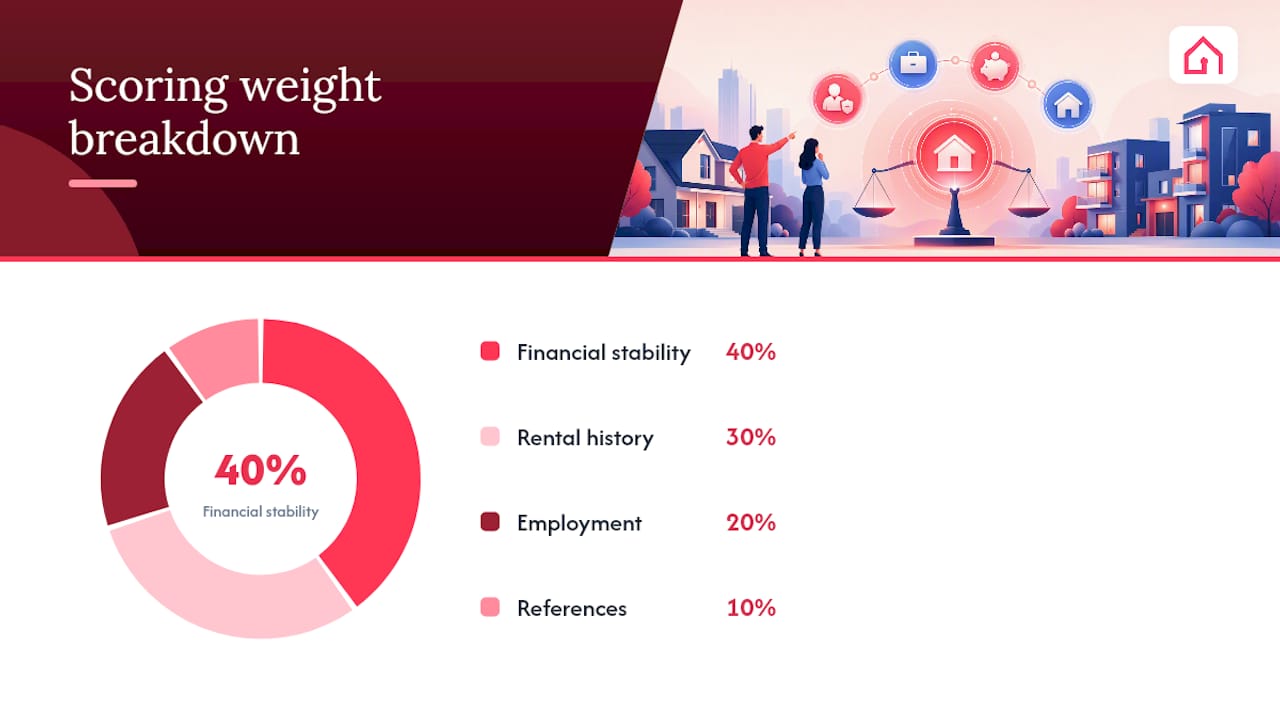
Financial stability (40%): income multiple, credit report, and bank statement patterns.
Rental history (30%): previous landlord reference and length of tenancy.
Employment (20%): contract type, job stability, and length of time in role.
References beyond the landlord (10%): employer confirmation, character reference where relevant.
Score each category as pass, conditional, or fail, then weight and total them to rank candidates objectively rather than by instinct.
Category
Weight
Pass criteria
Conditional trigger
Financial stability
40%
Meets 2.5 to 3× rent income multiple, no adverse credit
Thin file or income near threshold
Rental history
30%
Positive reference confirming on-time rent, good condition
No prior reference available
Employment
20%
Permanent contract, over 1 year in role
Probation period or recent job change
References
10%
Employer or character reference confirms details
Reference vague or unverifiable
Keep the underlying documents, your notes on the scoring, and the final decision in a single applicant file, and hold onto it for as long as your local data protection retention guidance recommends. Beyond legal protection, this scoring approach removes a lot of the second-guessing that slows down decisions when you're comparing two similarly strong applicants, according to the self-managing landlord's guide to screening. It also gives you a ready answer, backed by numbers, whenever an unsuccessful applicant asks why.
How can Hauzed help you apply these checks consistently?
Running this checklist manually, chasing payslips over email, verifying references by phone, cross-checking IDs, eats hours you don't have if you're managing more than one property. Hauzed's verified tenant profiles give you a head start: applicants complete identity verification and build out their rental profile before you ever exchange a message, which means less time spent chasing basic documents from scratch.
The platform's AI tools handle the repetitive parts of the process. Hauzer surfaces tenant matches suited to a specific property, Echo handles conversation follow-up so you're not manually replying to every enquiry, and Lia supports leasing conversations through chat. None of this replaces your own judgement on affordability, credit history, or references, and verification through Hauzed increases trust in an applicant's profile without guaranteeing they'll pass your financial checks.
Documents and identity data submitted through the platform stay within secure product flows with the applicant's consent, which matters both for your data protection obligations and for the applicant's peace of mind. Used well, Hauzed's outputs slot directly into the scoring framework above: a verified profile strengthens the identity and rental history sections, while faster replies mean you spend your saved time on the checks that genuinely need a human eye.
What extra checks matter for international or non-native tenants?
International applicants often get judged unfairly on paperwork that simply looks unfamiliar, rather than on any real risk. A landlord who doesn't recognise a foreign payslip format or a non-UK bank statement can end up treating unfamiliarity as a red flag, which isn't fair and isn't good screening either.
A few adjustments make the process fairer and more accurate. Ask for a certified translation of income documents where the original isn't in English, rather than rejecting them outright. Where an applicant has no UK credit history, treat that the same way you'd treat any thin file: corroborate with bank statements, an employer reference, or a guarantor, rather than assuming the absence of a UK credit footprint reflects badly on them.
For right-to-rent style checks specifically, the official GOV.UK process covers accepted document types for non-UK nationals, including visa and immigration status documents, and it's worth following that guidance precisely rather than improvising your own version. An overseas employer reference is just as valid as a domestic one; it simply takes longer to verify, so build that extra time into your decision timeline rather than penalising the applicant for it.
Language barriers can also make a reference call harder to interpret. If a previous landlord's English is limited, don't read hesitation or short answers as evasiveness. Consider asking for a written reference instead, which gives both sides time to communicate clearly.
The landlords who get into disputes are rarely the ones with strict criteria. They're the ones with no criteria at all, deciding case by case based on how an applicant came across at the viewing. Written, consistently applied standards do more than protect you legally; they make the whole process faster, because you're not relitigating your own judgement with every application.
Transparency helps both sides. An applicant who knows exactly what you're checking, and why, is far less likely to feel unfairly treated if they don't meet the bar. That alone prevents a good number of the disputes that end up costing landlords time and money.
None of this makes screening infallible. Good criteria reduce risk; they don't eliminate it. The point isn't certainty, it's fairness you can defend and consistency you can repeat.
— Hauzed
Ready to apply this checklist with less manual chasing?
Chasing payslips over email, calling references one by one, and cross-checking IDs manually is where most of the checklist above actually eats your time, not the decision itself. Hauzed is built to take that manual load off your plate: tenants arrive with a verified profile and identity checks already completed, so you're reviewing stronger applications from the start rather than starting from zero with every message.
From there, Hauzer surfaces suitable matches for your property, Echo keeps replies moving without you drafting every message yourself, and you can manage requests, chats, and visit scheduling in one place instead of across email, WhatsApp, and phone calls. Verification through the platform builds trust in an applicant's profile, but the final call on affordability, references, and fit stays with you. If you're managing one property or several, it's worth seeing how the Hauzed rental marketplace fits into the checklist you've just read, starting with your next listing.
Sources
For the checks covered in this article, go directly to primary sources rather than secondhand summaries. GOV.UK's right-to-rent verification guidance is the definitive reference for document checks and digital verification services. For broader referencing practice, the self-managing landlord's screening guide and UseLatch's referencing guide both cover credit interpretation in more depth. Hauzed's own tenant screening checklist offers a printable version of the criteria discussed here.
Evasive or vague answers from references, inconsistent details between the application and supporting documents, a recent unsettled CCJ, and bank statements showing persistent overdrafts or gambling transactions are the clearest warning signs.
What is the 2% rule for rental properties?
The 2% rule is an investment guideline suggesting monthly rent should equal roughly 2% of a property's purchase price to indicate strong cash flow; it's a landlord profitability measure, not a tenant screening criterion.
What is the 6 year rule on rental property?
This typically refers to tax rules, such as capital gains exemptions tied to a property being an owner's former main residence for a period before letting it out, and it varies significantly by jurisdiction, so check your local tax authority's guidance directly.
Do landlords have to replace mattresses between tenancies?
There's no blanket legal requirement to replace a mattress between every tenancy, but landlords must ensure furnishings meet fire safety regulations and are in a reasonably clean, usable condition for a new tenant.
How much income do I need to require from a tenant?
Most landlords apply an affordability rule of 2.5 to 3 times the annual rent in verified income, or roughly 30% of gross monthly pay, backed by payslips or bank statements.
Can I reject a tenant for a thin credit file?
Rejecting solely for a thin file isn't good practice, since it's common among younger or first-time renters; ask for additional evidence such as bank statements, a guarantor, or a stronger reference instead.