Landlord Playbook: 3 Tenant Sourcing Strategies to Cut Void Months
27 August 2026
10 min read
A practical landlord playbook: three quick steps—price right, list on targeted channels, and run fast screening—to cut vacancy time and speed lettings,...
The fastest way to source quality tenants is to price the property correctly, list it on the right mix of channels, and run a short, consistent screening process before anyone signs anything. In practice that means checking comparable rents this week, uploading three strong photos and a clear advert, and adding one screening line (income proof, references, move-in date) to filter out unsuitable enquiries. Do those three things and you cut most of the wasted time out of tenant sourcing.
TL;DR:
Listing on major portals combined with social and community channels speeds up tenant sourcing by balancing volume with quick response times.
Clear advert content—including rent details, tenancy length, pet policies, photos, and viewing instructions—filters out unsuitable applicants early.
Proper property presentation, especially focusing on kitchen and bathroom repairs, high-quality photos, and a brief video walkthrough, attracts better tenants and reduces vacancy periods.
Setting rent slightly below market value after comparing local listings and avoiding early price cuts helps secure quality tenants faster.
A consistent screening process, including verifying identity, income, references, and assessing bank statements, ensures safety without lengthy delays.
Big national property portals still do the heaviest lifting for most landlords. They reach the largest pool of active searchers and remain the default first stop, but reach alone doesn't guarantee quality. tends to produce faster results than relying on either alone, because portals bring volume while local groups bring speed.
Facebook Marketplace, community groups, and Instagram generate quick replies, sometimes within minutes of posting. The trade-off is quality control. Social channels attract more casual browsers, so your advert needs stricter filtering language than a portal listing does, because you can't rely on a paywall or a formal enquiry form to weed out unserious applicants.
Niche and audience-specific boards outperform general portals when your property suits a defined group. A two-bed near a university performs better on student housing boards than on a mainstream portal flooded with families. Corporate letting lists work well for professional short lets. HMO-specific sites reach room-seekers who already understand shared-living terms, which saves you explaining the setup twice.
A posting checklist that consistently reduces unsuitable enquiries includes:
Headline stating property type, bedrooms and area, not just "Lovely apartment to let"
Rent and what it includes (bills, parking, furnishings) stated plainly, not "POA"
Tenancy length and move-in date, so applicants self-select against their timeline
Pets and smoking policy, stated once, clearly, to stop repeat questions
A full photo set covering every room plus exterior and any outdoor space
Viewing instructions, including how to book and what to bring
Pro Tip:Put your screening line inside the advert itself, not just in your reply template. "Applicants should have proof of income and be able to provide a previous landlord reference" filters out a chunk of unsuitable enquiries before they ever message you.
How do you prepare a property to attract better applicants?
Presentation acts as a filter long before a tenant walks through the door. Landlords who invest modestly in photography and small repairs report fewer unsuitable enquiries and stronger applications, because a well-presented listing signals a well-run tenancy and discourages time-wasters who were only ever browsing.
Not every repair pays back equally. Focus spend where it changes first impressions fastest.
Fix anything in the kitchen and bathroom first. These two rooms decide most viewing outcomes; a dripping tap or stained grout does more damage to perceived value than tired carpet elsewhere.
Deep clean before you shoot, not after. Cleanliness reads instantly in photos and costs almost nothing beyond time.
Photograph with natural light, ideally mid-morning or early afternoon, and shoot wide rather than close, so rooms read as spacious rather than cramped.
Order the shots deliberately: living space first, then kitchen, then bedrooms, then bathroom, then any outdoor area last. That sequence mirrors how people actually walk a viewing.
Add a short video walkthrough for anything let unseen or to overseas applicants. It cuts wasted viewings from people who were never going to commit once they saw the layout.
High-quality photography and accurate descriptions reduce vacancy time largely because they set correct expectations upfront. Applicants who've seen a genuine wide shot of a small box room don't turn up disappointed and don't waste your Saturday.
Pro Tip:A three-minute phone video walkthrough, even unedited, will cut viewing no-shows more than any amount of extra text in the advert.
When should you list and how do you price competitively?
Pull five to ten comparable listings in your immediate area before you set an asking rent, and weight that research against how much a void month actually costs you. A property that sits empty for four weeks at £1,200 has already cost more than the difference between two competing asking prices, so slight underpricing to secure a strong tenant fast is often the cheaper outcome.
Round to a figure that reads as considered, not desperate. £1,195 signals a calculated decision; a randomly precise £1,187 signals uncertainty.
Avoid dropping the price within the first week. A rushed reduction reads as desperation and can attract lower-quality applicants who assume you'll negotiate further.
Late spring and summer typically bring higher enquiry volumes, so listing in that window, where your timeline allows it, shortens the search.
If enquiries stay thin after two weeks, choose one lever at a time: adjust the price, improve the listing (photos, description), or extend the search window. Changing everything at once makes it impossible to know what worked.
What checks actually protect you from a bad tenancy?
Start filtering before the viewing, not after. Your application form should ask for employment status, monthly income, notice period at their current address, and reason for moving, so you can screen out mismatches without wasting a viewing slot on someone who can't actually afford the rent.
At the viewing itself, ask direct questions rather than making small talk: current notice period, why they're leaving their last place, and whether they can name a previous landlord who'll take a call. A short, consistent viewing script improves selection and reduces bias precisely because you're comparing every applicant against the same benchmark rather than trusting gut feeling.
Once you've shortlisted, run these checks in order:
Identity verification against a passport or driving licence.
Affordability evidence, typically payslips or a bank statement showing income at roughly 2.5 to 3 times the monthly rent.
Employment or income confirmation, either a reference letter or a direct call to the employer.
Previous landlord reference, ideally by phone rather than email. Calling a previous landlord catches issues that digital referencing sometimes misses, because people answer follow-up questions differently on a call than in a written form.
A qualitative read of bank statements, not just the credit score. Persistent overdraft use or several short-term loans can point to payment risk even when the number itself looks acceptable.
Where the applicant's income sits below your comfort threshold, a guarantor or rent-guarantee insurance covers the gap without rejecting an otherwise suitable tenant outright. Paid referencing services are worth the fee when you're letting to someone from abroad or with a thin UK credit history, since they can verify details you can't check yourself. Hauzed's tenant screening checklist sets out this sequence step by step if you want a template to work from.
An operator's routine for repeatable tenant sourcing
The workflow that actually holds up under repeated use runs: advert live, shortlist within 48 hours, invite the strongest three to view, hold a small deposit from whoever you offer to, reference in parallel, then sign. Templated replies and a fixed viewing window each week save hours that otherwise disappear into scheduling back-and-forth.
The habit that separates a smooth letting from a stressful one is consistency: the same application form, the same viewing questions, the same reference checklist, every single time. Keep a written record of every decision. It protects you if a rejected applicant ever queries the outcome.
— Hauzed
Where Hauzed fits into this workflow
Most of the steps above take time because they're manual: sorting genuine enquiries from tyre-kickers, chasing references, and juggling viewing slots by text. Hauzed is built to strip that manual layer out without removing your control over who gets accepted.
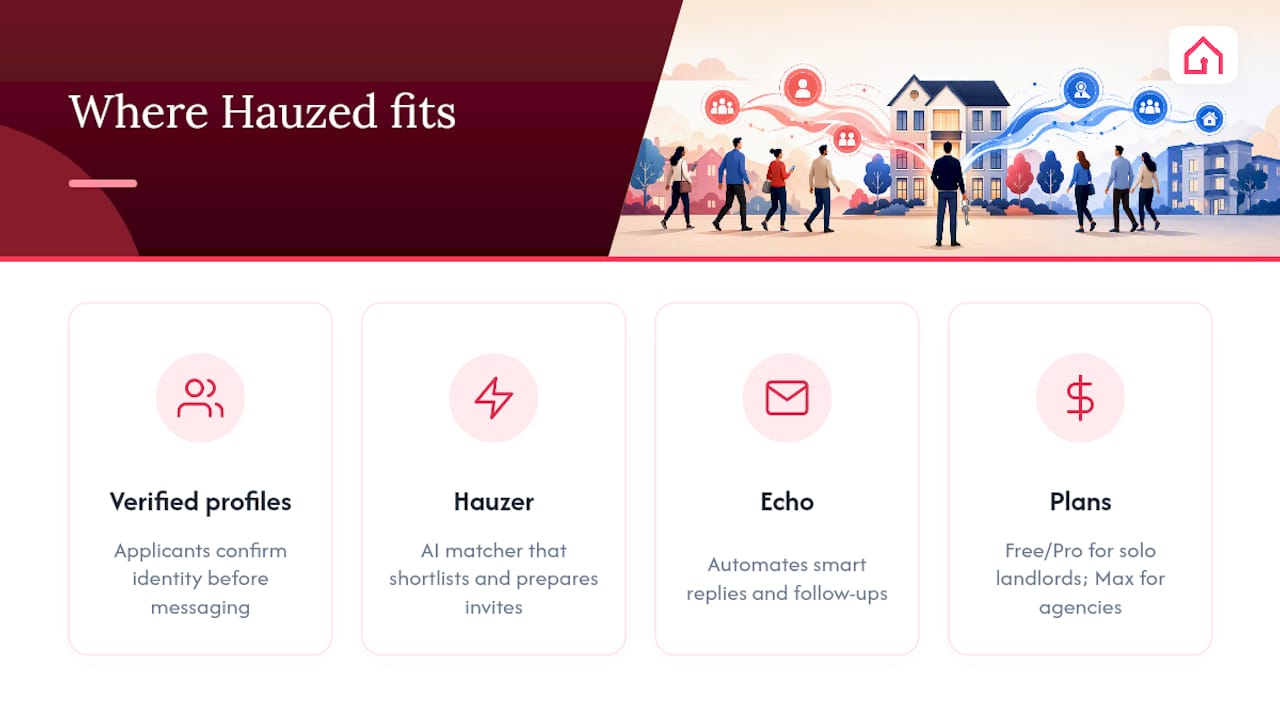
Verified tenant profiles do the advert filtering for you, since applicants have already confirmed identity and built out a profile before they message you, rather than arriving as one more anonymous enquiry. Hauzer, the platform's AI matching agent, surfaces suitable tenants for a live property and prepares invitations, cutting the shortlisting step down considerably. Echo handles the repetitive back-and-forth, smart replies and follow-up messages, so a full inbox stops meaning a full evening. Scheduling and document handling sit in the same place as your conversations, so viewings get confirmed without a separate calendar app.
A single landlord with one or two properties typically finds the Free or Pro plan covers what's needed; agencies managing larger portfolios lean towards Max for bulk publishing and team accounts. Details on current plan limits sit on the Hauzed site, and it's worth checking there before assuming a specific tier fits your case. If you're setting up your first listing, the guidance on verified rental listings is a sensible place to start.
Frequent overdraft use, an unwillingness to provide a previous landlord's contact, a notice period that doesn't add up, and payslips that don't match the stated employer are all worth pausing on before you proceed.
What shouldn't you say to your landlord as a tenant?
Avoid vague statements about payment ("I'll sort it soon") or unclear reasons for leaving a previous tenancy; landlords read directness as reliability, so specific answers to direct questions tend to work in an applicant's favour.
How long does tenant sourcing usually take from listing to signed tenancy?
With a correctly priced listing and a consistent screening process, most landlords move from advert to signed tenancy within two to four weeks, though demand-heavy months such as late spring and summer often shorten that window.
Should you use a letting agent or source tenants yourself?
Self-sourcing costs less time-for-money and gives you direct control over screening, while an agent reduces your hands-on workload at a higher fee, so the right choice depends on how many properties you're managing and how much time you have.
Is Hauzed suitable for a landlord with just one property?
Yes. Hauzed's Free and Pro plans are aimed at individual landlords with one to a few active properties who want verified applicants and less manual message filtering without agency-level fees.