Unlock faster success by streamlining your agency rental pipeline with automated systems and AI, boosting efficiency and lead quality.
The fastest way to improve your rental pipeline is to stop treating the inbox as a workflow and start treating it as a bottleneck. A verification-first, automated pipeline, combining structured intake, identity-gated lead capture, AI matching, and staged follow-up, removes the manual sorting that consumes most of a negotiator's day. Goodlord research finds that a majority of agents say administration limits their business. Meanwhile, industry reporting argues the inbox itself is the root cause of capacity constraints, and that AI holding full conversation context can return significantly more validated offers per listing.
The pipeline elements that matter most:
Structured intake forms with mandatory verification gates at lead capture
AI matching and triage to surface qualified tenants without manual filtering
Automated scheduling and follow-up to replace repetitive back-and-forth
Secure document handling with audit trails for compliance
Accounting and signing integrations to close the loop without re-keying data
Hauzed is built around exactly this model, combining verified tenant profiles, AI agents (Hauzer, Echo, and Lia), and agency-scale workflows to reduce inbox load and increase the quality of offers reaching landlords.
Key takeaways
Treating the inbox as a pipeline bottleneck, not a workflow, is the single most important shift an agency can make to improve rental process efficiency.
Point
Details
Inbox is the bottleneck
76% of agents say admin limits their business; fixing intake structure is the first lever.
Pilot before scaling
A 6–8 week pilot on 5–10 properties proves value before any major investment.
Time savings are real
Automating core workflows can save 8–12 hours of negotiator time per tenancy.
Compliance must be built in
Right to Rent, GDPR, and deposit protection timelines should be automated, not manual.
Related Topics
#streamline agency rental pipeline#increase agency rental productivity#optimize rental agency workflow#rental pipeline management strategies#agency rental lead generation#how to streamline rentals#enhance rental agency operations#simplify rental application process#improve rental process efficiency
Related Articles
Hauzed reduces inbox load
Hauzer, Echo, and Lia handle matching, follow-up, and leasing conversations for agencies.
Before any major build, there are steps your team can take within hours to cut message volume and reduce triage load.
Replace open enquiry forms with structured intake. Require move-in date, budget, household size, and employment status before a lead enters your queue. Incomplete submissions should trigger an auto-redirect, not a manual reply.
Set up auto-responses for every channel. Web enquiries, portal leads, and email should each receive an immediate acknowledgement with a clear timeline and a link to your verification or pre-qualification step. This alone reduces "have you received my message?" follow-ups.
Create three triage queues. Tag leads as verified-ready, incomplete, or out-of-criteria on arrival. Route each automatically: verified-ready to a negotiator, incomplete to a re-engagement sequence, out-of-criteria to a polite rejection template.
Block spam and duplicate leads at source. Use a honeypot field or CAPTCHA on web forms, and deduplicate by email address in your CRM before any lead reaches a human.
Prepare a Right to Rent guidance checklist. Your auto-response to shortlisted applicants should include the documents required for a Right to Rent check, so tenants arrive prepared. This removes a common back-and-forth cycle before viewing.
Standardise your WhatsApp and email reply templates. Write five templates covering: initial acknowledgement, viewing invitation, referencing request, offer confirmation, and tenancy start. Keep each under 80 words.
Pro Tip:Draft your triage rules before touching any software. A clear decision tree, written on paper first, prevents you from automating a chaotic process and simply making the chaos faster.
A practical 6–8 week pilot to build a faster rental pipeline
A short, measurable pilot is the safest way to prove value before committing to a full build. UOptimise's guidance is clear: map the lived process, remove duplicate steps, and assign owners before you automate anything.
Week-by-week outline:
Weeks 1–2 (Discovery): Map every step from portal enquiry to signed tenancy. Record who touches each step, how long it takes, and where leads drop off.
Weeks 3–4 (Quick wins and build): Implement structured intake forms, auto-responses, and triage queues. Configure your CRM to route leads automatically.
Weeks 5–6 (Pilot): Run the new workflow on a defined property set (5–10 listings). Measure response time, validated offers per listing, and negotiator hours per tenancy.
Weeks 7–8 (Measure and iterate): Review KPIs against baseline. Identify the one or two steps still causing friction and fix them before scaling.
Ownership model:
Operations lead: owns the process map and pilot scope
Lettings negotiator: tests the workflow daily and flags friction points
Compliance owner: signs off on Right to Rent and GDPR controls
IT or integrator: configures CRM, webhooks, and document storage
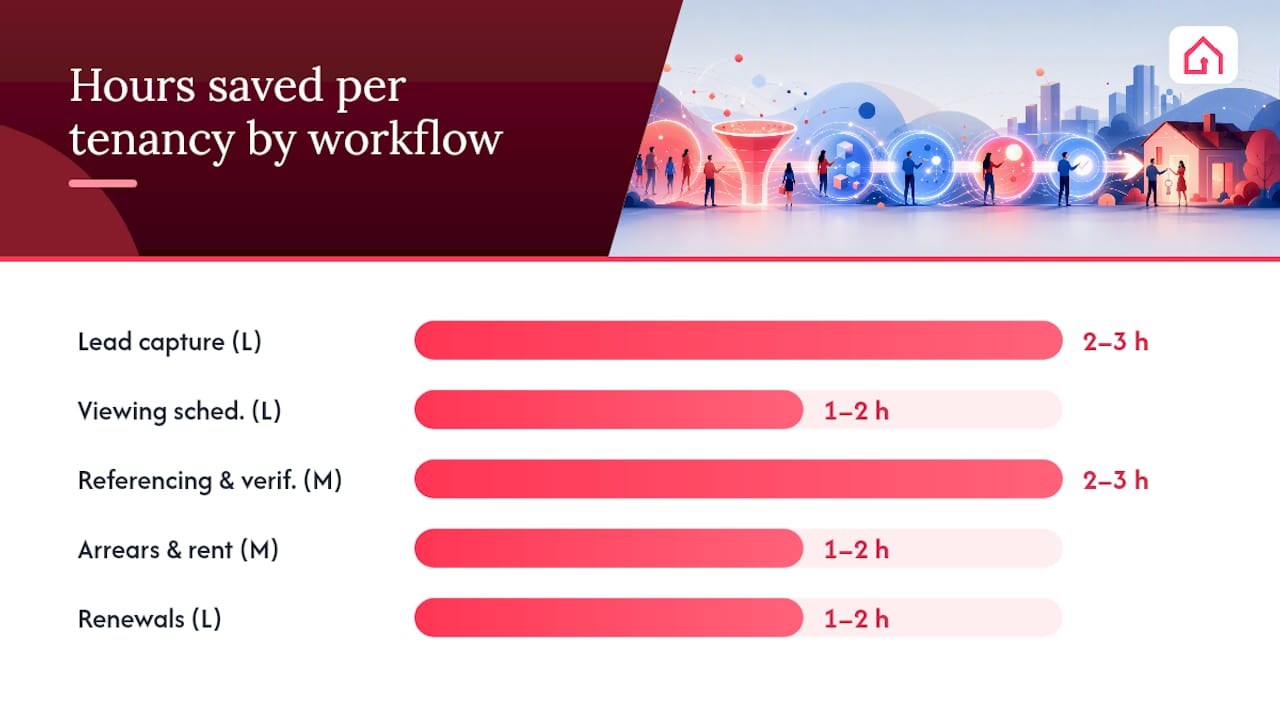
Softomate's research shows automating five core workflows can save a three-negotiator agency 12–18 hours per week. A full lead-to-signed-tenancy pipeline can save 8–12 hours of negotiator time per tenancy, with build costs typically in the range of £8,000–£15,000 for a CRM-plus-integration approach.
Workflow
Estimated hours saved per tenancy
Pilot effort
Lead capture and triage
2–3 hours
Low
Viewing scheduling
1–2 hours
Low
Referencing and verification
2–3 hours
Medium
Arrears and rent chasing
1–2 hours
Medium
Renewal reminders
1–2 hours
Low
Which tools should your agency connect, and how?
Your tech stack does not need to be complex. It needs to be connected. The core components are: a portal or lead capture layer, a CRM, a tenant verification provider, an AI matching or assistant layer, a calendar or booking tool, digital signing, and an accounting integration with bank feeds.
Integration priorities matter more than individual tool choice. Prefer tools with open APIs and webhook support so you can connect them without custom code. NRLA guidance confirms that bank feeds and automated rent matching reduce manual reconciliation and support MTD-ready record keeping, which is increasingly non-negotiable for agencies managing landlord accounting.
Vendor selection checklist:
Open API or native webhook support
Exportable audit logs with timestamps
Reliable document retention (minimum 6 years for tenancy records)
Data portability if you switch providers
GDPR-compliant data processing agreements in place
Pro Tip:Build your automation layer on an integration platform (such as Zapier or Make) rather than point-to-point connections between tools. This protects you if a single vendor changes their API or you need to swap a component later.
UK compliance and data-handling guardrails you must follow
Compliance built into the workflow is far less painful than compliance bolted on afterwards. The practical rule: every automated step that touches tenant data should generate a timestamped record without requiring anyone to remember to log it.
Right to Rent: Automate the document request and store copies with a date-stamped record. Your system should flag expiry dates for time-limited permissions and prompt re-checks before they lapse.
GDPR consent and lawful basis: Capture explicit consent at intake for each purpose (marketing, referencing, sharing with landlords). Store consent records in your CRM, not in email threads.
Tenancy deposit protection: Automate the 30-day protection deadline as a CRM task triggered on tenancy start. Store the deposit scheme certificate against the tenancy record.
MTD-ready accounting: Use bank feeds and automated rent matching to maintain near-real-time records. The NRLA confirms this approach supports timely reporting without manual reconciliation.
Role-based access: Restrict document access by role. A viewing coordinator does not need access to referencing documents. Segment permissions from day one.
Goodlord's data shows 82% of landlords are concerned about the Renters' Rights Act, which means your compliance posture is now a client retention issue, not just a regulatory one.
Pro Tip:Log every decision point automatically, including who approved a tenancy, when a Right to Rent check was completed, and when a deposit was protected. Human judgement steps remain auditable without any extra admin.
Who does what: in-house, outsourced, or blended?
Rushbrook & Rathbone research makes the point clearly: 81% of agents say regulatory burden has increased, and 56% report difficulty recruiting property managers. Property management is now a specialist discipline, and your operating model should reflect that.
Three models to consider:
Fully in-house: Suits agencies with a trained compliance lead and sufficient volume to justify specialist roles. Highest control, highest fixed cost.
Partner-blend: Keep client-facing and judgement tasks in-house (viewings, negotiations, landlord relationships). Outsource repeatable process tasks (referencing, deposit registration, arrears chasing) to a specialist provider.
Full specialist outsource: Appropriate for agencies whose core business is sales, not lettings management. Frees negotiator time but reduces direct control over tenant experience.
Decision checklist:
Does the task require local knowledge or client relationship context? Keep it in-house.
Is the task a repeatable process with a clear pass/fail outcome? Automate or outsource it.
Does the task carry regulatory liability? Ensure the owner (in-house or outsourced) has documented accountability.
Automation changes job descriptions. A negotiator who previously spent two hours a day on referencing chasing can redirect that time to landlord advisory work, which is where retention is actually won.
What to measure and how to build a simple ROI case
Track six KPIs from day one: response time to new enquiries, validated offers per listing, negotiator hours per tenancy, vacancy days, arrears incidence, and landlord satisfaction score.
Pro Tip:Include downstream benefits in your ROI model. Reduced void days and improved conversion materially shorten payback, often more than the direct admin hours saved.
For a simple ROI calculation: multiply your negotiator's fully loaded hourly cost by the hours saved per tenancy, then by your monthly tenancy volume. Add estimated void reduction value. Softomate's modelling suggests payback within several months when downstream benefits are included.
How Hauzed, Hauzer, Echo, and Lia implement this approach
Hauzed combines verified tenant profiles, AI matching via Hauzer, conversational follow-up via Echo, and leasing assistant workflows via Lia to reduce inbox load and increase the quality of offers reaching your team.
Feature mapping:
Lead capture and verification: Tenants complete identity verification before interacting, so your inbox receives pre-qualified interest rather than anonymous messages.
Hauzer (AI matching): Surfaces tenant profiles that match a property's requirements, so you review candidates rather than sort through every enquiry. Learn more about AI-powered tenant matching.
Echo (smart replies): Handles conversation follow-up and sends contextual replies, reducing the need for negotiators to respond to every message manually.
Lia (leasing assistant): Supports leasing conversations and scheduling workflows, available where enabled on the account.
Secure document handling: Tenant documents are uploaded through secure product flows with consent, not shared through chat or email.
Bulk publishing and team accounts: Agencies on the Max plan can import portfolios via CSV or Excel and manage shared workflows across team members.
Pilot checklist:
Select 5–10 active listings as your pilot set.
Configure your Hauzed account with team roles and lead routing.
Enable Hauzer for AI matching on each pilot property.
Set Echo to handle initial follow-up messages.
Measure validated offers per listing and response time over four weeks.
Compare against your pre-pilot baseline before scaling your subscription tier.
Pro Tip:Run the pilot on properties that currently generate high message volume but low conversion. That is where the time saving is largest and the improvement most visible.
The Hauzed AI agents overview covers the full capability set for agencies evaluating the platform.
Common mistakes when automating rental workflows
Most automation failures are process problems, not technology problems. Agencies that automate a chaotic intake process simply produce chaotic output faster.
Automating before simplifying: Map and simplify first. Remove duplicate steps, clarify ownership, and confirm the process works manually before adding automation.
Missing audit trails: Every automated action should write a log entry. If your system cannot tell you who triggered an action and when, it will fail a compliance review.
Noisy notifications: Automating alerts without filtering creates notification fatigue. Route alerts by role and urgency; not every event needs to reach every person.
Fragile point-to-point integrations: Direct connections between two tools break when either vendor updates their API. Use an integration platform as the middle layer.
Insufficient training: Negotiators who do not understand the new workflow will work around it. Budget two to three hours of structured training per person, not a single demo.
Pro Tip:Schedule a two-week review after going live. Check logs for errors, ask negotiators where they are still working around the system, and fix those gaps before they become habits.
Why inbox-first, verification-first is the right approach for modern agencies
The inbox problem is not a technology gap. It is a structural one. When every enquiry arrives as an undifferentiated message, agents default to scarcity behaviour: reply to whoever seems most serious, ignore the rest, and hope the best candidate does not go elsewhere. That is not a pipeline. It is a lottery.
Industry analysis shows that AI holding full conversation context reduces chasing, shortens resolution times, and increases validated offers. The mechanism is simple: when the system knows what has already been said, it does not ask the tenant to repeat themselves, and it does not ask the negotiator to re-read a thread before replying.
Verification-first marketplaces shift the effort earlier in the process, where it costs less. A tenant who has verified their identity and completed a profile before enquiring is already a stronger candidate. The agency's job becomes selection, not sorting. That reallocation of effort, from admin to advisory, is where landlord retention is actually built.
Starting with a short pilot creates something more valuable than a one-off efficiency gain. It creates a measurement habit. Agencies that track validated offers per listing, response time, and vacancy days from week one tend to keep improving, because they can see what is working.
Ready to run a faster rental pilot with Hauzed?
Agencies that move from inbox-first to verification-first typically see the difference within the first four weeks of a pilot. Hauzed gives you verified tenant interest from day one, AI agents that handle follow-up without replacing your team's judgement, and secure document handling that keeps you GDPR-compliant throughout.
Before you get in touch, prepare three things: a list of 5–10 properties for the pilot, your current average response time and vacancy days as a baseline, and the name of the team member who will own the pilot internally. That is enough to get started.
Hauzed's platform is built with privacy controls, data minimisation, and secure document upload flows aligned to GDPR requirements. Tenant documents stay within the platform and are never shared through chat. Start your pilot on Hauzed and see how many more validated offers your listings can generate in the first month.
Sources
These are the primary sources cited in this article, useful for evidence, practical steps, and ROI inputs as you build your own case.
What is the fastest way to reduce inbox volume for a letting agency?
Replace open enquiry forms with structured intake that requires verification before a lead enters your queue. Auto-responses and triage rules handle the rest without negotiator input.
How long does it take to see results from rental pipeline automation?
Most agencies see measurable improvements in response time and validated offers within the first four weeks of a pilot, based on a 6–8 week pilot-to-scale model.
What KPIs should agencies track when automating their rental workflow?
Track response time, validated offers per listing, negotiator hours per tenancy, vacancy days, and arrears incidence. Validated offers per listing is the single most useful leading indicator.
How does Hauzed help agencies manage their rental pipeline?
Hauzed provides verified tenant profiles, AI matching via Hauzer, smart follow-up via Echo, and leasing conversation support via Lia, reducing inbox load and surfacing qualified candidates faster.
Is automation compliant with UK GDPR and Right to Rent requirements?
Yes, when built correctly. Automate document requests, consent capture, and audit logging so every compliance step generates a timestamped record without manual intervention.