How to scale rental business operations without losing control
5 de agosto de 2026
19 min de lectura
Learn how to scale rental business operations effectively. Stop relying on founder memory and implement systems for streamlined growth.
The fastest way to scale rental business operations is to stop relying on founder memory and build a system-led operation: documented SOPs, one source of truth, staged automation, and a clear 90/180/365 rollout. According to the British Franchise Association, systems, standards, technology and a team-led model are essential to scale a local property management business. Without them, growth exposes every weakness in your operation rather than hiding it.
Your three immediate actions this week:
Document three core SOPs — tenant onboarding, maintenance escalation, and arrears handling. Write them as step-by-step checklists, not narrative paragraphs, so any team member can follow them without asking you.
Pick your single source of truth — one place where every property record, tenancy document, and communication log lives. A shared spreadsheet works at one to three properties; a property management system (PMS) becomes necessary as you grow.
Run a 30-day pilot on one property — test your new SOP and source-of-truth setup on a single unit before rolling out across your portfolio. Measure time spent per property before and after.
#automate rental operations#expand rental service offerings#scale rental business operations#rental business growth strategies#best practices for rental business#increase rental efficiency#how to scale a rental company#rental management solutions#rental business expansion tips#optimize rental operations#scale business processes
How do you build the operational foundation to scale rental business operations?
Before you add a second property, you need three things locked down: repeatable processes, clear role ownership, and a dashboard that tells you whether the operation is healthy. Operational scalability is the ability to grow without sacrificing performance, and that requires you to measure capacity before you hit the ceiling, not after.
Which SOPs to standardise first
Four SOPs carry the most risk if left undocumented:
Tenant onboarding — from application received to keys handed over, including identity checks, referencing, tenancy agreement signing, and inventory sign-off. A rental onboarding checklist prevents missed steps that create legal exposure later.
Role ownership and escalation paths
When you map responsibilities, a useful frame is the four core business operations: production (property and maintenance), marketing (listings and tenant acquisition), finance (rent collection, reporting), and HR (contractors, staff). Assigning SOP ownership across these four domains, as outlined in standard operations frameworks, prevents the common failure mode where everyone assumes someone else owns a process.
Each SOP needs a named owner, a deputy, and a clear escalation path. At three properties, that owner is probably you. At eight, it needs to be someone else.
Pro Tip:Start with a shared Google Sheet for your KPI dashboard. It is free, accessible to any team member, and easy to migrate into a PMS later. The discipline of filling it weekly matters more than the tool you use.
When should you hire, and what should you outsource?
The decision to hire versus outsource is not about preference; it is about capacity thresholds and control. Growth often fails because operational control is not strengthened as headcount rises, so the structure you put in place before hiring matters as much as the hire itself.
Signs you need to act
You are spending more than 2–5 hours per property per month on administration.
Maintenance issues are going unresolved for more than 48 hours because you are the only person who knows the contractor.
A tenant has waited more than 24 hours for a response to a routine query.
You have missed a compliance deadline (gas safety certificate, EPC renewal) because it was only in your head.
You are turning down new properties because you cannot handle the workload.
Priority hires
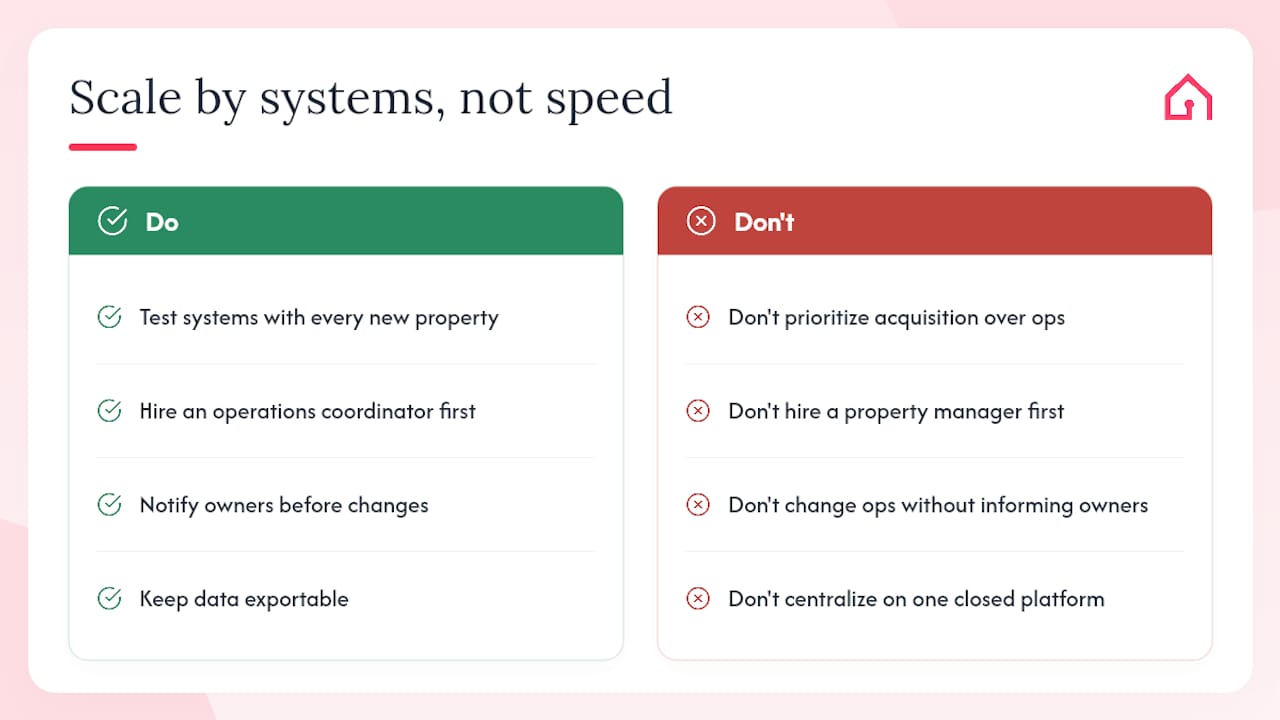
The first hire for most operators is an operations coordinator: someone who owns the day-to-day SOP execution, manages contractor relationships, and handles tenant communications. This role removes you as the bottleneck without requiring you to hire a full property manager.
The second hire, usually at eight or more properties, is a maintenance lead who manages the contractor network, logs issues, and tracks SLA compliance. The third is a client relations person if you manage properties on behalf of other landlords.
How do you choose and implement technology without creating new silos?
Technology is the lever that lets you manage more properties without proportionally more time. But the wrong stack creates fragmented data, hidden costs, and a dependency on platforms you cannot easily leave. Automation, risk management and clear communication channels are the core moves for scaling operations, but only when the underlying data is clean and centralised.
Feature checklist for a scalable tech stack
Feature
Why it matters at scale
Risk if absent
Single property record
All data for a unit in one place
Duplicate records, missed updates
Document store
Tenancy agreements, certificates, invoices
Compliance gaps, evidence loss
Automated workflows
Rent reminders, maintenance routing
Manual errors, slow response
Payments integration
Rent collection, contractor invoices
Reconciliation errors
Reporting API
Export data to accountant or BI tool
Lock-in, manual reporting
Audit trail
Timestamped log of all actions
Dispute risk, compliance failure
Automation quick wins
Rent reminders are the easiest automation to implement and the one with the most immediate impact. A scheduled message sent three days before rent is due, and again on the due date if unpaid, reduces arrears without any manual effort. Most PMS platforms support this natively.
Maintenance routing is the second quick win. When a tenant logs an issue, an automated triage message can confirm receipt, set an expectation for response time, and route the request to the correct contractor category. This alone removes the most common tenant complaint: feeling ignored.
Standard message templates for viewing confirmations, tenancy renewals, and check-out instructions save significant time across a portfolio. The key is to write them once, review them quarterly, and store them in your single source of truth so any team member can use them.
Warnings: over-automation risks
The most common mistake is automating before the underlying process is correct. If your maintenance escalation SOP is broken, automating it makes the problem faster and harder to spot. Pilot every automation on one property for 30 days before rolling it out.
Platform dependency is a real risk. If your entire operation runs through a single closed platform with no data export, you lose negotiating power and face significant switching costs. Always confirm that you can export your full data set in a standard format (CSV, JSON) before committing to a system.
Pro Tip:Before signing any software contract, ask the vendor for a sample data export from a live account. If they cannot produce one within 48 hours, treat that as a red flag about data ownership.
How do you build a portfolio strategy that holds up at scale?
Adding properties without a clear selection framework is one of the fastest ways to dilute service quality. Scaling without strengthening control causes quality drift, and nowhere is that more visible than in a portfolio that has grown opportunistically rather than strategically.
Market selection checklist
Before adding a property in a new location, check:
Regulatory risk — does the local authority have selective licensing, additional licensing, or Article 4 directions that affect your property type? Check the relevant local authority website and GOV.UK guidance on landlord licensing.
Portfolio shape guidance
Geographic concentration reduces operational complexity. Managing five properties in the same postcode is materially easier than managing five properties across three cities. Expand geographically only once your systems and team can absorb the additional coordination cost.
Diversifying your tenant profile across property types (single-let, HMO, short-term) adds complexity faster than most operators expect. Each model has different SOPs, different compliance requirements, and different tenant communication norms. If you are scaling for the first time, stay in one model until your systems are proven.
For operators managing shared tenancies or group applications, tools that help split rent and coordinate payments between multiple tenants can reduce the administrative load significantly.
Listing standardisation template
Every property in your portfolio should have: a minimum of ten professional photographs (including all rooms, exterior, and key amenities), a description written to a consistent format (location, property type, key features, transport links, terms), a defined pricing bucket (budget, mid-market, premium), and a minimum amenity checklist (broadband, white goods, heating type, parking if applicable).
Standardisation is not about making every property look the same. It is about making every listing equally easy to evaluate, which speeds up tenant matching and reduces the volume of repetitive enquiries.
When to pause acquisition
Pause adding properties when your maintenance lead time exceeds five days, your arrears rate rises above your baseline, or your operations coordinator is working at full capacity. Integration before expansion is the rule that most operators learn the hard way.
What compliance and maintenance processes do you need at scale in the UK?
A reusable inspection checklist should include: property address and date, inspector name, timestamped photographs of every room and all fixtures, meter readings, condition notes against the original inventory, any maintenance issues identified, and the tenant's signature (or a record of their absence). Store every completed inspection in your document management system with the property record.
Pro Tip:Schedule compliance renewals 60 days before expiry, not 30. Gas safety certificates in particular can be delayed by contractor availability, and a lapsed certificate exposes you to a civil penalty of up to £30,000 under the Housing Act 2004.
Budget roughly two to three hours of compliance administration per property per year at small scale, reducing as fixed costs amortise across a larger portfolio.
How do you choose software, vendors and partners without getting burned?
Poor vendor selection is one of the most expensive mistakes in a scaling operation. A platform that cannot export your data, a contractor who disappears mid-tenancy, or an accountant unfamiliar with buy-to-let taxation can each set you back months.
Vendor questionnaire template
Ask every software vendor these questions before committing:
Can I export my full data set (properties, tenancies, documents, communications) in CSV or JSON at any time?
What is your uptime SLA, and what is the compensation if you breach it?
Do you have an API, and is it documented publicly?
What is your support response time for critical issues?
How do you handle data security and GDPR compliance?
What is your pricing model, and how does it change as my portfolio grows?
What is on your product roadmap for the next 12 months?
Pilot checklist
Before committing to any system or vendor:
Define your pilot objective in one sentence (e.g., "reduce time spent on rent reminders by 50% across three properties in 30 days").
Set a minimum success threshold before you start.
Identify your rollback plan: what you will revert to if the pilot fails.
Assign one person to own the pilot and report weekly.
Set a fixed end date and review the metrics before extending.
Red flags that indicate a poor fit
No data export capability or a vendor who is evasive about it.
Pricing that scales steeply with portfolio size, with no volume discount.
Documentation that is inconsistent, outdated, or hard to find.
No named support contact for critical issues.
Contract terms that assign data ownership to the vendor.
Structuring supplier contracts
For any supplier handling tenant data or property access, your contract should specify: data ownership (yours, not theirs), a data return or deletion obligation on termination, a minimum notice period for price changes, and a performance remedy if SLA targets are missed. A solicitor familiar with commercial contracts can draft a standard template you reuse across suppliers.
What does a 90/180/365-day implementation roadmap look like?
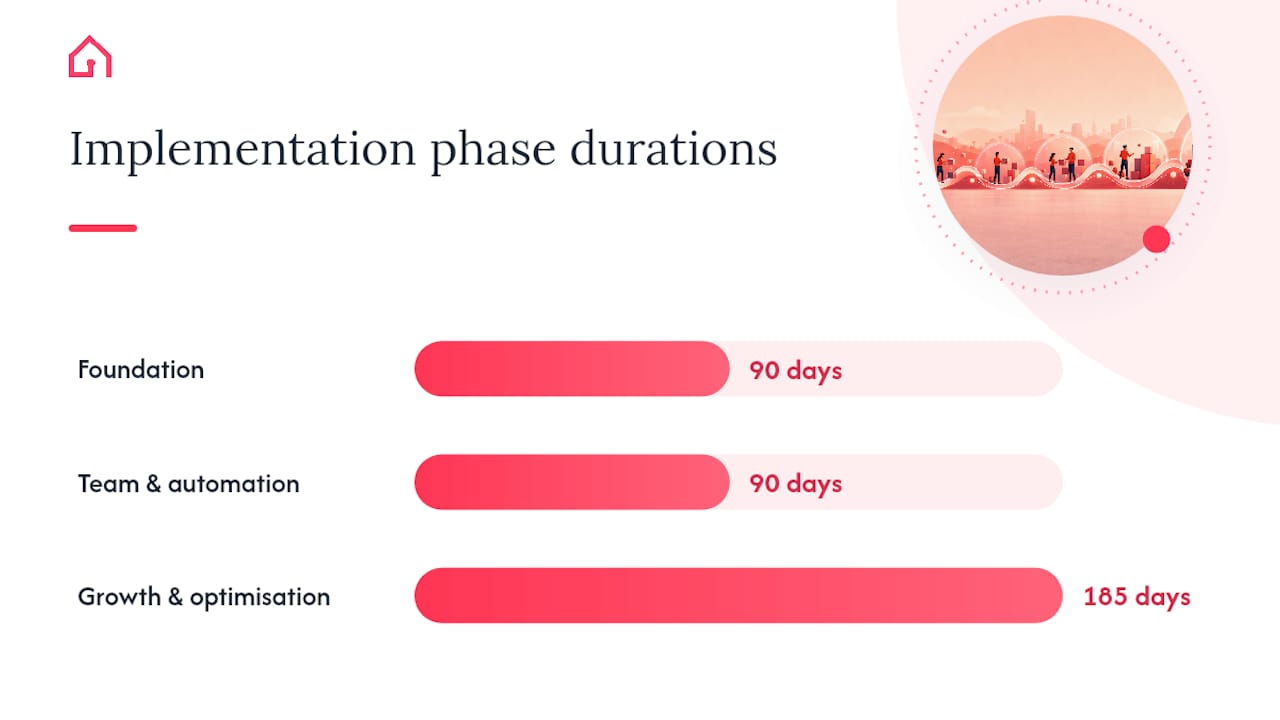
A phased rollout prevents the most common scaling failure: trying to change everything at once and losing control of the operation in the process. Each phase has a clear deliverable, a cost band, and a milestone KPI that tells you whether you are ready to move forward.
Phase
Timeframe
Key deliverables
Typical cost band
Milestone KPI
Foundation
Days 1–90
4 core SOPs documented; KPI dashboard live; single source of truth selected and populated; compliance calendar built
—
Time per property falls below 3 hours/month
Team and automation
Days 90–180
Operations coordinator hired or outsourced; 3 automation workflows live (rent reminders, maintenance routing, message templates); vendor contracts reviewed
—
Maintenance lead time under 5 days; arrears rate stable
Growth and optimisation
Days 180–365
Portfolio expanded by 2–5 properties; reporting API connected to accountant; owner NPS survey in place; compliance audit completed
—
Occupancy rate above 90%; net yield per unit maintained or improved
Cost bands are indicative and will vary by portfolio size, location, and whether you hire staff or use outsourced contractors. The foundation phase is the most important: operators who skip it and move straight to growth typically spend significantly more correcting problems in months 7–12.
Pacing guidance
Accelerate when your milestone KPIs are consistently met for four consecutive weeks. Pause when any KPI deteriorates, when a compliance deadline is at risk, or when your operations coordinator is at capacity. The 90/180/365 structure is a guide, not a contract with yourself.
How does Hauzed help you scale rental operations in practice?
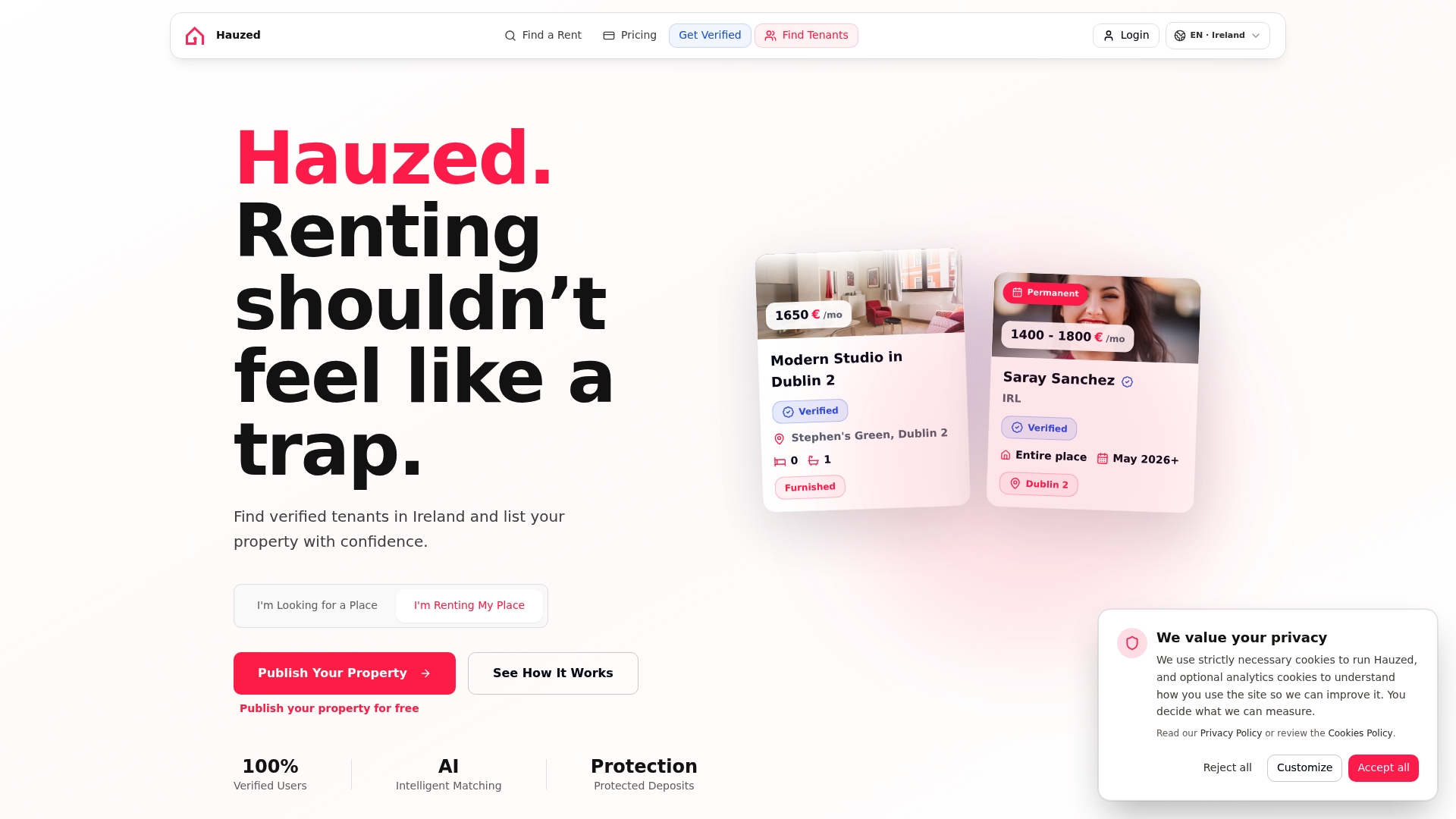
The most useful way to think about Hauzed is as a trust-first workflow layer that removes the manual work that slows down scaling: filtering leads, replying to messages, matching tenants, scheduling visits, and managing conversations. Each of those tasks is a bottleneck at scale, and Hauzed's AI agents address them directly.
Hauzed feature map
Scaling lever
Hauzed capability
Operational impact
Tenant verification
Identity verification for all tenants
Reduces unqualified leads; fewer wasted viewings
Tenant matching
Hauzer AI agent
Surfaces best-fit candidates without manual filtering
Conversation management
Echo AI agent (smart replies and follow-up)
Reduces response time; frees coordinator time
Leasing conversations
Lia AI agent
Handles WhatsApp-style leasing workflows where available
Portfolio publishing
Bulk import via CSV/Excel (Max plan)
Reduces time to publish a new property from hours to minutes
Team coordination
Team accounts (Max plan)
Multiple team members manage one portfolio without duplicating work
Property promotion
Social Booster
Supports promotion via connected social pages when enabled
Structured, documented application trail for each property
Before and after: three operational scenarios
Scenario 1 — Lead filtering. Before: a landlord with five properties receives 40 messages per listing, most unverified, and spends three hours per week filtering. After: Hauzer surfaces the strongest-fit verified candidates, and the landlord reviews a shortlist rather than an inbox.
Scenario 2 — Agency portfolio publishing. Before: an agency with 20 properties publishes each listing manually, taking 20–30 minutes per property. After: bulk import via CSV reduces the same task to a single upload, with team accounts allowing two coordinators to manage the portfolio simultaneously.
Scenario 3 — Conversation follow-up. Before: a property manager misses a tenant query over a weekend, the tenant moves on, and the property sits empty for an extra week. After: Echo handles smart replies and follow-up, keeping the conversation active without requiring manual intervention.
Suggested pilot path
Run a 30-day pilot on two to three properties. Enable Hauzer for tenant matching, Echo for conversation follow-up, and the verified tenant profile flow for all new applicants. Measure: time spent on lead filtering per week, number of viewings booked versus enquiries received, and response time to tenant queries. At the end of 30 days, compare those figures to your pre-pilot baseline.
Hauzed offers Free, Pro, and Max plans for landlords and agencies. The Free plan covers basic use; Pro suits individual landlords with multiple active properties; Max is built for agencies needing bulk publishing, team accounts, and broader AI usage. Check the current plan details on Hauzed before committing to a tier.
Pro Tip:Start the pilot on your highest-turnover property, where lead volume is greatest. That is where the time saving from AI matching and automated follow-up will be most visible within 30 days.
Key takeaways
Scaling rental business operations successfully requires a system-led model built on documented SOPs, a single source of truth, a structured team, and staged automation, implemented in phases before adding properties.
Point
Details
Build systems before scaling
Document four core SOPs and a KPI dashboard before adding any new property.
Know your capacity threshold
Self-management typically requires 2–5 hours per property per month; most operators hit a ceiling at 8–10 properties without professional systems.
Hire or outsource at the right moment
Bring in an operations coordinator when you are spending more than 2–5 hours per property per month on administration.
Automate the right tasks first
Rent reminders, maintenance routing, and message templates deliver the fastest time savings with the lowest implementation risk.
Compliance is a scaling advantage
Per-property compliance costs fall as fixed costs spread across more properties; build your compliance calendar in the foundation phase.
Hauzed for verified, automated workflows
Hauzed's AI agents (Hauzer, Echo, Lia) and bulk publishing tools reduce manual lead management and support agency-scale operations.
What most scaling guides get wrong about rental operations
The conventional wisdom on scaling rental businesses focuses almost entirely on acquisition: more properties, more markets, more revenue. What it underestimates is the operational debt that accumulates when you grow faster than your systems.
The operators who scale well are not necessarily the ones who move fastest. They are the ones who treat each new property as a test of their existing system rather than an addition to a list. When a new property exposes a gap in your SOP, that is valuable information. When it exposes the same gap for the third time, that is a systems failure.
The first hire question is one that most guides answer with "a property manager." That is usually wrong at small scale. A property manager is expensive, often generalist, and adds a layer of management you may not yet need. The better first hire is an operations coordinator: someone who owns process execution, not strategy. Strategy stays with you. Execution moves to them.
On owner trust: if you manage properties on behalf of other landlords, the biggest risk when changing your operations is that owners feel the change before they understand it. Tell them what you are doing and why, before you do it. A one-page note explaining that you are implementing a new maintenance SOP to improve response times costs nothing and prevents the kind of anxiety that leads to early contract terminations.
The platform dependency risk is real and underappreciated. Several operators have built their entire workflow around a single closed platform, only to face a price increase or a feature removal that they cannot easily work around. Always maintain the ability to export your data and run your operation without any single vendor.
Ready to run a structured pilot on your rental portfolio?
Fewer unqualified leads, less time spent filtering messages, and a verified tenant pipeline from day one: that is the practical difference between a fragmented rental workflow and a structured one. Hauzed gives landlords and agencies the tools to manage that workflow without rebuilding it property by property.
Hauzer matches verified tenants to your properties without manual filtering. Echo handles follow-up and smart replies so your coordinator is not tied to an inbox. Bulk publishing via CSV means a new property goes live in minutes, not hours. Team accounts let two or more coordinators manage one portfolio without stepping on each other. These are not abstract features; they map directly to the SOPs, automation quick wins, and team structure this guide covers.
To run your pilot: enable Hauzer and Echo on two to three properties, measure lead filtering time and response time over 30 days, and compare to your pre-pilot baseline. Free, Pro, and Max plans are available depending on your portfolio size and workflow needs. Start your pilot on Hauzed and see where the time savings show up first.
Useful sources
The following references cover regulatory detail, operational frameworks, and practical scaling guidance for UK rental operators:
What does it really take to scale a local property management business? — British Franchise Association
How to scale buy-to-let portfolio: 1 to 10 properties | PropertyTaxPartners
Why professional management is now a survival requirement for UK landlords | PropMatch.uk
Scaling Short-Term Rentals: Fix Operations Before Growth
What does it mean to scale rental business operations?
Scaling rental operations means growing your portfolio or revenue without a proportional increase in your time or headcount. It requires documented processes, a single source of truth, and staged automation so the operation runs on systems rather than founder memory.
How do you scale business operations efficiently?
The most reliable approach is to document your core SOPs first, then automate the highest-volume repetitive tasks (rent reminders, maintenance routing, message templates), and hire or outsource only once your processes are proven. Trying to automate a broken process makes the problem faster, not smaller.
What is operational scalability in a rental context?
Operational scalability is the ability to grow your portfolio while maintaining performance across occupancy, maintenance response times, and compliance. The key metric to monitor is time per property per month; when that figure rises as you add units, your systems are not yet scaling.
When should a landlord stop self-managing and professionalise?
Most operators reach a practical capacity limit around 8–10 properties when self-managing, given that each property typically requires 2–5 hours of work per month. The economics of professionalisation often justify the change by three to five properties, particularly when compliance obligations are factored in.
How can Hauzed help with scaling rental operations?
Hauzed reduces the manual work that creates bottlenecks at scale: Hauzer matches verified tenants to properties without manual filtering, Echo handles conversation follow-up and smart replies, and bulk publishing tools let agencies publish multiple properties from a single CSV upload. Team accounts on the Max plan allow multiple coordinators to manage one portfolio without duplicating effort.