Why screen tenants before renting: your 2026 UK guide
22 July 2026
13 min read
Discover why screen tenants before renting in the UK is crucial. Protect your property and income while minimizing risks of legal disputes.
Screening tenants before renting is the single most important step you can take to protect your property, your income, and your peace of mind. A thorough vetting process reduces the risk of rent arrears, property damage, and costly legal disputes. Since the Renters' Rights Act 2025 abolished Section 21 no-fault evictions, landlords in England can only regain possession through Section 8 grounds, which require solid evidence and a court hearing. Court delays are often long, meaning a single bad tenancy can easily cost you thousands in lost rent and legal fees before you see a possession order.
Here is what rigorous screening does for you:
Reduces the likelihood of rent arrears and property damage before they occur
Creates a documented paper trail showing you acted reasonably, which matters if possession proceedings become necessary
Protects you from discrimination claims under the Equality Act 2010 when criteria are applied consistently
Confirms financial suitability through affordability checks and credit history
Satisfies your legal obligation to conduct Right to Rent checks on every adult occupant
Prevention, not eviction, is your strongest defence in 2026.
#how tenant screening scales agencies#screening process for landlords#risks of not screening tenants#rental applicant verification#what to check when renting#tenant screening process#how to screen potential tenants#reasons to screen renters#tenant background checks#why vet tenants before renting#tenant screening importance#why conduct tenant screening#benefits of tenant screening#why screen tenants before renting#screening rental applicants#benefits of screening tenants#tenant background check#questions to ask potential renters#why rent to reliable tenants#best practices for tenant screening#how to screen tenants#importance of tenant screening
What questions should you ask prospective tenants before viewings?
Screening starts before the viewing. A short set of consistent pre-qualification questions asked at first contact helps you filter applicants efficiently and fairly, and keeps your process legally defensible.
Ask every applicant the same questions:
Employment status and income level — are they employed, self-employed, or receiving benefits? What is their approximate monthly income?
Length of current employment — stability matters as much as the income figure itself
Reason for moving and desired tenancy length — urgency to move or vague answers about why they are leaving can be worth noting
Number of occupants — you need this for Right to Rent purposes as well as practical suitability
Pets, smoking, and other household factors — relevant to property condition and your insurance
Consistency is the key word here. Asking the same questions of every applicant, and recording the answers, protects you from any suggestion of bias. Pay attention to evasive answers or stories that shift between calls. A quick online search can sometimes surface inconsistencies, though always stay within legal limits and avoid making judgements based on protected characteristics such as race, nationality, or family status. Never ask whether an applicant has children or plans to have them, and never use benefit receipt as an automatic disqualifier.
Legal requirements for UK tenant screening in 2026
UK landlords operate within a clear legal framework, and getting this wrong is expensive. Three pieces of legislation shape your obligations.
The Renters' Rights Act 2025 removed Section 21 as a possession route from 1 May 2026. If a tenancy goes wrong, you must prove a specific ground under Section 8 in court. That process is slower and more costly than the old notice route, which makes pre-tenancy screening your primary line of defence.
Right to Rent checks are mandatory for all adult occupants of private rented property in England under the Immigration Act 2014. Failure to conduct them correctly carries a civil penalty of up to £20,000 per tenant for a first breach. Checks must be applied equally to every adult, regardless of nationality, to avoid discrimination claims. Keep copies of all documents checked and retain them for at least two years after the tenancy ends.
The Equality Act 2010 prohibits discrimination in the letting process based on protected characteristics including race, sex, disability, religion, and age. Blanket policies such as "No DSS" or "No children" are indirectly discriminatory and legally risky. Your decisions must be based on objective, consistently applied financial and behavioural criteria, not on assumptions about who an applicant is.
GDPR requires you to obtain written consent from applicants before running credit checks, and to handle their personal data lawfully and securely. Tell applicants clearly what data you are collecting and why.
Effective tenant screening methods for UK landlords
A complete screening process combines several checks, each giving you a different piece of the picture.
Credit checks reveal County Court Judgements (CCJs), Individual Voluntary Arrangements (IVAs), insolvency orders, and missed payments. Use a soft check, which does not affect the applicant's credit score, and always obtain written consent first. A thin credit file is not the same as a bad one; younger applicants or recent arrivals to the UK often have limited credit history without it indicating financial risk.
Affordability assessment — a common guideline is that gross income should exceed the annual rent by a comfortable multiplier, verified through payslips, bank statements, or an employer's salary letter. For self-employed applicants, two years of accounts or an accountant's reference is appropriate.
Previous landlord references are arguably the most revealing check you can run. Contact the landlord before the current one, not the current landlord, who may give a positive reference simply to move the tenant on. Ask factual questions: was rent paid on time, was the property left in good condition, were there any complaints from neighbours? Confirm references by telephone rather than accepting written statements alone.
Employment verification through payslips or an employer reference letter confirms income stability. For borderline cases, bank statements showing three months of consistent income add further reassurance.
Guarantors are a lawful and practical option when an applicant's affordability is marginal or their credit history is limited. The guarantor should go through their own credit and income checks, typically meeting a threshold of around 3 times the annual rent in gross income.
Right to Rent verification is non-negotiable. For British and Irish citizens, check an original passport or birth certificate plus National Insurance proof. For non-UK or non-Irish nationals, use the Home Office online checking service with the applicant's share code.
For a fuller breakdown of what each check involves, the tenant reference check guide covers the process step by step.
How to build a fair and defensible screening process
Think of screening as a methodical audit, not a gut-feel conversation. The landlords who face discrimination claims or possession difficulties are almost always the ones who screened inconsistently, thoroughly with one applicant and casually with the next.
Define your criteria before you market the property. Write down your affordability threshold, your approach to adverse credit markers, your reference requirements, and your pet or smoking policy. Documented criteria applied before any applicant appears are far easier to defend than criteria invented after the fact.
Standardise your application form. Every applicant should provide the same information in writing. The form itself is evidence that you treated everyone equally.
Document every decision with an objective reason. If you decline an applicant, record the specific reason: for example, income below the 2.5x threshold, or a CCJ within the last three years. Vague notes offer no protection if a rejected applicant challenges your decision.
Review your policy regularly. The legal landscape shifted significantly in 2026, and it will continue to evolve. Build a habit of checking for updates from the National Residential Landlords Association (NRLA) or equivalent bodies.
Balance rigour with transparency. Tell applicants upfront what the screening process involves. Transparent screening policies reassure tenants and reduce disputes later.
Pro Tip:Contact the landlord before the current one for a reference. Current landlords sometimes give glowing references to move a problem tenant on. The previous landlord has nothing to gain from flattery.
Step-by-step: how to conduct a thorough tenant background check
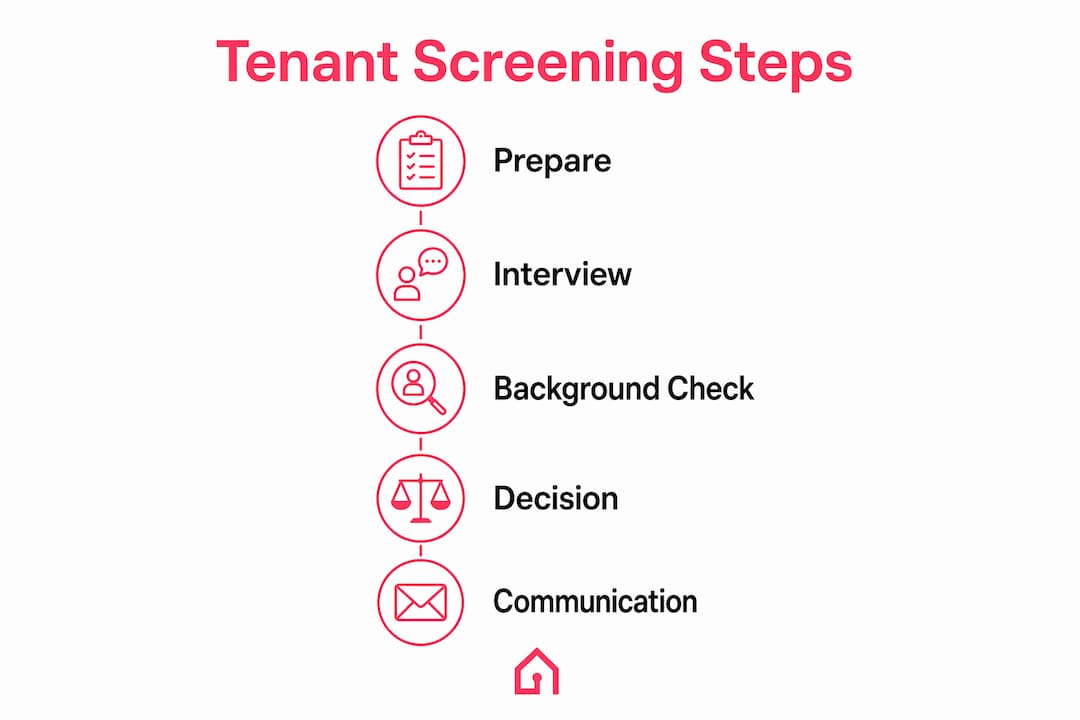
A repeatable process protects you legally and saves time. Follow the same sequence for every applicant.
Advertise at a fixed rent with clear, objective criteria listed in the advert. You cannot invite or accept offers above the advertised rent under the Renters' Rights Act 2025.
Collect applications in the order received and screen them in that order. This gives you a defensible method for choosing between multiple qualified applicants.
Run Right to Rent checks on every adult who will occupy the property, not just the person signing the agreement.
Obtain written consent for credit and referencing checks before running them.
Run a credit check through a recognised referencing service. Typical turnaround is 24–72 hours and costs around £20–£40 per applicant, paid by you, not the tenant, under the Tenant Fees Act 2019.
Verify income through payslips, bank statements, or an SA302 for self-employed applicants.
Contact the previous landlord (not the current one) for a factual reference by telephone.
Request a guarantor if income or credit is borderline, and run the same checks on the guarantor.
Document your decision and the objective reasons behind it.
Offer the tenancy to the first applicant who passes all checks.
Once all your checks are back, you need a consistent way to weigh the results. Avoid making decisions on instinct alone. A friendly applicant at a viewing is not a substitute for a credit check; some of the most problematic tenants present brilliantly in person.
A written scoring framework removes subjectivity. You might weight financial stability most heavily, followed by rental history, employment stability, and reference quality. The exact weighting matters less than applying the same framework to every applicant. If rental bidding is banned and several applicants all meet your criteria, the simplest defensible approach is to offer the tenancy to the first qualified applicant in the order applications were received. Whatever method you choose, write it down before you start reviewing applications, not after.
Look for consistency across the whole picture. Does the income on the payslips match what the applicant told you on the phone? Does the previous landlord reference align with the credit report? Gaps in rental history deserve a direct question, not automatic rejection. There may be a perfectly good explanation, or there may not be.
How to communicate screening results to applicants
Clear, prompt communication protects your reputation and reduces the risk of disputes. Once you have made a decision, tell every applicant in writing, whether they have been successful or not.
For successful applicants, confirm the next steps clearly: what documents they need to bring, when the tenancy agreement will be ready, and what the move-in process looks like. For unsuccessful applicants, keep your response factual and brief. You are not obliged to share the full detail of a credit report, but you should indicate the objective reason for the decision, such as income below your affordability threshold or an adverse credit marker. Avoid vague rejections, which can look discriminatory even when they are not. If an applicant asks for more detail, respond in writing and stick to the documented, objective criteria you applied.
What to do when a tenant fails screening
A failed check is not always the end of the conversation. Work through the options before declining outright.
Failed affordability: Consider whether a guarantor would adequately cover the shortfall. The guarantor must pass their own credit and income checks. Bear in mind that the Renters' Rights Act 2025 restricts requiring a guarantor from a family member or employer as a condition of granting a tenancy where the tenant already passes standard affordability checks.
Failed credit check: A CCJ or IVA is a serious marker, but context matters. A single missed payment from several years ago is different from a pattern of defaults. Decide in advance what your threshold is and apply it consistently. You can also consider a higher deposit, up to the five-week cap under the Tenant Fees Act 2019.
Failed Right to Rent check: This is the one area where there is no workaround. If an adult occupant cannot evidence their right to rent and the Home Office Landlord Checking Service cannot confirm it, you cannot proceed with that applicant. Doing so exposes you to a civil penalty.
No previous landlord reference: If an applicant is a first-time renter, ask for a character reference or a guarantor instead. The absence of a rental history is not itself a reason to refuse.
Document every decision, including the cases where you offered an alternative and the applicant declined. That paper trail is your protection if any decision is later challenged. You can find more on the rental application process and how screening fits into it as a whole.
Hauzed: verified tenant interest from the start
The screening process described in this guide takes time and discipline. Much of that effort goes into a problem that starts even before the formal checks: sorting through dozens of unverified enquiries to find the applicants worth screening at all.
Hauzed is a trust-first rental marketplace built for landlords who want better-qualified interest from the outset. On Hauzed, tenants verify their identity and build a rental profile before they contact you, so you are already working with real, prepared applicants rather than anonymous messages. AI matching through Hauzer helps you identify suitable tenants for a specific property, and Echo handles follow-up conversations so you are not manually answering the same questions repeatedly. The result is a shorter path from listing to a qualified applicant ready for formal referencing. If you are managing a portfolio, the Max plan supports bulk publishing and team workflows. Start with Hauzed and spend your screening time on applicants who are already worth your attention.
Key takeaways
Thorough tenant screening before renting is your strongest legal and financial protection in the post-Section 21 era, combining consistent checks with documented decisions.
Point
Details
Section 21 is gone
From 1 May 2026, possession requires Section 8 grounds; court delays of six to nine months are typical.
Right to Rent is mandatory
Failure to check every adult occupant carries a civil penalty of up to £20,000 per tenant.
Affordability benchmark
Gross income of 2.5–3 times the annual rent, verified through payslips or bank statements.
Document every decision
Record the objective reason for each acceptance or rejection to defend against discrimination claims.
Hauzed reduces pre-screening effort
Verified tenant profiles mean you receive better-qualified interest before formal referencing begins.
FAQ
What are the biggest red flags when screening a tenant?
Evasive answers about income or employment, inconsistent stories across different stages of contact, urgency to move with offers of large advance payments, and gaps in rental history that the applicant cannot explain are all worth investigating further. A credit report showing recent CCJs or a pattern of missed payments is a concrete financial red flag.
Can I refuse a viewing to a prospective tenant?
Yes. You are not obliged to offer a viewing to every enquiry, provided your reasons are not based on a protected characteristic such as race, disability, or family status. Refusing a viewing because an applicant cannot confirm basic affordability or Right to Rent eligibility is lawful.
What tenant screening do most UK landlords use?
The standard process combines a Right to Rent check (legally required), a credit check run through a referencing service, an affordability assessment against the 2.5–3 times annual rent guideline, employment verification, and a previous landlord reference confirmed by telephone.
What is the 2% rule for renting?
The 2% rule is not a recognised standard in UK tenant screening or landlord practice. The relevant UK affordability benchmark is that a tenant's gross income should be at least 2.5 to 3 times the annual rent, verified through payslips or equivalent documentation.
Do I need written consent before running a credit check?
Yes. Under UK GDPR, you must obtain written consent from the applicant before processing their personal data for a credit check. Most referencing services use soft checks, which do not affect the applicant's credit score.