Why deposit scams are common and what renters can do
22 August 2026
9 min read
Discover why deposit scams are so prevalent and learn key strategies renters can use to protect themselves from fraud.
Deposit scams are common because they sit at the exact meeting point of three things: too many renters chasing too few homes, a rental search that now happens almost entirely through screens rather than face to face, and payment habits that leave victims with almost no way to get their money back. Fraudsters exploit that mix with fake listings and false urgency, then ask for a bank transfer before anyone has verified who actually owns the property. Government guidance confirms this pattern directly: fraudsters advertise homes that either do not exist or are not theirs to let, frequently pricing them below market to speed up the transfer of a deposit before a viewing even happens.
The rule that matters more than any other: never send money for a property you have not verified independently. No exceptions, no matter how convincing the listing looks.
Key Takeaways
Deposit scams thrive on urgency and anonymity, so the single most reliable defence is refusing to pay anyone before their ownership and identity are independently verified.
Point
Details
Verify before you view
Check the Land Registry and redress scheme membership before treating any listing as genuine.
Never pay a personal account
Insist on protected payment routes or an approved deposit scheme, not a bank transfer to an individual.
Watch for below-market pricing
A rent noticeably lower than comparable local listings is the most consistent scam signal.
A viewing is not proof
Staged viewings and short-term bookings can fake legitimacy without documentary checks.
Act fast if scammed
Contact your bank, report to fraud authorities and the platform, and keep every message and receipt.
#what is deposit fraud explained#what is a fraudulent deposit request#why deposit scams are common#are deposit scams increasing#why people fall for scams#scam prevention strategies#deposit scam risks#common types of scams#how to avoid deposit scams#deposit protection tips
Why is why deposit scams are common in today's rental market?
Rental markets with more demand than supply give scammers a built-in advantage: desperation makes people skip the checks they would normally run. When five other applicants are messaging the same "landlord," the instinct is to move fast, not to slow down and ask for proof of ownership.
That urgency collides with a second shift: almost nobody views a rental in person before making first contact anymore. Search, enquiry, and often the first payment happen entirely online, which normalises exactly the kind of remote, no-face-to-face transaction that scams depend on. Sector reporting points to this digital-first search behaviour, combined with below-market pricing, as one of the clearest enablers of rental fraud in the current market.
Scammers have also got better at looking legitimate. A polished set of listing photos, a professional-sounding email signature, and a plausible backstory about "working abroad" are enough to pass a casual glance.
Urgency from low supply pushes renters to skip verification steps.
Remote, screen-only searching removes the natural friction of meeting someone in person.
Convincing digital presentation (photos, brochures, staged viewings) manufactures false trust.
Bank transfers to personal accounts, rather than protected payment routes, make recovery extremely difficult once the money has gone.
Pro Tip:If a "landlord" gives you a reason why they cannot meet in person or show ID before payment, treat that reason as the red flag, not the explanation.
What are the most common types of deposit scams?
Most rental fraud falls into a handful of repeating patterns. Recognising the shape of the scam is often faster than checking every individual claim in a listing.
The fake listing. Stolen photos and a price noticeably below similar local homes are designed to generate rapid interest and rushed payments.
The ghost impostor landlord. Someone impersonates a real owner or agent, often using a mule account, so a matching name alone proves nothing.
The double-let. The same property gets "rented" to several people at once, each paying a deposit before anyone discovers there is only one set of keys. Investigative reporting has documented cases where entire groups lost thousands of pounds this way, arriving on move-in day to find no access to the property at all.
The deposit-only or viewing-fee demand. Payment is requested before a contract exists or before any viewing takes place.
The staged viewing. A short-term rental booking or an accomplice is used to create a convincing but entirely fake "real" viewing.
What quick checks can you run before paying a deposit?
A handful of checks, done properly, catch nearly every version of this fraud. None of them take more than a few minutes.
Compare the advertised rent against at least five comparable local listings; a price far below the pack is the single most consistent red flag identified by prevention guidance.
Verify the registered owner through the Land Registry rather than relying on whatever name appears in the advert.
Check whether the letting agent is a member of a recognised redress scheme, such as The Property Ombudsman or the Property Redress Scheme.
Insist on an in-person viewing, verified identity, and a written contract before any money changes hands, and ask directly for deposit protection details.
Never pay into a personal bank account, since a genuine agency will have a business account and paperwork to match.
Government reporting shows younger renters and students are disproportionately targeted, largely because they are more likely to be searching remotely, under time pressure, and without a network of local contacts to sanity-check a listing before committing.
How does deposit protection actually reduce your risk?
Deposit protection works by removing the deposit from the landlord's direct control and holding it with an independent, approved scheme instead. That structure means the money cannot simply disappear the moment it lands in someone's account, and it gives you a documented paper trail if a dispute arises later.
Card payments and escrow-style arrangements offer similar protection where they are available, because both create a record and, in the case of cards, sometimes a chargeback route. Bank transfers to a personal account offer none of that, which is precisely why so many scams insist on them.
Before paying anything, ask for:
A copy of the tenancy contract.
Proof of ownership or, for agents, proof of agency and client money protection.
Confirmation of which approved deposit protection scheme will hold your money.
Documentation such as the kind covered in this landlord's document checklist, which sets out what a genuine landlord should be able to produce without hesitation.
Pro Tip:A legitimate landlord or agent will never be offended by a request for identity verification and paperwork. Reluctance to provide it is itself an answer.
Platforms that verify identity before allowing contact between tenants and landlords remove much of the anonymity scammers rely on, because a fraudulent account leaves a traceable digital footprint rather than a disposable email address.
What should you do if you've paid a deposit to a scam?
Speed matters here more than almost anywhere else in the process, because the window for stopping or reversing a payment closes fast.
Stop any further payments immediately and gather every message, receipt, and bank reference connected to the transaction.
Contact your bank straight away to ask about a chargeback or payment reversal, since some transfer types allow a short recall window.
Report the fraud to the national fraud reporting body and your local police, and separately report the listing itself to whichever platform hosted it.
Speak to a consumer advice service about your options, including small-claims routes, and check what a proper deposit return process should have looked like for comparison.
How do verified rental marketplaces cut deposit-scam risk?
Identity verification does not eliminate fraud, but it raises the cost of running one. A scammer who has to pass identity checks to even message a tenant loses the anonymity that makes rental fraud cheap and repeatable.
Hauzed builds its tenant and landlord interactions around structured requests, invitations, and scheduled visits rather than open, anonymous messaging. That structure closes off the noisy channels, unmoderated Facebook groups and ad-hoc WhatsApp threads, where fake listings circulate most easily and where nobody can trace who is actually on the other end of the conversation. Sensitive documents move through secure upload flows with consent, rather than being emailed or messaged to a stranger on request.
Verified profiles mean both sides know who they are dealing with before a serious conversation starts.
Structured requests and visit scheduling replace the scattergun messaging that scammers exploit.
AI-assisted matching, through tools like Hauzer, surfaces genuine interest instead of leaving tenants to sort real leads from fake ones themselves.
Pro Tip:Verification builds trust, but it doesn't confirm a landlord's finances or guarantee the property is still available. Always pair it with your own checks.
Editorial take: why deposit scams are common and what renters can do
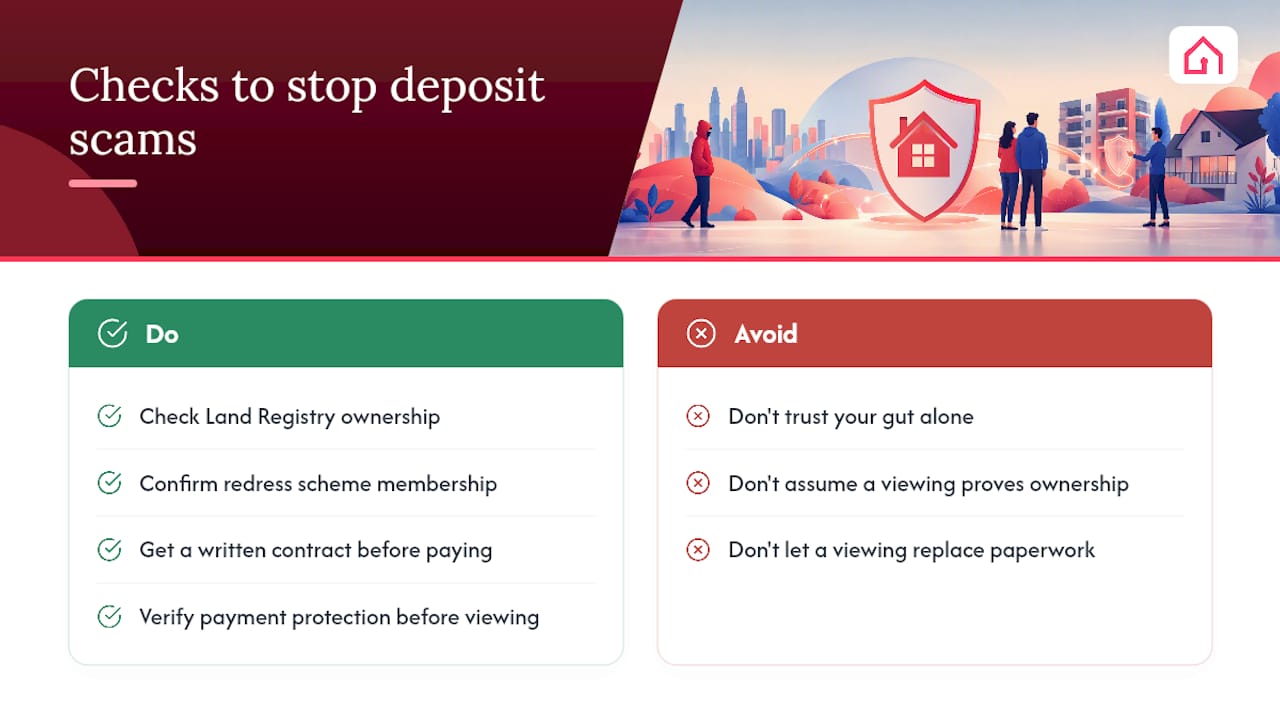
The advice most renters hear boils down to "trust your gut," and that is precisely why deposit scams stay so common. A gut feeling is useless against a scammer who has built a polished website, a fake brochure, and a staged viewing to look exactly like the real thing. What actually stops fraud is documentary proof: a Land Registry check, a redress scheme membership, a written contract, none of which require intuition, only ten minutes and a willingness to ask an awkward question.
The overlooked point is that a viewing proves almost nothing on its own. Short-term rental bookings and accomplices can produce a convincing viewing without anyone owning the property. If there is one habit worth prioritising above all others, it is this: verify ownership and payment protection before you view, not after, and never let a good viewing substitute for a paper trail.
Low rental supply creates urgency, remote searching removes face-to-face checks, and unprotected bank transfers make stolen deposits almost impossible to recover.
What is the fastest way to check if a landlord is real?
Verify the registered owner at the Land Registry and confirm any agent's membership with The Property Ombudsman or the Property Redress Scheme before paying anything.
What should I do immediately if I've sent a deposit to a scammer?
Contact your bank about a chargeback or reversal, report the fraud to the national reporting body and police, and report the listing to the platform it appeared on.
Does a genuine viewing prove a listing is safe?
No. Staged viewings using short-term rentals or accomplices can look completely convincing, so a viewing should always be paired with ownership and paperwork checks, not treated as proof on its own.