When Forty Enquiries Arrive: Workflow WhatsApp CRM for Letting Teams
12 September 2026
10 min read
Learn how a workflow first, auditable WhatsApp CRM captures leads, automates viewings, and keeps conversations governed for letting teams.
Yes, use a purpose-built WhatsApp CRM rather than the consumer app to capture, qualify, and progress property leads. Team-scale work needs the WhatsApp Business API, not a personal number shared between agents. A workflow-focused platform for landlords and letting teams can pair verified tenant profiles with automated conversation handling.
TL;DR:
Using a WhatsApp Business API-based CRM enables shared team inboxes and automated lead management, supporting multiple agents and high message volumes.
Automated workflows capture inquiries from portals, assign leads by rules, and automatically log all exchanges to reduce response time and prevent lost leads.
A proper WhatsApp CRM supports calendar syncing, document sharing, and quick escalation for urgent issues, essential for efficient property leasing processes.
Choosing a platform with API support, audit logs, compliance features, and scalability is crucial to avoid breaking at busy times or losing control over messaging data.
Starting with a pilot on high-volume channels and clearly defining owner roles, templates, and escalation rules ensures a smooth rollout and effective adoption.
#whatsapp for letting#CRM software for property agents#automated messaging real estate#whatsapp crm real estate#real estate customer management#CRM tools for real estate#real estate WhatsApp integration#WhatsApp marketing solutions#real estate communication strategies#using WhatsApp for leads
What does a WhatsApp CRM do for real estate teams?
A WhatsApp CRM turns a single messaging thread into a shared, trackable business tool rather than a personal inbox one agent quietly owns. For a letting team fielding enquiries from three portals and a dozen ad campaigns at once, that distinction decides whether leads get followed up or lost in someone's phone.
The core mechanics look like this:
Shared team inbox: multiple agents can see, claim, and respond to the same WhatsApp number without forwarding screenshots or asking "has anyone replied to this one yet?"
Auto-captured lead records: every new number that messages in becomes a contact record automatically, linked to the property or listing that triggered the enquiry.
Templates and auto-acknowledgements: pre-approved messages confirm receipt within seconds and can trigger broadcast updates to shortlisted tenants when a price changes or a viewing slot opens.
Visit scheduling with calendar sync: a tenant can pick a viewing slot inside the chat, and it lands directly in the agent's calendar with automated reminders sent beforehand.
Pipeline tracking and routing rules: conversations move through stages (enquiry, qualified, viewing booked, offer, closed) with rules that assign new leads to the right agent by property, location, or workload.
The measurable payoff shows up in response speed and conversion tracking. Messaging-first architectures integrated into property workflows have been shown to improve operational metrics such as mean time to response and vacancy periods, according to industry analysis from RealTrends. For a letting agent juggling forty active enquiries, that's the difference between a tenant who books a viewing today and one who finds somewhere else by Thursday.
How does a WhatsApp enquiry become a closed let?
A well-built workflow follows a predictable sequence from first message to signed lease, with clear handoffs at each stage.
Capture. An enquiry from a portal listing, a web form, or a paid ad routes into the WhatsApp CRM through an API webhook, arriving as a live chat rather than an email nobody checks until lunchtime.
Auto-create. The system creates a lead record instantly and fires a qualification template asking for budget, move-in date, and must-haves, usually two or three quick fields rather than a long form.
Route. Rule-based assignment sends the lead to the right agent based on the property or area, and the tenant can book a viewing slot that syncs straight to that agent's calendar.
Progress. Every message and document exchanged gets logged against the record automatically, and the pipeline stage updates once the viewing happens, whether that's "offer made" or "not proceeding."
Exception handling. Keyword detection flags urgent messages (a burst pipe, a lockout) so they bypass the automated flow and alert a human immediately, while the tenant still gets an instant acknowledgement.
Using canonical identifiers, such as a property ID or unit number, in every webhook payload keeps messages tied to the correct record even when a tenant is chatting about two different properties in the same week.
Pro Tip:Build your emergency keyword list before launch, not after the first missed maintenance call. Words like "leak," "lockout," or "no heating" should trigger immediate human escalation, bypassing any automated reply queue entirely.
What should you look for when choosing a WhatsApp CRM?
Not every messaging tool marketed to estate agents actually supports team-scale operations, and the gap usually shows up during a busy launch weekend rather than in a sales demo.
The non-negotiables:
WhatsApp Business API support, not just a connected personal app, because the API is what enables multiple agents, automation, and audit trails at once.
A shared inbox with CRM linkage, so conversations attach to contact records instead of sitting isolated in a phone.
Calendar and document support for viewing bookings, ID uploads, and lease paperwork exchanged mid-conversation.
Audit logs that record who said what and when, essential if a dispute over a viewing time or a deposit query ever surfaces.
Compliance deserves equal weight to features. Consent capture, a documented data-retention policy, and controlled access to conversation history all matter once messaging becomes a formal business channel rather than a convenience. UK government guidance on data protection sets out the baseline expectations for any business handling customer data through digital channels, and messaging platforms are no exception.
Before signing anything, ask vendors about onboarding time, whether the business number gets verified, how message templates get approved, and what the support SLA actually guarantees. Cost structures vary by message volume, seat count, and the number of active leads or listings a plan supports, so a quote that looks cheap at ten conversations a day can look very different at two hundred. A shared inbox built on the WhatsApp Business API is what separates a tool that scales with a growing agency from one that quietly breaks at the first busy month.
What's the rollout plan for adopting a WhatsApp CRM?
Treat this as a pilot first, not a full portfolio switch on day one.
Assign an internal owner, map how enquiries currently reach you, and register a verified business number rather than reusing a personal one.
Pilot with your highest-volume source first, whether that's one portal or one ad campaign, and enable acknowledgement templates and routing rules so you can measure time-to-first-contact from day one, a sequencing recommended in RealTrends' analysis of messaging rollouts in property teams.
Train staff on ownership, handover rules between agents, and the emergency keyword list before opening the pilot to real enquiries.
Iterate templates and routing rules based on what the numbers show, particularly no-show rates on viewings and average time-to-first-contact.
Lock down governance last: document retention periods, consent logs, and who has access to conversation history across the team.
Use WhatsApp for the fast, conversational parts of the relationship, but keep formal notices, lease documents, and payment records inside your CRM or portal, where they stay consistent and auditable, a split industry guidance consistently recommends.
How does Hauzed put these workflows into practice?
Hauzed builds several of these principles directly into its platform for landlords and agencies managing verified tenant conversations.
Identity verification gives landlords stronger signals about who they're talking to before a viewing gets booked, though verification increases trust without guaranteeing tenant approval or financial standing.
Scheduling and team accounts let agencies coordinate viewings and manage multiple properties without rebuilding a workflow for each listing.
The practical outcome for landlords is fewer low-value messages and better-qualified interest, since tenants arrive with a profile rather than as one anonymous line in a crowded inbox. Some AI actions still require review, and features depend on account settings and plan access, so treat these as practical assistants rather than fully autonomous systems.
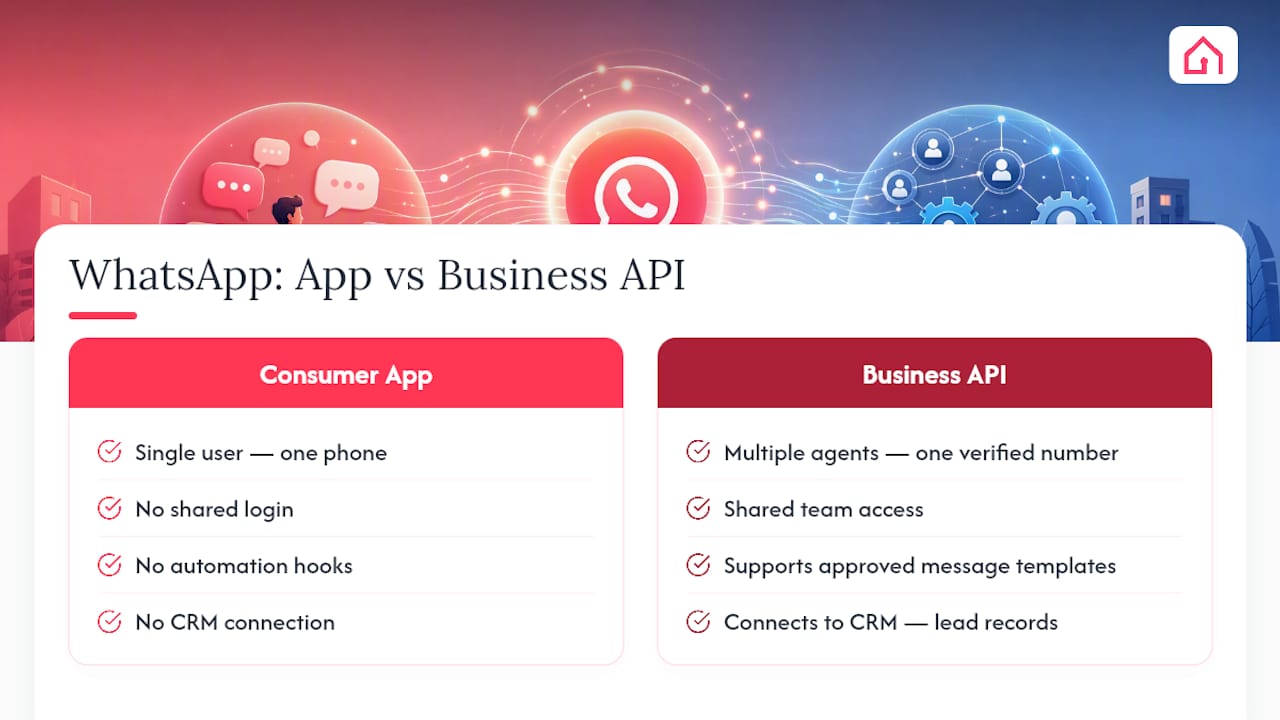
What's the difference between the WhatsApp app and the Business API?
The consumer WhatsApp app is built for one person having conversations on one phone. It has no shared login, no automation hooks, and no way for a second agent to see what the first one already said. For a solo landlord with one property, that might be fine. For a letting team fielding fifty enquiries a week across three agents, it breaks almost immediately.
The WhatsApp Business API solves the structural problem the app can't. It allows multiple team members to access one verified business number simultaneously, connects to a CRM so every message attaches to a lead record, and supports pre-approved templates for automated replies and reminders. It also generates the audit trail that a shared inbox depends on, a record of who responded, when, and what was said, which matters both operationally and for compliance. Coverage of WhatsApp adoption in property management is consistent on this point: the API model, not the consumer app, is what multi-agent teams actually need.
The trade-off is setup complexity, but platforms like Haio showcase how advanced automation and messaging tools can streamline implementation. Getting API access typically means going through a verified business solution provider rather than downloading an app from a store, and message templates need approval before they can be sent as automated replies. That extra step is precisely why teams evaluating vendors should ask directly how business verification and template approval get handled, rather than assuming it works the same way as the free app.
What actually happens once the automation is running?
Time saved on repetitive replies is real, and missed leads drop noticeably once every enquiry auto-creates a record instead of relying on someone remembering to reply. The bigger shift, though, is what automation should never touch: a serious offer, a dispute, or anything emotionally loaded still needs a human on the other end, quickly.
Over-automate and you get technically correct replies that feel hollow to a tenant deciding where to live. Keep ownership and escalation rules explicit from day one.
Ready to see this workflow in action?
There are platforms built as alternatives to juggling a personal WhatsApp number and a spreadsheet, aiming to provide verified tenant conversations without hiring extra admin support. Features like shared visibility on conversations, AI-assisted matching, faster replies, and scheduling that does not rely on manual calendar checks are available in some such offerings.
Rather than adopting a generic messaging tool and building the property logic yourself, you get a workflow already shaped around rental conversations from day one. Feature availability varies by plan, so it's worth checking what's included before committing a portfolio to it. Visit the Hauzed platform to see current plans, or get in touch to ask about a demo suited to your property volume and team size.
Further reading and primary sources
For the compliance side of messaging-based lead handling, GOV.UK's guidance on data protection sets out consent and retention obligations relevant to any business messaging customers digitally. For implementation patterns and measurable outcomes, RealTrends' analysis of messaging tools in property management and AnswerForMe's coverage of WhatsApp for rental teams both cover the shift from consumer app to API-based workflows in detail.
Yes. Several platforms integrate with the WhatsApp Business API to add shared inboxes, lead capture, and automation on top of WhatsApp conversations, and Hauzed applies these principles specifically to letting and rental workflows.
Which CRM is best for real estate?
The right choice depends on whether you need general sales pipeline features or messaging-first workflows built around viewings and tenant qualification. For letting teams specifically, look for WhatsApp Business API support, shared inboxes, and scheduling built into the conversation itself, which is where Hauzed's approach is designed to fit.
Can WhatsApp be used for real estate sales?
Yes, WhatsApp works well for fast, conversational parts of a sale or letting, such as initial enquiries, viewing bookings, and follow-up. Formal documents, lease terms, and payment records are better kept in a CRM or portal for consistency and audit purposes.
Is there a free CRM for WhatsApp?
Some basic tiers exist, but genuine team-scale features, the WhatsApp Business API, shared inboxes, and automation, typically sit behind paid plans once message volume or team size grows. Pricing usually scales with active leads, seats, or message volume, so it's worth checking current plan details before assuming a free tier covers your needs.