Discover how a white-label rental platform improves the renting experience by connecting verified tenants and landlords safely and efficiently.
A white-label rental platform, as used in this guide, is a trust-first rental marketplace that connects verified tenants with landlords and property agencies through identity verification, verified profiles, and structured letting workflows. It is not rebrandable software. Think of it as the rental equivalent of a secure, organised hiring platform: both sides show up verified, prepared, and ready to move.
Three reasons this matters for landlords, agencies, and tenants in Ireland:
Landlords and agencies receive better-qualified leads from verified applicants, reducing time spent filtering anonymous messages and lowering the risk of fraud.
Tenants build stronger rental profiles that help them stand out, rather than being one of dozens of unverifiable messages in a landlord's inbox.
Both sides benefit from a safer, more organised process: fewer fall-throughs, clearer evidence, and less reliance on fragmented channels like WhatsApp groups or Facebook posts.
This guide focuses on Ireland and UK Right to Rent (RtR) compliance, covering the verification signals, platform features, and practical steps that landlords, agencies, and tenants should look for.
Key takeaways
A trust-first rental marketplace works because both sides arrive verified, which removes the manual filtering, fraud risk, and communication chaos that passive listing portals leave unsolved.
Point
Details
Definition
A trust-first rental marketplace connects verified tenants with landlords via ID checks, AI matching, and structured workflows.
RtR compliance
Checks must meet GPG45 medium confidence; records must include name, DOB, biometric image, photograph, date, and identity-verified flag.
Authentication vs recording
A "pass" on a referencing report can mask weak verification if no biometric match was performed.
Retention rules
Landlords can keep document copies for one year after the tenant leaves, then must delete them.
Hauzed
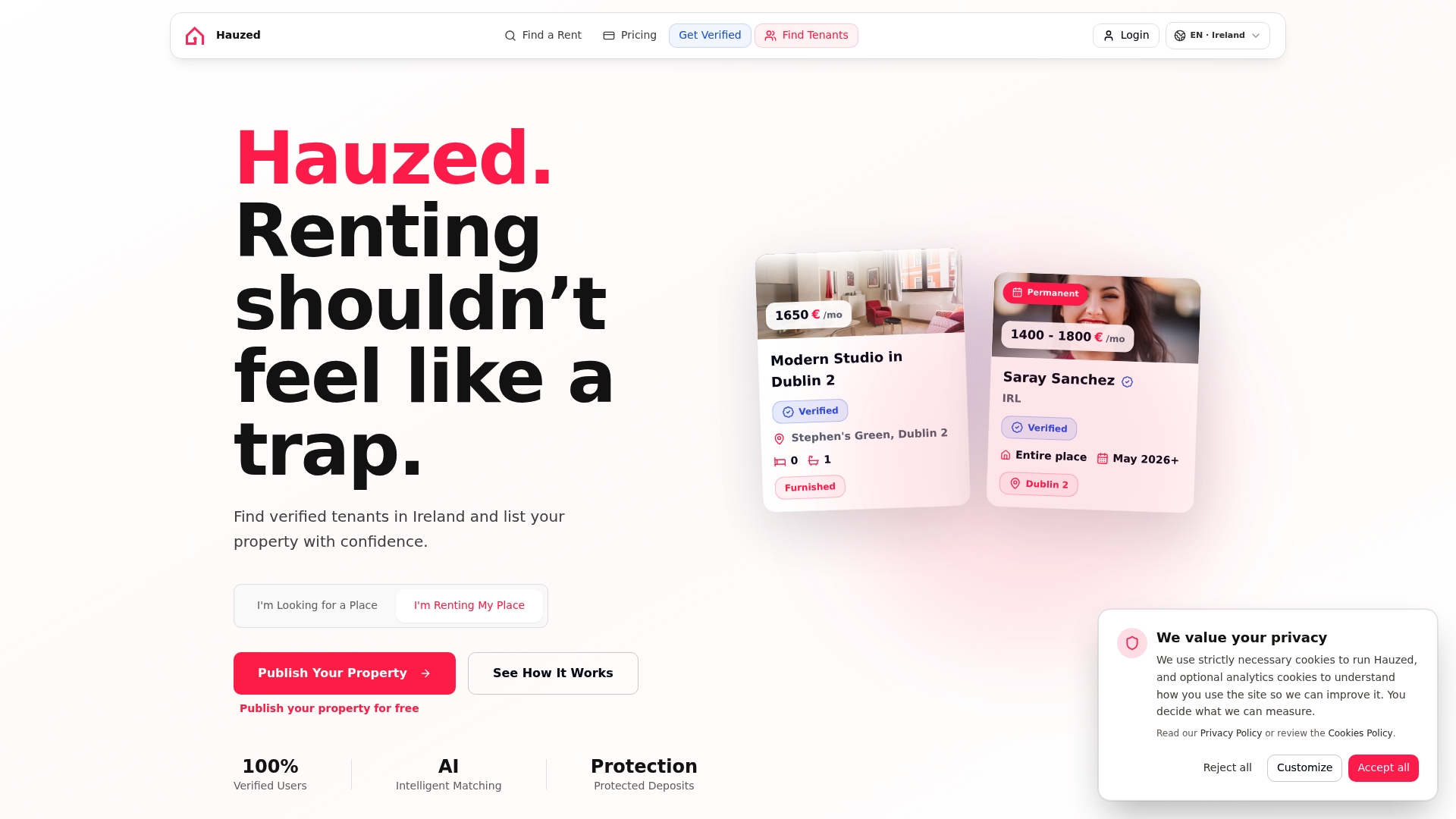
Hauzed is a free-for-tenants, plan-based marketplace for Ireland with identity verification, AI matching, and secure document upload.
Related Topics
#benefits of white-label rentals#what is white-label rental platform#white-label rental software#white-label platform explained#how to use white-label solutions#white-label vs branded platforms#white-label marketplace definition#what are rental platforms#best white-label rental services
How does a trust-first rental marketplace actually work?
The workflow moves in clear stages. Here is the typical sequence from first profile to signed tenancy:
Tenant creates a verified profile. The tenant registers, completes onboarding, and verifies their identity through the platform's ID check flow. Supporting documents (proof of income, references) can be uploaded with consent.
Landlord or agency publishes a listing. The property goes live with required material disclosures. An audit of roughly 27,000 listings found that requiring compliance information at publish time reduces fall-throughs.
Matching and invitations. AI matching surfaces suitable verified tenants for the landlord. Landlords can send invitations; tenants can send requests. Both actions happen within the platform.
Messaging and viewing scheduling. Conversations and visit bookings happen through platform chat, keeping communication structured and on record.
Referencing and offer. The landlord reviews the verified profile, requests any additional referencing, and makes an offer through the platform.
Secure deposit handling. Where enabled, deposit flows are managed within the platform rather than through unprotected bank transfers.
What each party should expect to do:
Tenants: verify identity, complete profile, upload supporting documents with consent, send requests, respond to invitations, book viewings, and communicate through platform chat.
Landlords: publish listings with full disclosures, review verified profiles, use AI matching to shortlist, send invitations, schedule visits, and retain evidence of checks.
Agencies: bulk-publish portfolios, manage team workflows, route leads to the right team member, and maintain compliance records across multiple properties.
Typical timelines: identity verification takes minutes to 48 hours depending on the check type; referencing usually completes within 24–72 hours.
What do landlords, agencies, and tenants actually gain?
Landlords
Receive verified leads rather than anonymous messages, reducing manual filtering.
Clearer evidence trail for compliance: verified identity records, timestamped conversations, and document uploads.
Less scheduling friction: viewings booked through the platform, not via personal phone numbers.
Lower void risk, since AI-driven pipelines can reduce void periods when integrated with RtR checks.
Agencies
Bulk publishing from structured files (CSV or Excel) for larger portfolios.
Team accounts with shared workflows and clear lead routing.
Reduced reliance on third-party portals. Industry analysis recommends mixing portal presence with owned channels to protect lead quality and conversion.
AI agents for matching, follow-up, and leasing conversations.
Tenants
A stronger tenant profile that replaces a weak, anonymous message with verified identity and supporting documents.
Faster responses: landlords can act on verified profiles without chasing basic information.
Safer interactions: no need to share sensitive documents over WhatsApp or email.
Pro Tip:Verification is a trust signal, not an automatic guarantee of acceptance. A verified identity confirms you are who you say you are; it does not guarantee financial approval or that a landlord will select you. The final decision always rests with the landlord or agency.
Identity verification and Right to Rent: what should you expect?
Compliant digital verification for Right to Rent checks means the platform uses a certified Identity Service Provider (IDSP) employing Identity Document Validation Technology (IDVT). Government guidance confirms that IDSPs using IDVT can provide the level of assurance required for RtR checks, and that checks must meet the GPG45 medium confidence profile as a minimum.
The RtR supplementary code specifies the fields a certified Digital Verification Service (DVS) must return to the landlord. Your evidence record should include:
Full name and date of birth
Image of the full biometric passport page (or passport card front)
Photograph of the applicant
Date the check was carried out
Name of the person or service that carried out the check
Biometric match confirmation (the applicant was matched to the document, not just recorded)
That last point is critical. Investigations have shown that some referencing packages record documents without authenticating them, leaving landlords exposed. A "pass" on a referencing report can mask weak verification if no biometric match was performed.
Trust signals to ask for when choosing a platform:
Certification under the UK Digital Identity and Attributes Trust Framework (DIATF), overseen by the Office for Digital Identities and Attributes (OfDIA)
GPG45 medium confidence or above
ISO 27001 or equivalent information-security accreditation
Date-stamped, unalterable verification records
Official gov.uk guidance confirms landlords may use a Digital Verification Service for passport checks, must retain required documents or evidence for specified periods, and should return originals to applicants when finished.
Pro Tip:Ask the provider to supply a copy of their DIATF/OfDIA certification at the time of the check, and confirm their retention policy in writing. You should also keep your own record of when the check was carried out and by whom, to meet your statutory obligations.
How to choose a trust-first rental marketplace: your checklist
Use this checklist to vet any verified rental marketplace before committing.
No audit trail or timestamped verification records
Vague language ("we check IDs") with no mention of DIATF, OfDIA, or GPG45
Platform stores original documents by default without a stated retention limit
No biometric match confirmation in the verification output
Sample script for contacting a provider:
"Are you certified under the UK DIATF/OfDIA framework for Right to Rent checks?"
"Do your checks meet GPG45 medium confidence or above?"
"What fields does your verification record include, and can I export it?"
"What is your document retention policy, and how do I request deletion?"
"Is your platform ISO 27001 certified or equivalent?"
Practical trade-off to keep in mind: faster automated checks (minutes) may use fewer data points than a full manual referencing package (24–72 hours). Speed and thoroughness are not always the same thing. Most platforms offer free access for tenants and plan-based pricing for landlords, so weigh the cost of a paid plan against the risk of a void or a fraudulent tenancy.
How to use a trust-first rental marketplace
Getting started is straightforward. Here are the two flows, one for each side of the market.
For landlords and agencies:
Create an account and select a plan that matches your portfolio size.
Publish your listing with full material disclosures and property media.
Review incoming verified tenant profiles and use AI matching to shortlist.
Send invitations to suitable tenants or accept incoming requests.
Schedule viewings through platform chat; keep all communication on record.
Request any additional referencing, review the verified evidence, and make an offer.
Complete identity verification (typically minutes to 48 hours).
Upload supporting documents (proof of income, references) through the secure upload flow only.
Search listings, save favourites, and send requests to properties you want.
Respond promptly to landlord invitations and confirm viewings through the platform.
Keep all communication within the platform chat until an offer is confirmed.
Pro Tip:Prepare your documents before you start applying. Have your passport, proof of address, and proof of income ready to upload. Tenants with complete, verified profiles tend to receive faster responses because landlords can act without chasing basic information.
Privacy, consent, and secure handling of your documents
Platforms must have a lawful basis for processing your personal data, whether that is contract performance or explicit consent, and must limit retention to what is strictly necessary. Here is what you should expect from a compliant platform:
Secure upload using TLS encryption and encrypted storage at rest
Limited access logs showing who viewed your documents and when
Clear retention windows: gov.uk guidance confirms landlords can keep copies for one year after the tenant leaves, then must delete them
Purpose limitation: documents uploaded for RtR checks should not be used for marketing or shared with third parties
The ability to request deletion or transfer of your data
A clear prohibition on sharing original documents through unprotected chat
Tenants should never send scanned identity documents, bank statements, or payslips through unprotected chat, email, or public groups. If a platform or landlord asks you to do this, treat it as a red flag. Use the platform's secure upload flow only.
Landlords should keep their own retention records alongside the platform's evidence, noting the date of each check and the document type reviewed, to meet statutory obligations where applicable.
Why trust-first marketplaces are the right direction
The rental market in Ireland and the UK has a trust problem, and it is not subtle. Tenants send dozens of messages into a void; landlords sort through unverified enquiries manually; agencies juggle WhatsApp threads and spreadsheets. The result is wasted time on both sides and, at worst, fraud.
What changes with a verified marketplace is the starting point. Both parties arrive having already confirmed who they are. That single shift removes a surprising amount of friction: landlords spend less time on basic filtering, tenants get faster responses, and the evidence trail for compliance is already built before the first viewing.
The Property Compliance Hub audit of roughly 27,000 listings showed how much falls through the cracks when disclosures are not required upfront. Verified marketplaces that enforce these requirements at publish time produce better outcomes for everyone. The landlord has clearer evidence; the tenant has a more accurate picture of the property; the agency has fewer late-stage fall-throughs.
The practical implication is simple: if you are choosing between a passive listing portal and a trust-first marketplace, the latter gives you a better starting position regardless of which side of the transaction you are on.
Hauzed: a verified marketplace built for Ireland
Fewer anonymous messages, stronger applications, and a clearer compliance trail: that is the concrete difference Hauzed offers landlords and agencies compared with fragmented listing portals or informal rental channels.
Hauzed maps directly to the checklist above. Identity verification is built into the tenant onboarding flow. AI matching through Hauzer helps landlords shortlist verified tenants without opening every message. Echo handles smart replies and follow-up. Agencies can bulk-publish portfolios via CSV import and manage team workflows under a single account. Secure document upload keeps sensitive files out of unprotected chat. Listings can include full material disclosures at publish time, reducing fall-throughs.
Tenants use Hauzed for free. Landlords and agencies access plan-based features (Free, Pro, and Max) depending on portfolio size and workflow needs. Visit Hauzed to explore the platform, or go straight to the verified tenant directory to see how verified profiles work in practice.
What is a white-label rental platform in plain terms?
In this context, it is a trust-first rental marketplace that connects verified tenants with landlords and agencies through identity checks, AI matching, and structured letting workflows. It is not rebrandable software.
Do Right to Rent checks have to meet a specific standard?
Yes. Government guidance requires checks to meet the GPG45 medium confidence profile as a minimum, carried out by a certified IDSP using IDVT technology under the DIATF/OfDIA framework.
How long must landlords keep Right to Rent documents?
Gov.uk guidance confirms landlords can retain copies for one year after the tenancy ends, after which they should be deleted and originals returned to the tenant.
Is a "pass" on a referencing report enough for compliance?
Not always. Investigations have shown that some referencing packages record documents without authenticating them or performing a biometric match, which leaves landlords exposed. Always ask whether authentication and biometric matching were carried out.
Is Hauzed free to use?
Tenants use Hauzed for free. Landlords and agencies access plan-based features (Free, Pro, and Max) depending on portfolio size and workflow requirements.