What is co-living explained: definition, types and how it works
17 August 2026
11 min read
Discover what co-living is and how it offers affordable, efficient housing solutions in shared spaces. Explore its benefits today!
Co-living is a housing model where you rent a private bedroom inside a shared home or building, while an operator or community manages communal kitchens, lounges and services under one roof. It matters right now because cities are short on affordable homes, energy costs are rising, and the United Nations has flagged buildings as one of the biggest sources of carbon emissions worldwide, making shared, resource-efficient living arrangements genuinely useful rather than just trendy.
Here's the quick shape of it:
You get your own bedroom, usually lockable, sometimes with an ensuite.
You share kitchens, lounges, laundry and often a coworking space.
An operator, landlord, or resident committee handles bills, cleaning and community events.
Leases tend to be shorter and more flexible than a standard tenancy.
Key Takeaways
Co-living works best when private space, shared facilities and structured community management are all deliberately designed together, not left to chance.
Point
Details
Definition matters
Co-living means a private bedroom plus shared facilities, usually under one managing operator or resident group.
Type shapes the experience
Purpose-built, student, senior and cooperative co-living differ sharply in lease length and service intensity.
Benefits depend on design
Affordability and social connection only materialise when onboarding and community programming are genuinely present.
Regulation protects you
Check tenancy type, deposit protection and planning status before signing anything.
#co-living for young professionals#how does co-living work#co-living spaces explained#what is co-living explained#is co-living right for me#co-living definition#what is communal living#co-living vs traditional housing#benefits of co-living
Ask "how does co-living work?" and the honest answer is: it depends who's running it. In an operator-run scheme, a company owns or leases the building, sets the rules, and sells you a room with services bundled in, much like a hybrid between renting and hotel living. In a community-run model, residents themselves set the culture and handle disputes, closer to a housing cooperative in spirit.
What you typically get:
A furnished private bedroom
Shared kitchen and living space
Utilities, Wi-Fi and cleaning included in rent
Coworking or lounge areas
Organised social events or activities
Flexible lease lengths, often month-to-month or a few months minimum
Management styles split roughly three ways: a professional operator who handles everything from maintenance to move-ins, a resident-led community that self-governs, or a hybrid where an operator sets the framework and residents run the social side.
Pro Tip:Ask any operator how they onboard new residents in the first week. Schemes that run a structured welcome, introducing housemates and house norms upfront, consistently report higher wellbeing and social connection than those that just hand you a key and a WhatsApp group.
What types of co-living spaces exist?
Co-living spaces explained properly means recognising it isn't one product. The main variants:
Purpose-built co-living: new-build blocks with studio rooms and dedicated shared amenity floors, often in city centres.
Student co-living: campus-adjacent schemes designed for cohorts moving through together, usually on academic-year leases.
Senior or multigenerational co-living: smaller, homelier setups aimed at reducing isolation among older residents.
Niche cohort co-living: creative, wellness or remote-worker focused houses that group people around a shared interest.
Community-led or cooperative co-living: resident-owned or resident-governed, often in converted houses or rural settings.
You'll typically find purpose-built and student schemes in converted offices or new blocks near transport links, while cooperative and niche models tend to occupy older housing stock or village settings. Lease length, service intensity, and how much community programming is baked in are the fastest ways to tell them apart.
Who is co-living for?
Co-living for young professionals is the most common framing, but the resident base is wider than that. Core groups: students, early-career professionals, digital nomads, people relocating for work, and a growing number of older adults seeking connection over isolation.
Students: want affordability plus a ready-made social circle.
Young professionals: want convenience and speed of move-in.
Digital nomads and remote workers: want flexible leases and coworking space on-site.
People relocating for a new job: want furnished, bills-included housing without a long commitment.
Some older adults: want company and shared services without full-time care.
A relocating professional given two weeks' notice by a new employer, for instance, often can't furnish a flat, set up utilities, and sign a year-long lease in that window. Co-living answers all three problems in one booking.
What are the main benefits of co-living?
The benefits cluster into four areas: affordability, social connection, convenience, and sustainability. Each one solves a real friction point in traditional renting.
Cost predictability: all-inclusive rent means no surprise utility bills.
Faster social integration: shared spaces and events reduce the isolation of moving somewhere new.
Convenience: furnished rooms and included cleaning cut the admin of setting up a home.
Flexible leases: shorter commitments suit people whose plans might change.
Resource efficiency: shared kitchens, laundry and heating reduce duplication per person.
Research callout: Academic analysis of the sector suggests well-designed co-living schemes can reduce per-person energy and resource consumption by densifying underused urban space and cutting duplicated appliances and heating systems across a building.
What are the criticisms and regulatory issues around co-living?
Co-living isn't without valid critics. The common complaints: reduced privacy, a sense that housing is being "commodified" into a subscription product, high resident turnover disrupting community, and questions over whether rents genuinely stay affordable once services are priced in.
Tenancy status ambiguity: some co-living contracts sit in a grey area between licence and tenancy, affecting your rights.
Noise and shared-space friction: dense communal living amplifies small conflicts.
Data and privacy handling: operators collect identity and payment data that needs careful safeguarding.
Accountability: who actually holds the lease and answers for repairs isn't always obvious.
Before signing anything, check: the exact tenancy type you're offered, whether your deposit is protected, who legally holds the head lease, and whether the building has been assessed under local planning policy. UK city authorities have started addressing this directly. London's strategic planning guidance sets out how large-scale shared living schemes should be treated by planning authorities, building on an earlier pre-consultation draft that first flagged the gap. If you're unsure how a decision was reached on a scheme near you, the government's plain English guide to planning is a genuinely useful starting point.
How does co-living differ from house shares, cohousing and co-ops?
The comparison matters because these terms get used interchangeably when they shouldn't be. A house share is peer-led with no central operator; cohousing is a community that jointly designs its own space and governance; a housing co-op is member-owned, with residents holding a financial stake.
Co-living: operator-managed (usually), individual leases, curated community programming, can scale to hundreds of residents.
House share: informal, peer-organised, one shared tenancy agreement, small scale.
Cohousing: resident-designed from the outset, shared governance decisions, moderate scale.
Housing co-op: residents co-own or hold membership shares, democratic governance, variable scale.
The sharpest distinctions sit across five points: who manages it, what the lease looks like, how bills are handled, who governs community decisions, and how large the scheme typically runs.
What do co-living costs and lease terms look like?
Co-living pricing usually comes as one all-inclusive figure rather than rent plus separate bills, and consumer guides confirm this bundling is now standard practice across most operators. You'll pay a premium for central locations and higher service levels, but you avoid setting up utility accounts, furniture purchases, or Wi-Fi contracts yourself.
What's usually included: Wi-Fi, cleaning of communal areas, some organised events, and often a shared subscription to streaming or coworking access. What's usually excluded: your personal contents insurance, and in some cases local council tax equivalents, depending on jurisdiction.
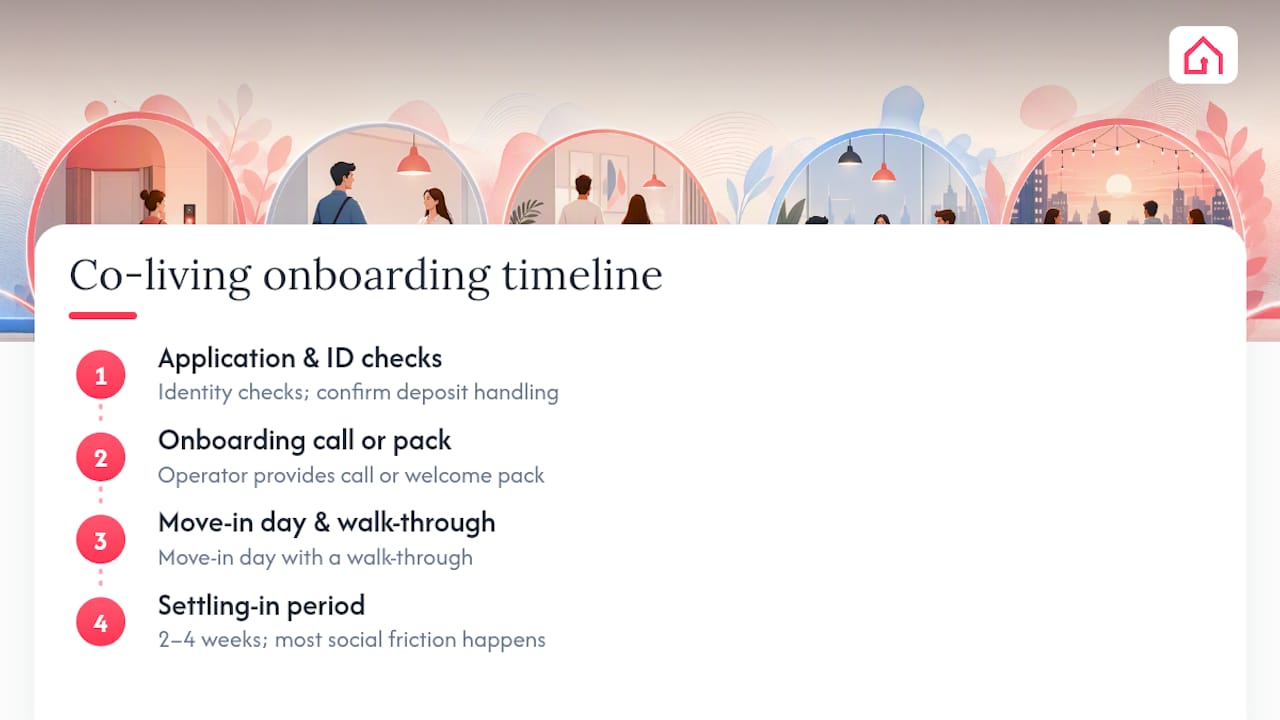
A rough timeline runs: application and identity checks, then an onboarding call or welcome pack, then move-in day with a walk-through, then a settling-in period of two to four weeks where most social friction happens. Be wary of any operator vague about how your deposit is held or what triggers a deduction. If you're comparing local room prices before deciding, rooms for rent in Dublin give a useful benchmark for what all-inclusive pricing should realistically look like.
What does research say about co-living's social and environmental impact?
Co-living can genuinely reduce per-person resource use and support social belonging, but the evidence is clear that outcomes hinge on design quality and service level, not the model alone. A scheme with no onboarding and no shared culture doesn't automatically deliver either benefit just because residents share a kitchen.
Densifying underused buildings for co-living can lower per-person energy and resource demand compared with equivalent standalone flats. Separately, studies of student co-living show that homelike scale and pre-built social structures foster genuine belonging, while badly regulated or oversized schemes risk the opposite effect.
Research callout: Structured onboarding and a visible "service layer" correlate with significantly higher resident wellbeing scores than schemes where new residents are left to work out house dynamics on their own.
For planners and operators, this points to three practical implications: design intentional onboarding from day one, measure social outcomes alongside occupancy rates, and avoid building large anonymous blocks without any service or community layer attached.
Where did co-living come from and where is it heading?
Communal living traditions run back centuries, but the direct lineage runs through 20th-century cohousing movements into today's professionally managed sector. Purpose-built co-living blocks, converted office-to-residential schemes, and city regeneration projects are the three formats you'll most commonly see cited as illustrative examples of the modern model.
Sector commentary suggests studio-led conversions in dense, transport-connected cities are particularly cost-efficient ways to add rental supply without new-build costs. Investor interest has scaled the sector considerably in the past decade, with consultancies framing well-designed schemes as genuine tools for urban regeneration, provided quality of life isn't sacrificed to occupancy targets.
How do I find and join a co-living community?
Evaluating a scheme properly takes about the same effort as vetting any tenancy, just with a few extra questions.
Verify the exact tenancy or licence type you're being offered, and confirm your deposit is protected.
Visit in person and inspect shared kitchens, bathrooms and common areas, not just your bedroom.
Read the house rules document before signing, particularly around guests and noise.
Ask how the operator handles conflict between residents.
Check the cancellation and notice terms, including what happens if you need to leave early.
Questions worth asking directly: What's the resident turnover rate? Who runs community events, and how often? What's the cleaning schedule for shared spaces? How are disputes actually resolved in practice?
Pro Tip:Ask to see the operator's business registration and, where relevant, whether the building has planning consent for shared living use. A legitimate operator will hand this over without hesitation; a hesitant answer is itself a signal.
Our take on where co-living fits in housing
Co-living isn't a fad and it isn't a fix for the housing crisis on its own. It's a genuinely useful addition to the housing mix when operators design it properly, get the regulatory basics right, and treat community as something to build deliberately rather than assume will happen. If you're weighing it up, verify the tenancy and the operator before you verify the room. A trust-first marketplace like Hauzed can help you check who you're dealing with before you commit to anything.
Sources
For policy context, the London strategic planning guidance and the government's plain English planning guide are the most reliable starting points. For the research behind wellbeing and social impact claims, see the Emerald journal article on service layers. Use the planning sources for legal checks, and the research sources for judging whether a scheme's design will actually deliver on its promises.
The main downsides are reduced privacy, potential tenancy ambiguity, higher turnover disrupting community feel, and the risk that bundled rent masks a real premium over unbundled housing costs.
Why would someone want to live in a co-op?
People choose housing co-ops for the member ownership stake and democratic control over decisions, which differs from co-living's typically operator-managed structure.
What is a co-living relationship?
"Co-living relationship" usually just describes the arrangement between residents sharing communal space under one lease or licence structure, not a romantic or legal relationship between them.
How does co-living differ from a standard house share?
A house share is informally organised by peers with one joint tenancy, while co-living typically involves individual leases, professional management, and structured community programming.
Is co-living right for me?
If you value flexible leases, bundled bills, and built-in community over full independence and control, co-living tends to suit you better than a standard tenancy.