What is a pre-qualified tenant? A practical UK guide
6 de agosto de 2026
12 min de lectura
Discover what a pre-qualified tenant is and learn how this initial screening step can help landlords streamline property viewings in the UK.
A pre-qualified tenant is someone who has passed a short, initial screening at enquiry stage, confirming they meet the basic criteria for a property before a viewing is arranged or a formal application begins. Pre-qualification is not formal approval, and it is not the same as a completed reference. It is a quick triage step, distinct from the identity checks, credit searches, and employment verification that make up full tenant referencing. Landlords in England must still complete a Right to Rent check as required by law, and most rent guarantee insurers require a formal reference before cover applies, regardless of how well a candidate performed at pre-qualification.
Key takeaways
Pre-qualification is a fast, self-reported triage step that helps landlords prioritise enquiries, but it must be followed by formal referencing and a Right to Rent check before any tenancy begins.
Point
Details
Pre-qualification is not approval
It uses self-reported signals only; nothing is verified until formal referencing begins.
Right to Rent is a legal obligation
Run it in England after a conditional offer, not at pre-qualification stage.
Referencing costs fall on landlords
The Tenant Fees Act 2019 prohibits charging tenants for reference checks.
Keep forms short and consent-compliant
Collect only what you need and include a GDPR consent line on every pre-qualification form.
Tenants should prepare early
Have ID, proof of income, and a previous landlord contact ready before the first enquiry.
#what is a pre-qualified tenant#what does pre-qualification mean#tenant screening process#criteria for tenant pre-qualification#pre-qualified renter#how to pre-qualify a renter#understanding tenant qualifications#benefits of pre-qualified tenants#pre-screened tenants explained
Pre-qualification uses six quick signals at enquiry stage to reduce wasted viewings: affordability, Right to Rent status, employment type, intended timeline, rental history, and occupancy. Here is what each field on a standard form reveals and why it matters:
Full name and contact details. Basic identification so you can follow up and, later, match against ID documents.
Number of occupants. Flags whether the household size suits the property and whether additional adults need Right to Rent checks.
Intended move-in date. A mismatch between the tenant's timeline and your availability is one of the fastest disqualifiers.
Gross monthly income. Lets you apply an affordability rule of thumb before committing to a viewing.
Estimated rent-to-income ratio. A practical affordability check: rent should generally be no more than roughly 35–40% of gross monthly income, though treat this as a signal rather than a hard rule.
Basic credit flags. A self-reported question such as "Do you have any County Court Judgements or outstanding debt arrangements?" surfaces obvious issues early. This is not a credit check; it is a prompt for honesty.
Pets and smoking. Practical property-condition questions that can rule out a candidate immediately if the property does not permit them.
References and previous landlord contact. Confirms whether the applicant can provide a landlord reference, which is a standard component of formal referencing.
Guarantor availability. Relevant for students, those with irregular income, or applicants whose rent-to-income ratio is borderline.
Identity, Right to Rent status, and credit are noted at this stage but verified only later, after a conditional offer.
Why landlords and agents use pre-qualification
The main purpose of pre-screening is not to reject applicants permanently but to rank and prioritise enquiries so your time goes to candidates most likely to pass referencing. The practical benefits are real:
Time saving. A two-minute phone conversation or a short form filters out timeline mismatches, occupancy problems, and obvious affordability gaps before you spend an hour on a viewing.
Safer viewings. Knowing a candidate has confirmed their employment type and move-in date before they arrive reduces no-shows and inappropriate enquiries.
Better referencing outcomes. A well-run pre-qualification stage materially reduces the number of paid referencing attempts that fail, because it filters out candidates unlikely to pass full checks.
The limits are equally important to understand. Pre-qualification is entirely self-reported. Nothing at this stage has been verified. Treat it as a signal, not evidence, and never use it as a substitute for formal referencing or a Right to Rent check.
Pro Tip:Frame the pre-qualification conversation as a friendly chat rather than an interrogation. Saying "I just want to make sure the property is a good fit for you before we arrange a viewing" sets a collaborative tone and tends to produce more honest answers.
How to run a pre-qualification step by step
A structured process keeps you consistent, legally compliant, and ready to move good candidates quickly into referencing. Here is a practical workflow for UK landlords and agents:
Send or share a short form at first enquiry. Keep it to the fields listed above. Aim for a one-to-two-minute completion time. A phone call works equally well if you prefer a conversation.
Apply the affordability rule of thumb. Check whether the applicant's gross monthly income is roughly 2.5 times the monthly rent (equivalent to the 40% rent-to-income guide). Flag, but do not automatically reject, borderline cases where a guarantor may resolve the gap.
Note any immediate disqualifiers. Timeline mismatch, occupancy incompatibility, or a clear affordability gap are grounds to move the candidate to a "hold" or "not suitable" pipeline without proceeding to a viewing.
Obtain explicit consent before storing data. Under UK GDPR, you need a lawful basis for processing personal data. A simple consent line on the form is sufficient at this stage (see the sample form below).
Arrange the viewing for candidates who pass. Keep the pre-qualification form on file. Do not run a credit check or Right to Rent check yet.
Make a conditional offer to your preferred candidate. This is the trigger point for formal referencing and Right to Rent checks.
Run Right to Rent and full referencing after the conditional offer.Right to Rent is a legal obligation in England under the Immigration Act 2014. Full referencing, covering identity, credit, employment, and a previous landlord reference, is required by most rent guarantee insurers before cover applies.
Log outcomes clearly. Move candidates into "reference", "hold", or "not suitable" pipelines so you can return to strong candidates quickly if your first choice falls through.
Pro Tip:Treat pre-qualification as a five-minute investment that protects you from paying for referencing on unsuitable applicants. Referencing takes days; a short form takes minutes.
Have these ready before you fill in any form or take a call:
Photo ID (passport or driving licence) so you can confirm your identity quickly if asked.
Proof of income (recent payslips, a contract letter, or, if self-employed, your most recent tax return or accountant's letter).
Your notice period at your current address, so you can give an accurate move-in date.
Previous landlord contact details, including an email address or phone number for a reference.
Guarantor details, if your income is borderline or you are a student.
A few simple steps strengthen your application at this stage. Be honest about your income and any credit issues: landlords generally respond better to transparency than to discovering a problem later in referencing. Give a clear, realistic move-in date. If your income is irregular, briefly explain the pattern (for example, a mix of salary and freelance income) rather than leaving the landlord to guess. You are only being asked for self-reported information at pre-qualification; detailed documents and consent for credit checks come later, after a conditional offer.
Key UK legal obligations when pre-qualifying tenants
Pre-qualification sits within a legal framework you cannot ignore. Here are the main compliance points:
Right to Rent (England). Under the Immigration Act 2014, landlords must check that every adult occupant has the right to rent in England. Failing to complete this check can result in legal penalties. Run it after a conditional offer, not at pre-qualification stage.
Tenant Fees Act 2019. Landlords and agents must bear the cost of referencing. Charging tenants for reference checks is prohibited. Pre-qualification forms are free to send and receive, so they do not raise Tenant Fees Act issues, but any subsequent referencing cost falls on you as the landlord.
UK GDPR and data protection. Collect only the data you need. Obtain explicit consent before storing personal details or running any check. State clearly how long you will keep the data and delete it when it is no longer needed.
Anti-discrimination. Screen on objective criteria only: affordability, timeline, occupancy, and references. Never screen on protected characteristics such as race, nationality, religion, disability, or family status, in accordance with anti-discrimination laws.
Pre-qualified, pre-approved, and referenced: what is the difference?
These three terms describe different levels of confidence, and confusing them is a common and costly mistake.
Pre-qualified. Self-reported signals only. The candidate says they meet your criteria. Nothing has been verified. Fast, but provisional.
Pre-approved. A step beyond pre-qualification, sometimes used by agents to indicate a candidate has passed an internal review or a soft credit check. Still not a formal reference.
Referenced. A full evidence-based report covering identity, credit, employment verification, and a previous landlord reference. This is what insurers and most landlords require before signing a tenancy agreement.
Stage
What it involves
Timing
Confidence level
Pre-qualified
Self-reported form or conversation
At enquiry
Signal only
Pre-approved
Internal review or soft check
Before or after viewing
Moderate
Referenced
ID, credit, employment, landlord checks
After conditional offer
Evidence-based
Does pre-qualified mean you will be approved? No. Pre-qualification tells a landlord that a candidate looks suitable based on what they have said about themselves. It does not predict the outcome of a credit check, an employment verification, or a previous landlord reference. Candidates who pass pre-qualification sometimes fail referencing, and that is exactly why formal referencing exists.
A sample pre-qualification form you can copy and adapt
Keep the form short. Long forms deter good applicants. The fields below cover everything you need for a meaningful triage in under two minutes.
Fields to include:
Full name
Email address and phone number
Property you are enquiring about
Intended move-in date
Number of adults and children who will occupy the property
Can you provide a reference from a previous landlord? (Yes / No / First rental)
Would you be able to provide a guarantor if required? (Yes / No / Unsure)
Any additional information you would like to share?
GDPR consent line (copy verbatim or adapt):
"By submitting this form, you consent to [Landlord/Agency Name] storing your contact details and the information above for the purpose of assessing your suitability for this property. Your details will be held for no longer than [X months] and will not be shared with third parties without your consent, except where required by law."
Pro Tip:Add a short note at the top of the form explaining that this is a quick check to make sure the property is a good fit, not a formal application. Applicants who understand the purpose are more likely to answer honestly.
Why verified signals matter more than volume
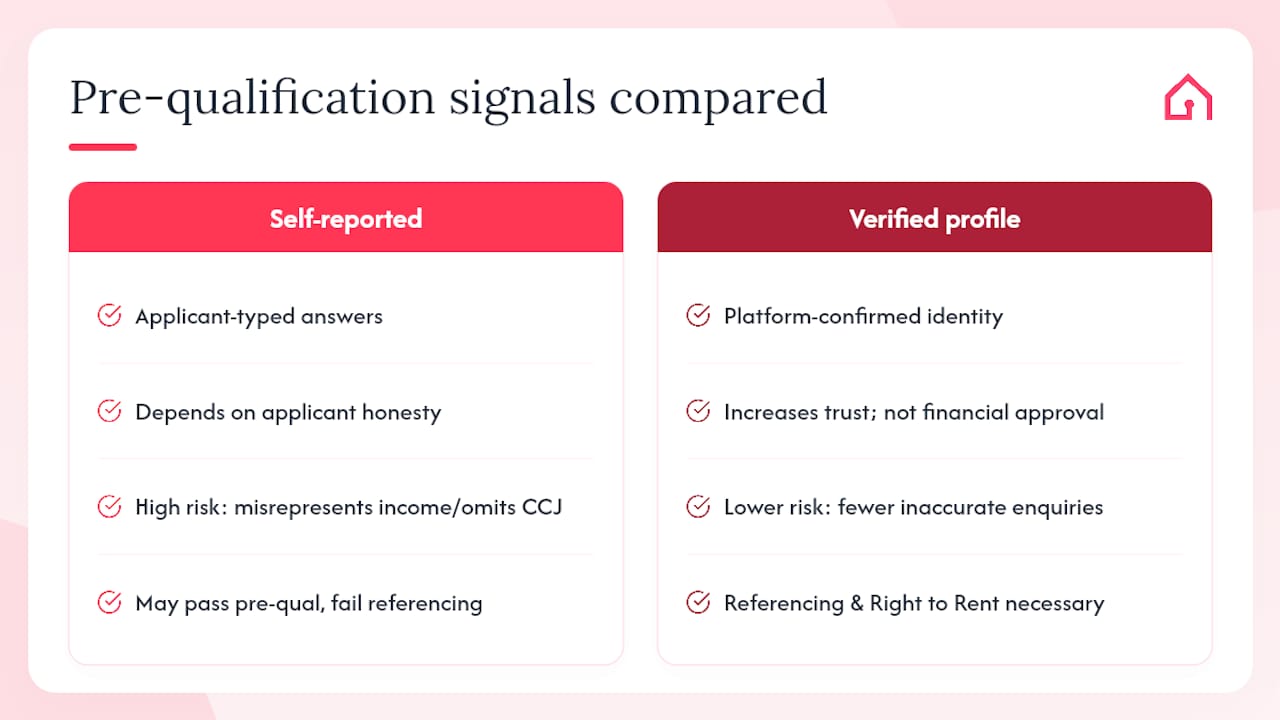
Pre-qualification works best when both sides are honest and prepared. The challenge with self-reported forms is that the quality of the signal depends entirely on the quality of the information the applicant provides. A candidate who misrepresents their income or omits a CCJ will pass pre-qualification and fail referencing, costing you time and money.
This is where verified profiles change the dynamic. When a tenant has already confirmed their identity through a platform before they enquire, the landlord receives a signal that is grounded in something real rather than something typed into a form. Verified identity and structured profiles increase trust but do not guarantee financial approval; they reduce the risk of wasted viewings caused by anonymous or inaccurate enquiries.
Hauzed is built around this idea. Landlords and agents using the platform can review verified tenant profiles before arranging a viewing, use Hauzer to surface suitable matches, and manage conversations through a structured workflow rather than a crowded inbox. Pre-qualification becomes faster and more reliable when the candidate has already completed identity verification, because the landlord is working with a stronger starting signal. Formal referencing and Right to Rent checks remain necessary regardless of platform, but the triage step is meaningfully more efficient.
Ready to receive better-qualified enquiries from the start? Hauzed connects landlords and agents with verified tenants, reducing the manual work of filtering, messaging, and scheduling so you can focus on the candidates most likely to progress.
This article is general information, not a substitute for advice from a qualified lawyer. Consult a qualified legal professional about your own circumstances before acting on anything here.
FAQ
What is a pre-qualified tenant?
A pre-qualified tenant is someone who has passed a short, self-reported screening at enquiry stage, confirming they appear to meet the basic criteria for a property. It is not formal approval and does not replace referencing or a Right to Rent check.
Does pre-qualified mean you will be approved?
No. Pre-qualification is based on self-reported information and carries no guarantee. A candidate can pass pre-qualification and still fail formal referencing if their credit, employment, or landlord reference does not check out.
What is the difference between pre-qualified and referenced?
Pre-qualified means a candidate has provided self-reported signals that suggest suitability. Referenced means an independent provider has verified their identity, credit history, employment, and previous landlord reference, producing an evidence-based report.
What does pre-tenancy mean?
Pre-tenancy refers to all the steps that happen before a tenancy agreement is signed, including pre-qualification, viewings, a conditional offer, formal referencing, and Right to Rent checks. Pre-qualification is the earliest stage in that sequence.
Who pays for tenant referencing in the UK?
Under the Tenant Fees Act 2019, landlords and agents must bear the cost of formal referencing. Charging tenants for reference checks is prohibited.