Landlords: 6 viewing invitation message essentials that cut no-shows
21 September 2026
11 min read
Copyable viewing invitation messages, channel-specific templates and privacy-safe Hauzed workflows to cut no-shows and speed rental decisions.
A viewing invitation message must state the date, start time, meeting point and a contact number, so nobody arrives confused or stands outside the wrong gate. It should give the expected duration and a clear action: confirm, reschedule or cancel. If documents or verification matter, say so briefly, and close with one plain instruction the tenant can act on straight away.
TL;DR:
Sending a clear and structured invitation with the date, time, exact meeting point, contact number, and a simple confirmation action reduces back-and-forth messages and confusion.
Use templates tailored to each communication channel, ensuring all essential logistics and requirements are included upfront, especially meeting details and document requests.
Best practices involve immediate confirmation, multiple time options, and reminders 24 hours and a few hours before the viewing to prevent no-shows and accommodate different schedules.
Asking the same screening questions of all applicants in a consistent way helps maintain fairness and avoids discrimination issues, especially regarding move-in date and household size.
Automating invites with tools like Hauzed streamlines the process, keeps documents secure, and speeds up tenant matching, reducing message clutter and accelerating property fill times.
What should a rental viewing invitation message include?
Everything else in this guide builds on that short list, but the order matters as much as the content. A tenant scanning a viewing invitation message on their phone between buses needs the answer before the explanation: viewing confirmed, here's when, here's where.
The essentials break down into three groups:
Logistics: date, start time, meeting point (with a postcode or map link), expected duration, and a mobile number for the day.
Preparation: anything the tenant needs to bring, such as photo ID, proof of income, or a completed application, so the visit isn't wasted.
Action: a single, unambiguous request, usually "reply YES to confirm" or a tap-to-confirm link inside the platform.
Miss any of the three and you generate more back-and-forth messages than the invitation was meant to prevent. Landlords who send a bare "viewing Tuesday 6pm" without a postcode or contact number routinely get a reply asking for both, which defeats the point of sending a template in the first place.
Templates you can copy for SMS, email, chat and WhatsApp
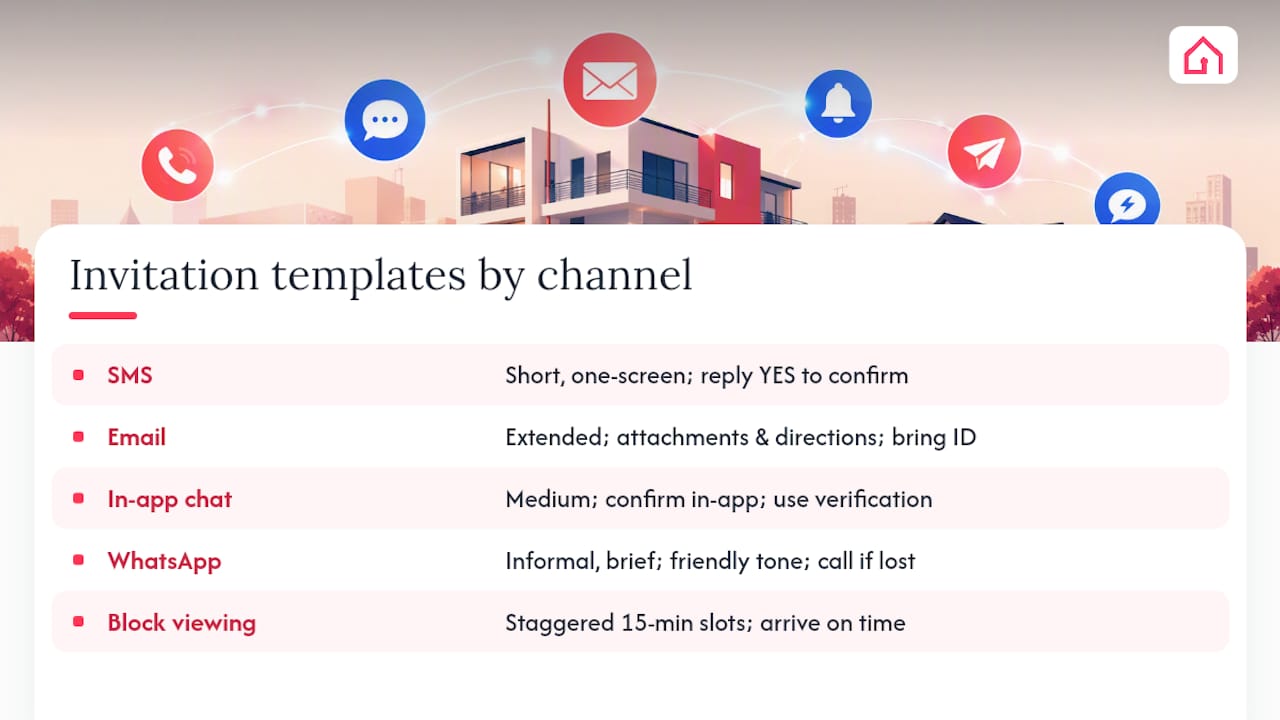
Different channels need different lengths. An SMS invitation message has to fit on one screen; an email can carry attachments and directions; an in-platform chat message can lean on features the tenant already trusts.
SMS confirmation (short):
"Hi [Name], your viewing for [Address] is confirmed for [Day, Date] at [Time]. Meet at [entrance/landmark]. Call [Phone] if you're running late. Reply YES to confirm."
"Hi [Name], thanks for your interest in [Address]. Your viewing is booked for [Day, Date] at [Time], lasting around 15 to 20 minutes. Please park on [street/car park] and meet me at [entrance]. For tips on effective on-site directions, see our Guide to Indoor Signage Placement for Open Houses. Bring photo ID and, if you have one, proof of your current address. I've attached the EPC and, where applicable, the gas safety certificate. Directions: [map link]. Call or text [Phone] if anything changes."
In-platform chat message:
"Your viewing request for [Address] has been accepted. Please confirm the slot on [Day, Date] at [Time] through the app. If you haven't yet completed identity verification, you can do that securely through your profile before the visit, no need to send documents over chat."
WhatsApp-style informal template:
"Hey [Name] 👋 Viewing's on for [Time], [Day] at [Address]. I'll meet you outside, ring me on [Phone] if you can't find it!"
Block-viewing script (multiple applicants, staggered slots):
"Viewings for [Address] are running in 15-minute slots between [Start] and [End] on [Date]. Your slot is [Time]. Please arrive on time as the next visitor will follow shortly after."
Replace every bracketed placeholder before sending, and strip out anything that reveals another applicant's details, particularly in group chat threads or forwarded messages.
Pro Tip:Keep a single master template per channel and edit only the bracketed fields. Rewriting from scratch each time is where typos, missing postcodes and GDPR slips creep in.
How do you structure a viewing invitation message?
Write the confirmation before the context. A tenant's first line of interest is whether the viewing is happening, not why you chose that time slot, so lead with "Your viewing is confirmed" or "I'd like to invite you to view" before anything else.
A reliable structure runs in this order:
The outcome: state plainly that the viewing is confirmed, or that you're extending an invitation.
The critical facts: date, time, and exact meeting point, written together rather than split across two sentences.
Directions and contact: a map link plus a phone number covers both the tenant who drives and the one who walks from the nearest station.
What happens next: a line on duration and what the visit will cover, so the tenant knows whether to expect a five-minute walkthrough or a longer conversation about the tenancy.
What to bring: ID, proof of income, or a reference contact if you'll ask for one on the spot.
A closing action: one instruction, such as "reply to confirm" or "tap confirm in the app."
Screening questions belong in this structure too, but they should read the same for every applicant. NRLA recommends a consistent pre-viewing question set precisely because varying the questions between candidates opens the door to discrimination complaints, intentional or not. Ask about move-in date, household size and income the same way every time, in the same message template, and you remove the guesswork from your own process as well as the risk.
Pro Tip:If you find yourself writing three sentences to say "meet at the front door," you've probably buried the meeting point in the middle of the message. Put it in the same sentence as the time.
When is the best time to send a viewing invitation?
Sending pattern matters almost as much as wording. Get it wrong and you either overwhelm a tenant with too many messages or leave them without enough notice to plan around work or transport.
Immediate confirmation: send within minutes of a booking request, even if it's just "Got it, confirming your slot for [Time] shortly."
Reasonable notice: offer two or three time windows rather than a single slot; tenants juggling shift work or exams need options, not an ultimatum.
24 hour reminder: "Just a reminder, your viewing at [Address] is tomorrow at [Time]." Keep it under two lines.
Same-day reminder: a short nudge two to three hours before, particularly for SMS or WhatsApp, catches the tenants most likely to forget.
Block viewings: when several applicants are viewing the same property in one window, Hello Neighbour's research on managed viewings finds that short, staggered 15-minute slots reduce no-shows and speed up decisions, because applicants sense competing interest and commit faster.
Occupied properties: give the current tenant written notice and offer several windows, scheduling around their day rather than yours.
No-shows: a simple "Sorry we missed you today, would another slot this week work?" keeps the door open without sounding accusatory.
What can you ask, and what should stay off chat?
Fairness starts with repetition, not creativity. Ask the same pre-viewing questions of every applicant: move-in date, household size, income range, pets. That consistency is what keeps your screening lawful and defensible if it's ever challenged, and it's the exact approach NRLA's guidance on pre-viewing questions recommends.
Some practical boundaries to build into every invitation and follow-up:
Never request passports, payslips or bank statements through open SMS or WhatsApp threads, direct applicants to a secure upload flow instead.
Explain briefly why you need identity verification and where it happens, so tenants aren't left guessing.
Answer questions about the property honestly at the viewing itself, including known issues; Landlord Vision's guidance on conducting viewings points out that clear directions and straight answers at the visit build the trust that gets applications over the line.
Be upfront that identity verification improves confidence in an applicant, it doesn't guarantee approval or confirm someone can afford the rent.
A tenant screening checklist helps keep your question list consistent across every viewing invitation you send, which matters more than most landlords realise until a complaint lands.
How does Hauzed handle viewing invitations end to end?
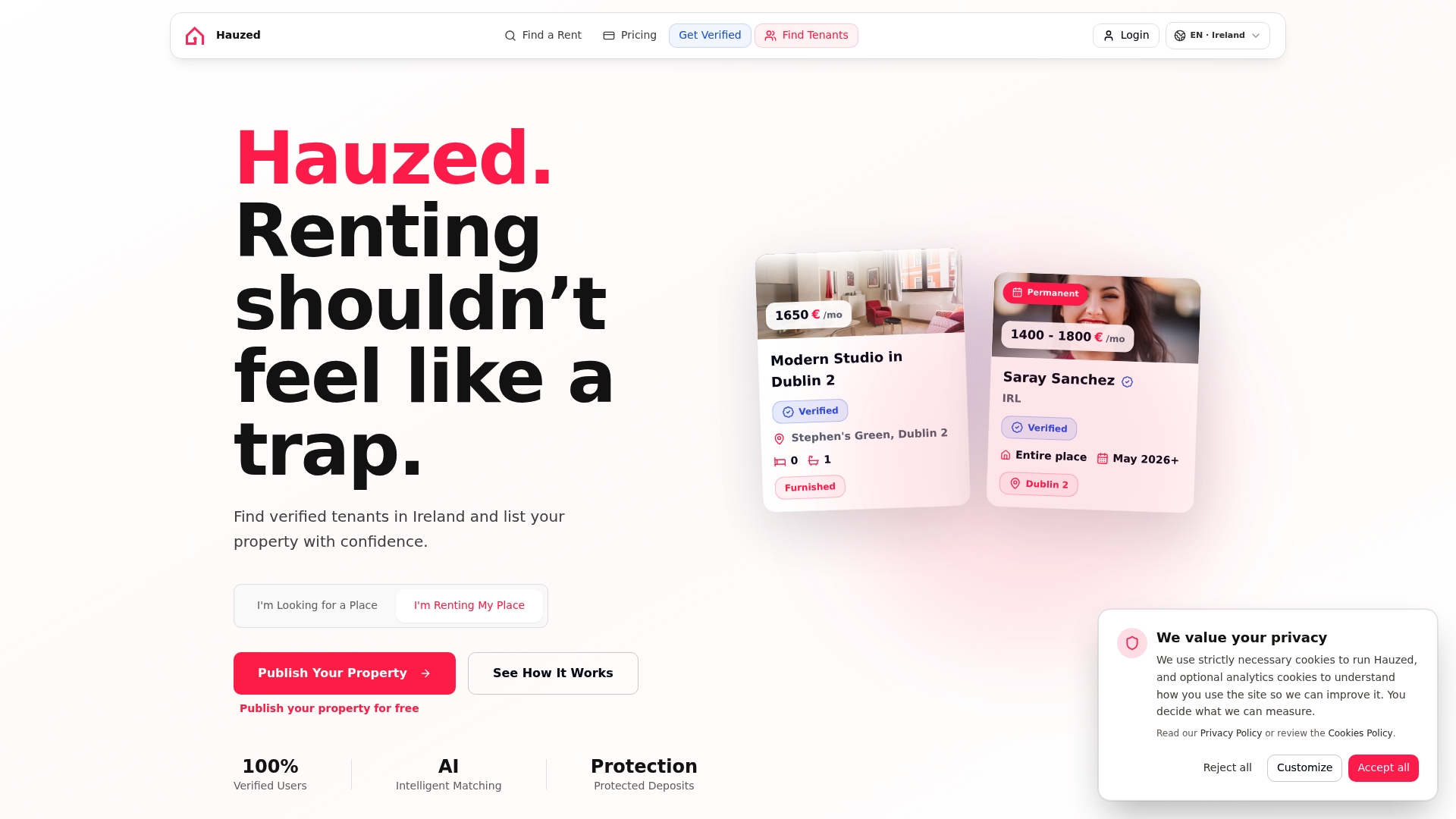
Hauzed builds the date, time, meeting point and contact details directly into the invitation flow, so landlords and agents aren't retyping the same fields into every message. Once a tenant requests a viewing, the invitation carries a secure link for any document upload, keeping ID and reference documents off open chat entirely.
Identity verification sits inside that same flow. It doesn't promise a tenant will pay rent on time, but it does give a landlord a stronger signal than an anonymous message from an unverified number, which is most of what fills a typical inbox.
Hauzer surfaces tenant matches so the invitation goes to people already suited to the property.
Echo drafts smart replies to routine questions about timing or documents, though final approval and sending stay with the landlord or agent.
Lia supports leasing-style conversations for landlords managing higher enquiry volumes, where available.
Pro Tip:Let the automated reply handle the first filter, then send a short, personal invitation once you've reviewed the applicant. Tenants notice the difference between a bot and a human closing the loop.
What actually separates a good viewing invitation from a bad one
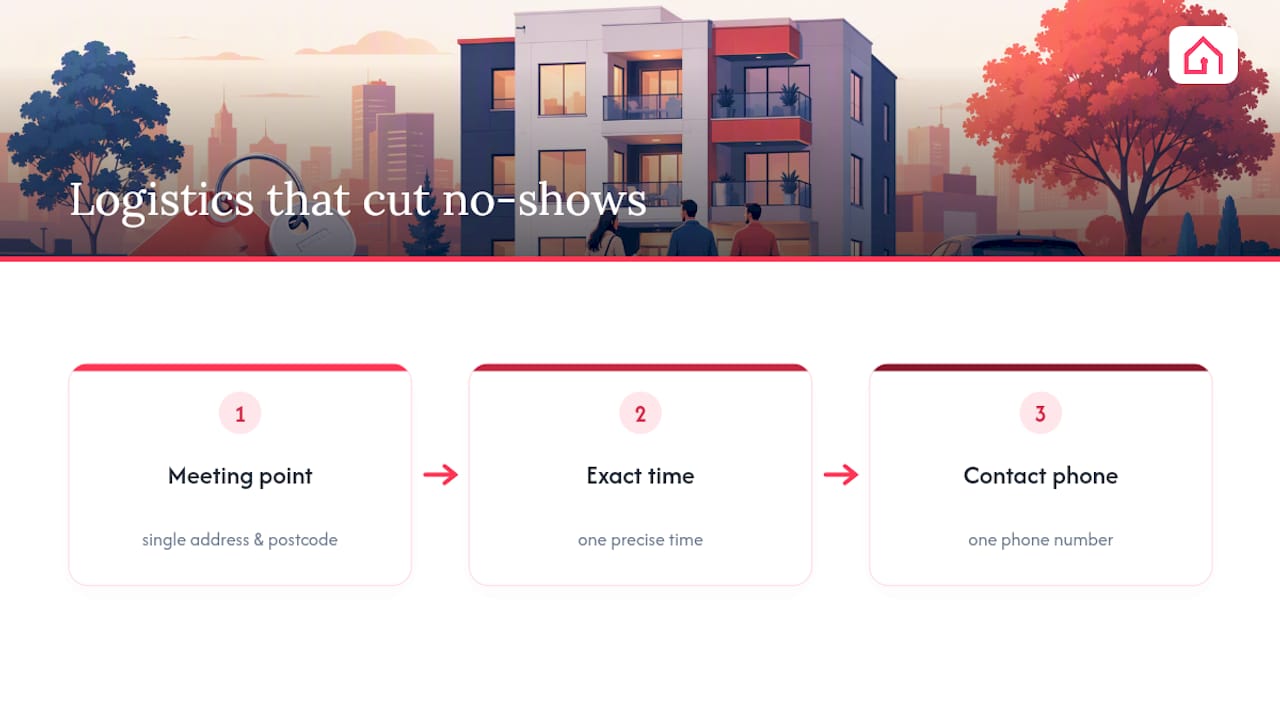
Most advice on this topic focuses on tone, whether a message sounds "friendly enough." That's the wrong lever. The invitations that actually reduce no-shows are the ones with unambiguous logistics: one meeting point, one time, one phone number, stated once and stated clearly.
The conventional wisdom oversells personalisation. Warmth matters far less than a tenant being able to find the flat. A landlord who writes a charming paragraph but omits the postcode has produced a worse message than a blunt template that gets every fact right.
If you take one thing from this guide, prioritise the structure before the script. Get the order right, outcome first, then logistics, then the ask, and even a stiff, slightly robotic message will outperform a warm one that buries the meeting point in paragraph three. Automation helps here precisely because it enforces that order every single time, which is harder for a busy landlord to do manually across dozens of enquiries.
Where readers get this wrong most often is treating documents and verification as an afterthought, tacked on after confirming the slot. Say it early, say it once, and point to a secure upload rather than a chat thread. That single habit prevents more disputes than any amount of polished wording.
— Hauzed
Send fewer messages, fill the property faster
Hauzed is the alternative to juggling SMS threads, email chains and WhatsApp groups for every viewing, because the invitation, the reminder and the document request all live in one workflow instead of three apps. Landlords managing a single property can use Hauzed's Free Plan to send verified invitations without exposing a personal number to every enquiry that comes in.
Agencies handling higher volumes get more from the AI Team, priced at €19.90 per month, which puts Hauzer, Echo and Lia to work on matching tenants, drafting replies and keeping leasing conversations moving without losing the final say over who gets invited. Tenants browsing for their next home can explore current rental listings and build a verified profile before their first viewing request goes out, which tends to get a faster reply than an anonymous message ever will. Set up your first property or your profile today and see how much shorter your message threads get.
What should I include in a viewing invitation message?
Include the date, start time, exact meeting point and a contact number, plus expected duration and one clear action such as "reply to confirm." Mention any documents to bring, like ID or proof of income, so the visit isn't wasted.
How far in advance should I send a viewing invitation?
Send confirmation within minutes of a booking request, then follow with a reminder around 24 hours before and a short nudge a few hours ahead. Offering two or three time windows upfront, rather than one fixed slot, tends to get faster replies.
Can I ask different screening questions to different applicants?
No, asking varied questions between applicants risks discrimination complaints. NRLA recommends a consistent pre-viewing question set covering the same points, such as move-in date and household size, for every enquiry.
Are block viewings a good idea?
Block viewings, short staggered slots within one window, work well when several applicants want the same property. Research on managed viewings finds they reduce no-shows and speed up decisions, since applicants sense competing interest.
Does Hauzed help with sending viewing invitations?
Yes, Hauzed's invitation flow auto-populates the date, time and location and attaches secure links for document uploads, keeping ID off open chat. Pricing details for landlords and agencies are listed on Hauzed's pricing page.