How to find verified landlords in Ireland before you pay a deposit
24 August 2026
17 min read
Ensure a safe rental experience in Ireland by confirming verified landlords before paying deposits. Follow these crucial checks.
Do not pay a deposit until you have confirmed five things: the property's real address, a live viewing of it, the advertiser's identity as owner or PSRA-registered agent, its status on the RTB tenancy register, and a written receipt for anything you hand over. Ireland's rental market moves fast, and both the RTB and An Garda Síochána warn that scammers exploit that urgency to skip exactly these checks.
Run these five before you send a cent:
Address check: confirm the property exists on Google Maps or Eircode Finder, and matches the photos.
Live viewing: insist on an in-person visit or, if you're abroad, a live video walkthrough.
Identity check: confirm whether you're dealing with the owner or a PSRA-licensed agent.
RTB register search: check whether the tenancy is registered at that address.
Written receipt: never hand over money without a signed document naming what it covers.
Key Takeaways
Verifying a landlord's identity, RTB registration, and payment details before you pay a deposit is the single most effective way to avoid rental fraud in Ireland.
Point
Details
Never pay before viewing
Insist on an in-person visit or a live video call showing every room and the advertiser's ID.
Search the RTB register
A "Found = Y" result on the RTB register confirms the tenancy is currently registered.
Confirm agent licensing
Check any letting agent's PSRA number on the public register before engaging further.
Demand written receipts
Never hand over a deposit without a signed receipt naming both parties and what it covers.
Use verified platforms
Hauzed requires identity verification for tenants and verified participation for landlords and agents, reducing anonymous, high-risk contact.
Why verified landlords in Ireland matter more than ever
Rents in cities like Dublin and Cork rarely sit empty for long, and that scarcity is precisely what rental fraudsters count on. When ten people are messaging about the same room, nobody wants to be the one who "wastes time" asking questions, and that hesitation is the opening a scammer needs.
The CCPC's guidance on accommodation scams points to a consistent pattern: fraudulent listings pressure renters to pay before viewing, communicate only through social media, and dodge direct questions about ownership. An Garda Síochána sees the same techniques repeat: fake landlords who "live abroad," urgent countdown timers on offers, and requests for bank transfers to accounts that don't match the name on the lease.
Sticking to official channels does more than dodge a scam. It keeps your tenancy inside the RTB's dispute resolution system, so if a real disagreement over your deposit or repairs arises later, you have somewhere to bring it. Off-the-books arrangements, by contrast, leave you with no register entry and no protection.
Registered tenancies give you access to RTB dispute resolution.
Verified identity reduces the chance you're paying someone with no legal right to let the property.
Following the register habit now protects you for the whole tenancy, not just the deposit stage.
What red flags should make you stop and verify?
Certain behaviours are consistent enough across rental fraud cases in Ireland that they deserve a hard stop, not a shrug.
The landlord won't do a live viewing. Any refusal to show the property in person or on live video, replaced with "just a few photos" or a pre-recorded clip, is the single strongest scam signal there is.
Payment pressure with odd methods. Demands to pay quickly, in cash, via international transfer, or into an account under a different name than the advertiser's, are classic fraud markers.
The listing looks copied. Duplicate photos found on multiple sites, or a rent noticeably below what similar properties in the area are charging, often mean the ad was lifted from elsewhere.
Contact stays inside one platform. If every reply comes through WhatsApp or a Facebook message, with no phone call, no formal contract offered, and vague answers about who actually owns the property, treat that as a warning rather than convenience.
Genuine landlords and PSRA-licensed agents rarely object to being asked for proof. As one Newstalk piece on rental scams puts it, a real landlord won't mind the questions. Scammers rely on urgency and mild intimidation precisely because those tactics stop people from checking.
Step-by-step verification checklist you can follow before paying a deposit
Work through these steps in order. Skipping ahead to "just pay the deposit to hold it" is how most rental fraud in Ireland actually happens.
Pin the address. Search the exact address and Eircode on Google Maps and Eircode Finder. Check whether the same photos appear on short-let sites like Airbnb or Booking.com under a different name. A property listed as a long-term let and a short-term let simultaneously is worth questioning directly.
Arrange a real viewing. In person is best. If you can't attend, insist on a live video call, not a pre-recorded tour. During the call, ask the host to show the front door and house number, walk through every room, step outside to show the exterior from the street, and hold up photo ID to the camera. Take timestamped screenshots as you go. This mirrors the practical approach Threshold's Scamwatch recommends for suspicious lettings.
Establish who you're actually renting from. Ask directly: are they the owner, or a letting agent? Whoever answers should also be the name that appears on your tenancy agreement. If those names don't match later, that's a serious problem.
Search the RTB register. Enter the property address on the RTB's tenancy register check. A result of "Found = Y" confirms the tenancy is currently registered.
Confirm the agent's PSRA licence. If you're dealing with an agent, ask for their PSRA licence number and check it against the PSRA public register. Cross-check that their phone number and email match the domain of their stated business website.
Reverse-image search the photos. Drop the listing's main photos into a reverse image search. If they appear on other sites, under other names or other cities, walk away.
Compare the rent to the local market. A property advertised well below what similar homes in the same area cost is one of the oldest bait tactics going.
Get everything in writing before you pay. You need a written statement of exactly what the deposit covers, who holds it, and a signed receipt with both your name and the landlord's. Pay by traceable bank transfer, never cash, and never to an account whose name doesn't match your landlord or agent.
Ask for proof of right to let. A private landlord should be able to show ID plus proof of ownership; an agent should be able to produce a signed authorisation letter from the owner.
Pro Tip:Screenshot the full listing, the advertiser's profile, and your entire message thread the moment you start seriously considering a property. If something goes wrong later, that timestamped record is often the difference between a resolved dispute and a dead end.
How to check the RTB public register for a tenancy
Go to the RTB's register search tool and enter the property's address or Eircode. Confirm the search and read the result carefully.
"Found = Y" means the tenancy is currently registered, a strong sign the landlord is operating within the rules.
"Found = N" doesn't automatically mean fraud. It can also mean the address is entered slightly differently on the register (missing an apartment number, for instance), or that registration genuinely hasn't happened.
If you get no match, ask the landlord directly for registration confirmation before paying anything. Landlords must register every new tenancy and renew that registration annually, so a legitimate landlord should have an answer ready.
If the answer is vague or defensive, consider reporting your concern to the RTB and holding off on payment.
How to verify a letting agent and what to ask a private landlord
For agents, search the PSRA public register using their licence number, which they should give you without hesitation. A missing or invalid number is a dead stop.
For private landlords, ask for photo ID alongside a document proving ownership, such as a utility bill or mortgage statement in their name, or, for an authorised agent, a signed letter from the owner.
Check that the bank account name for any payment matches the landlord or agent's actual name. A request to pay a "cousin," "assistant," or unrelated third party is a serious warning sign.
Cross-reference a company's CRO number where the landlord operates through a limited company, rather than as an individual.
What you must get in writing before paying a deposit
Get a signed receipt before you hand over a cent, not after. It should state the amount paid, the date, what it covers, and the full names of both parties.
For tenancies covered by the Residential Tenancies Acts, the deposit should not exceed one month's rent. Anything higher is worth questioning directly.
A proper receipt names both parties, the amount, the date, and exactly what the payment covers.
Traceable bank transfers leave a paper trail; cash and informal transfer apps generally don't.
If a landlord wants to hold a "booking deposit" before you've even signed, get written terms on when and how it's refunded if the let falls through.
If you suspect a scam, who do you contact first?
Act immediately once something feels wrong, before evidence disappears or your bank's reversal window closes.
Report it to An Garda Síochária at your local station, and gather every piece of correspondence, adverts, screenshots, and payment confirmations, as Garda fraud guidance recommends. Contact your bank the same day if the payment was recent; reversal is far more likely within the first 24 to 48 hours.
Notify the RTB if you believe a tenancy registration was faked or misrepresented, and contact the CCPC or Threshold's helpline for tailored advice on next steps.
Preserve your evidence. Keep receipts, bank statements, and full copies of the advert and chat history, then report and block the account on whatever platform hosted the listing. Our guide on what to do if you've been scammed in Dublin walks through this in more detail.
How Hauzed helps reduce scam risk for renters in Ireland
Hauzed was built around the same verification job this article describes. Tenants complete identity verification before they can send serious requests, and landlords and agents appear on the platform as verified participants rather than anonymous message senders. Invitations, scheduling, and document uploads happen through the platform itself, not scattered across WhatsApp threads and email attachments.
That structure removes several of the red flags covered above by design: there's no anonymous social-media-only contact, no unverifiable identity, and a documented trail of who invited whom and when.
Pro Tip:Verification improves your odds of dealing with a real, accountable landlord, but it doesn't replace your own viewing, RTB register check, and receipt insistence. Treat it as one strong layer, not the whole checklist.
Understanding the RTB Verified Landlord scheme and its benefits
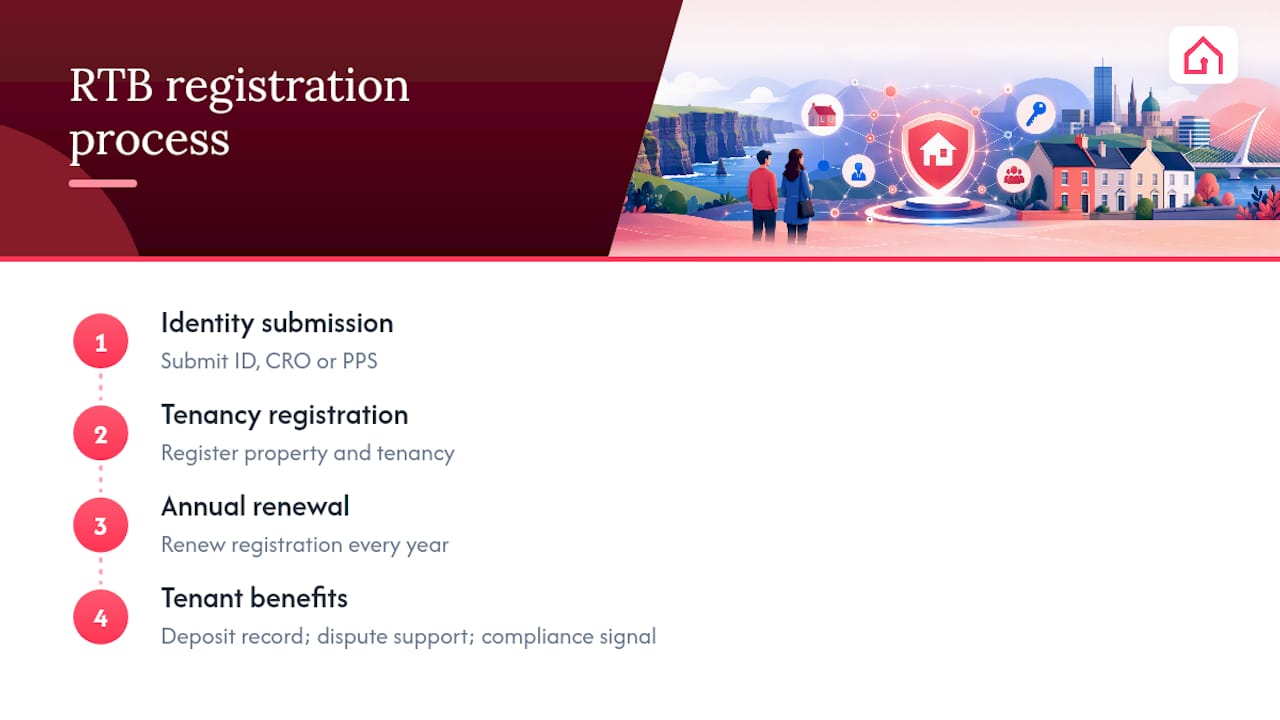
The RTB's registration system is the backbone of verification for anyone renting in Ireland, and it works in the landlord's direction as much as the tenant's. Every landlord letting a residential property must register that tenancy with the RTB and renew it annually, supplying their identity details, CRO or PPS reference, and the property's specifics.
For renters, that register is the fastest way to distinguish a landlord who is operating properly from one who isn't. A registered tenancy means the RTB holds a record of the landlord's identity tied to that specific address, which becomes useful in two ways. First, it gives you a paper trail if a dispute later arises over your deposit, notice periods, or repairs. Second, it signals that the landlord has already gone through a compliance step that scammers, by definition, skip.
The benefit isn't just theoretical. Landlords who register properly are also the ones who tend to follow the rest of the rules, such as capping deposits at one month's rent and issuing proper notice. Landlords who avoid registration entirely are far more likely to cut corners elsewhere too, whether that's ignoring repair obligations or attempting to bypass rent pressure zone limits.
If a landlord can't or won't confirm their registration status when asked directly, treat that hesitation as information in itself.
How do you report a landlord who isn't verified or breaches tenancy law?
Unregistered tenancies and breaches of tenancy law aren't just an inconvenience, they're something you can formally escalate, and knowing the right channel matters.
If you believe a landlord has never registered your tenancy, you can raise this directly with the RTB, which has enforcement powers to pursue non-compliant landlords, including sanctions for failing to register. This is separate from a scam report. A landlord might be entirely real and still be breaking the law by never registering, and the RTB is the correct body for that specific complaint.
If the issue is a tenancy law breach rather than registration, such as an illegal deposit demand, a refusal to return a deposit without cause, or an unlawful eviction attempt, the RTB's dispute resolution service is designed exactly for this. You'll need your tenancy agreement, payment records, and any written correspondence to support your case.
Where the situation looks more like fraud than a compliance gap, for instance a landlord using a false identity or letting a property they don't own, that goes to An Garda Síochána, not the RTB. The two bodies handle different problems: RTB for tenancy law and registration, Gardaí for criminal fraud. If you're unsure which applies, Threshold's helpline can help you work out where to direct your complaint.
What rights and responsibilities do landlords and tenants have?
Irish tenancy law sets out obligations on both sides, and knowing them helps you spot when something's being skipped, not just after a scam, but in an entirely legitimate tenancy that's still being run poorly.
Landlords must register the tenancy with the RTB, provide a property that meets minimum physical standards, give proper written notice before ending a tenancy, and return the deposit within a reasonable timeframe once the tenancy ends, provided the property is left in good condition and rent is fully paid. They cannot demand a deposit exceeding one month's rent for covered tenancies, and they cannot enter the property without notice except in emergencies.
Tenants, in turn, are responsible for paying rent on time, keeping the property in reasonable condition, allowing reasonable access for inspections or repairs with proper notice, and not subletting without permission unless the tenancy agreement allows it.
Both sides benefit from having these obligations written into a signed tenancy agreement from day one, not left as a verbal understanding. A landlord who resists putting standard terms in writing, or who claims none of this applies to "informal" arrangements, is often signalling something worth questioning before you've even reached the scam checklist above.
What other ways can you verify a landlord's identity?
The RTB register confirms whether a tenancy is registered, but it doesn't independently confirm who you're actually dealing with, which is why layering on additional identity checks matters.
Ask for government-issued photo ID and compare the name against any documents you're given, including the tenancy agreement itself. For landlords letting through a limited company, ask for the company's CRO (Companies Registration Office) number and check it against the CRO's public search, which will show the registered directors and confirm the company actually exists.
If a letting agent is involved rather than the owner directly, confirm their PSRA licence number on the PSRA public register and ask for a signed authorisation letter from the property owner naming that agent specifically for your property. An agent who can't produce this, or who claims it's "not necessary," is one you should be cautious about.
A useful practical test: does the name on the bank account you're asked to pay match the name on the ID, the tenancy agreement, and the CRO or PSRA record? Any mismatch between these should stop you before you pay anything.
How does verification affect tenancy security and disputes?
Verification isn't just a pre-payment safeguard, it shapes what happens if things go wrong months into your tenancy.
A registered, properly documented tenancy gives you standing to bring a case to the RTB's dispute resolution service over deposit retention, repair obligations, or improper notice. Without registration, or without a clear paper trail of who you actually agreed terms with, you're in a far weaker position if a dispute arises, because there's no official record connecting your payments to a specific, accountable landlord.
This is where the verification steps in this article compound over time. A landlord you've confirmed on the RTB register, whose PSRA licence checked out, and whose bank details matched their identity, is one you can name, locate, and pursue through a formal process if needed. A landlord you never verified is often one you can't even reliably identify once a dispute starts, which makes any RTB complaint or Garda report far harder to progress.
Documentation gathered during verification, screenshots, receipts, signed agreements, becomes the evidence base for any later claim. Renters who skip verification at the start frequently find they have nothing solid to bring forward when a genuine dispute emerges.
What the checklist gets right, and where it still falls short
The official guidance from the RTB, PSRA, and CCPC is sound, but it assumes a renter has the time and confidence to run six or seven separate checks across different websites while under pressure to secure a home before someone else does. That's the real gap. Most rental fraud doesn't succeed because renters don't know they should check the RTB register. It succeeds because checking takes time they feel they don't have.
The conventional advice also treats verification as a one-off gate at the deposit stage, rather than something that shapes the whole tenancy. A landlord you've properly verified is one you can actually hold accountable months later if a dispute arises. That's worth as much as the upfront scam protection.
What renters should prioritise first isn't the reverse-image search or the CRO lookup, it's the RTB register check and the live viewing. Those two alone eliminate the majority of fraudulent listings, and they take under ten minutes combined.
— Hauzed
Find verified rental listings in Ireland without the guesswork
The checklist above works, but running six separate checks across the RTB register, PSRA database, maps, and reverse image search for every listing you're serious about takes real time, time you often don't have in a competitive market. Hauzed removes that repeated manual work by verifying identity on both sides of the marketplace before you ever start messaging.
Tenants complete identity verification once, then browse listings from landlords and agents who've done the same, rather than starting every conversation from zero trust. Invitations, viewing schedules, and document uploads all happen inside the platform, with a documented trail if you ever need to refer back to it. That's a structurally different starting point than an anonymous Facebook Marketplace message or a listing site with no verification layer at all.
If you're currently searching for a home in Dublin or elsewhere in Ireland, browse verified rental listings on Hauzed and see how the process compares to what you've been doing so far.
This article is general information, not a substitute for advice from a qualified financial advisor. Consult a qualified financial professional about your own circumstances before acting on anything here.
How do I check if my landlord is registered in Ireland?
Search the property's address or Eircode on the RTB's public register. A "Found = Y" result confirms the tenancy is currently registered.
What is the six-year rule on rental property?
This refers to Part 4 tenancy protections, where after six years of continuous occupation, tenants historically gained stronger rolling protections against termination, though tenancy law has evolved, so check current RTB guidance for your specific situation rather than relying on the older rule alone.
What are the biggest red flags when renting in Ireland?
Refusal to allow a viewing, pressure to pay quickly, requests for cash or third-party bank transfers, and listings only reachable through social media are the clearest warning signs.
Can I get scammed even if a listing looks professional and verified?
Yes. Professional-looking photos and a polished ad don't confirm identity or ownership, which is why an RTB register check and PSRA licence verification matter more than how convincing a listing appears.
Does Hauzed guarantee I'll avoid rental scams?
No platform can guarantee that, but Hauzed's identity verification for tenants and verified participation for landlords and agents removes much of the anonymity that scammers depend on.