Discover what is short-term rental in Ireland for 2026. Learn new regulations and ensure a smooth booking experience for your stay.
A short-term rental in Ireland is defined as paid accommodation offered for stays of up to and including 21 nights, and from december 2026, every host must register with Fáilte Ireland and display a unique registration number on all listings. This new legal framework changes what it means to rent short-term in Ireland, whether you are a tourist booking a city-centre apartment, a business traveller needing a flexible base, or an expatriate arriving in Dublin and searching for temporary accommodation while you secure a long-term home. Understanding the rules protects you as a renter and helps you spot legitimate, compliant properties before you book.
What is short-term rental in Ireland?
Short-term rental, formally called short-term letting under Irish law, is paid accommodation provided for a continuous period of 21 nights or fewer. The category covers entire homes, self-contained apartments, and individual rooms within a host's principal private residence. It does not cover hotels, guesthouses, or registered bed-and-breakfast establishments, which sit under separate licensing frameworks.
The Irish government introduced the Short-Term Letting and Tourism Bill 2025 to bring the sector under formal oversight. The policy goal is twofold: protect long-term housing supply by tracking units removed from the residential market, and align Irish law with EU short-term rental regulations that require member states to collect and share data on tourism accommodation. Both goals matter to you as a renter, because they directly affect how many verified properties are available and how easy it is to confirm a listing is genuine.
The registration requirement applies to hosts, not guests. As a renter, you benefit from the system because compliant listings carry a traceable registration number. That number is your first signal that a property is legitimate.
What are the 2026 registration requirements for hosts?
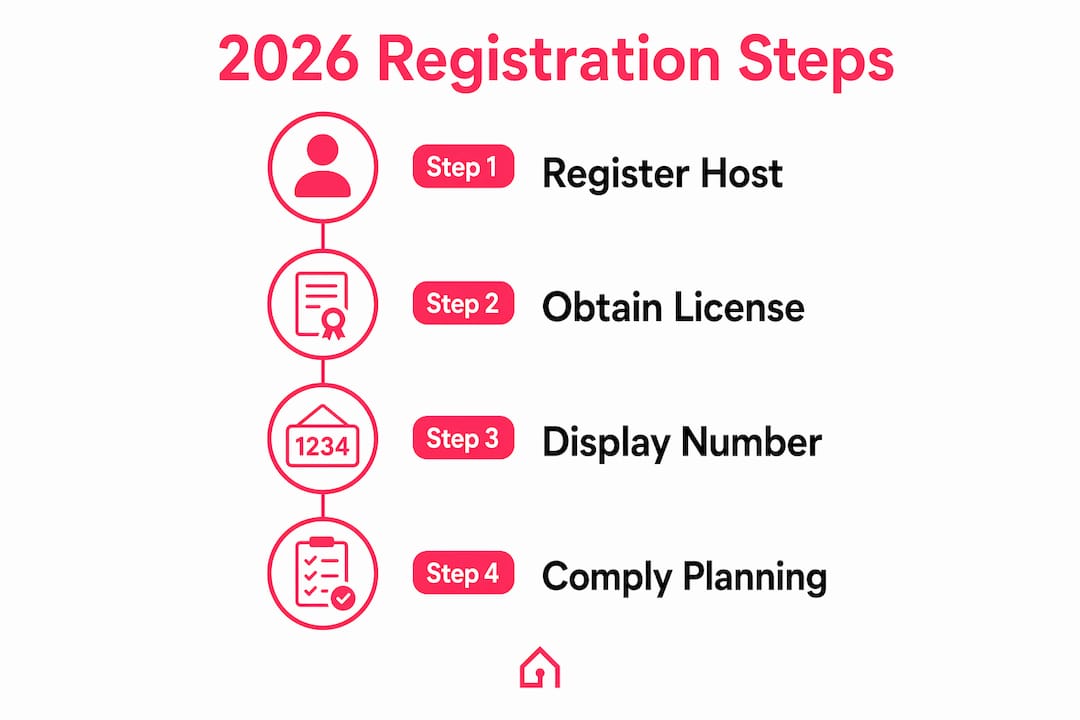
The registration framework under the Short-Term Letting and Tourism Bill 2025 comes into full effect on 1 december 2026. Here is how it works in practice.
Register with Fáilte Ireland. Hosts apply through the Fáilte Ireland online portal and receive a unique registration number.aspx) for each property unit they intend to let.
Related Topics
#what is short-term rental ireland#manage short-term rentals Ireland#how to rent short-term in Ireland#short-term accommodations in Ireland#Ireland rental market overview#benefits of short-term rentals#popular short-term rental sites#short-term rental definition#short-term rental regulations Ireland#short-term vs long-term rentals
Related Articles
Display the number on every listing. The registration number must appear on all booking platforms and advertisements from 31 december 2026. A listing without a visible number is non-compliant.
Make a statutory declaration. Hosts confirm the accuracy of their registration details through a formal statutory declaration. This is a legal statement, not a simple tick-box.
Renew annually. Registration is not a one-off process. Hosts must renew each year through the Fáilte Ireland portal and reconfirm their details.
Comply with unit-type definitions. Irish law distinguishes between a host, a unit, and a unit type. A host renting two separate apartments must register each unit individually.
The legal definitions matter because they determine which exemptions apply and what planning conditions a host must satisfy. If a registration number is missing from a listing you are considering, treat that as a red flag.
Pro Tip:Before booking any short-term accommodation in Ireland after december 2026, search the Fáilte Ireland register to verify the registration number shown on the listing. A few seconds of checking can save you from a fraudulent booking.
Do short-term lets in Ireland require planning permission?
Planning permission is one of the most misunderstood aspects of short-term letting in Ireland. The requirement depends on where the property is located and how the host uses it.
Rent pressure zones. Hosts in designated rent pressure zones must obtain planning permission to change a residential property's use to short-term tourism accommodation. Without it, the letting is unauthorised.
Principal private residence exemption. A host renting a room within their own home, where they also live, does not need planning permission. This is the home-sharing exemption.
Temporary absence exemption. A host can let their entire principal private residence for fewer than 90 days per year while temporarily away without requiring planning permission. Beyond 90 days, permission is needed.
Retention permission. If a host has already been letting a property without the required permission, they can apply for retention permission from the local authority. Approval is not guaranteed.
Enforcement risk.Failure to obtain required permissions can result in enforcement action by the local authority, including penalties and orders to cease the letting.
As a renter, you are not personally liable for a host's planning status. However, a property operating without permission could be shut down mid-booking, leaving you without accommodation. Checking the registration number reduces this risk considerably.
Pro Tip:If you are unsure whether a property you are considering sits in a rent pressure zone, the Residential Tenancies Board (RTB) publishes an up-to-date map of designated zones on its website.
How short-term rentals fit into Ireland's accommodation market
Short-term rentals serve a specific and practical role in Ireland's accommodation ecosystem. They are not a permanent housing solution. They are a bridge, particularly for expatriates and new arrivals who need a base while conducting an active housing search.
Active housing searches in Dublin typically take one to three months. Short-term lets provide a 2–4 week base from which you can attend in-person viewings, which landlords in Ireland strongly prefer over remote applications. Cities like Dublin, Cork, and Galway have competitive rental markets where renters who attend viewings with prepared documentation have a measurably higher success rate than those applying remotely.
Here is how short-term lets compare to other accommodation options for newcomers:
Accommodation type
Typical stay
Best suited for
Key limitation
Short-term rental
1–4 weeks
New arrivals, expats, business travellers
Higher nightly cost than long-term renting
Hotel or serviced apartment
1–7 nights
Short business trips, tourism
Expensive for stays beyond one week
Long-term rental
6–12 months
Settled residents, students
Requires local references and viewings
Hostel or shared room
1–14 nights
Budget travellers, students
Limited privacy and workspace
Short-term lets offer more space and kitchen facilities than most hotels, at a lower nightly rate for stays of one week or more. That makes them the practical choice for anyone arriving in Ireland for the first time and needing a few weeks to get organised.
The most successful expats plan an initial short stay of 2–4 weeks specifically to conduct viewings in person. Trying to secure a long-term rental from abroad, before you have a local address or can attend viewings, is genuinely difficult in Dublin's market.
Book your short-term rental before you arrive, not on arrival day.
Choose a location close to the area where you want to live long-term.
Use the address for correspondence during your search.
Attend every viewing you can, and bring your documents.
For practical guidance on finding accommodation quickly, preparation is the single biggest factor in shortening your search.
How to find and rent short-term accommodation in Ireland safely
Finding a short-term rental in Ireland is straightforward if you know what to look for. The 2026 registration requirement makes verification easier than it has ever been.
Check for a registration number. From december 2026, every compliant listing must display a Fáilte Ireland registration number. If a listing does not show one, ask the host directly. No number means no compliance.
Use established booking platforms. Reputable platforms are required to display registration numbers alongside listings. Avoid booking through informal channels such as social media groups or messaging apps, where scam listings are more common.
Verify the address independently. Cross-reference the property address with Google Maps or Street View. Scam listings often use photos of real properties at incorrect addresses.
Never send payment outside a secure platform. Legitimate hosts do not ask for bank transfers to hold a property. Use the payment system provided by the booking platform.
Prepare your documentation in advance. Even for short-term stays, having your passport, proof of employment, and a reference from a previous landlord ready speeds up the process and signals that you are a serious renter.
Pro Tip:Build a rental portfolio before you arrive in Ireland. A prepared rental portfolio containing your passport, an employer reference, a previous landlord reference, and recent bank statements significantly increases your chances of securing accommodation quickly in competitive cities.
Your tenant rights in Ireland as a short-term renter differ from those of long-term tenants. Short-term renters do not have the same security of tenure protections under the Residential Tenancies Act. Your rights are primarily governed by the booking contract you sign with the host or platform. Read it carefully before paying.
Key takeaways
Short-term rental in Ireland is a legally defined, regulated category requiring Fáilte Ireland registration from december 2026, and using it strategically as a 2–4 week bridge gives new arrivals the best chance of securing long-term accommodation.
Point
Details
Legal definition
Short-term letting covers paid stays of 21 nights or fewer, including entire homes, apartments, and rooms.
2026 registration
All hosts must register with Fáilte Ireland and display a unique number on every listing from december 2026.
Planning permission
Hosts in rent pressure zones need planning permission unless the principal private residence exemption applies.
Strategic use for newcomers
Book a 2–4 week short-term rental on arrival to attend viewings and build a local address before securing long-term housing.
Renter safety
Always verify the registration number, use secure payment platforms, and prepare documentation before arriving.
Ireland's short-term rental rules are a step forward, not a burden
From Hauzed's perspective, the 2026 registration requirement is genuinely good news for renters. The Irish rental market has long had a transparency problem. Anonymous listings, unverified hosts, and informal booking channels created real risks for anyone arriving in Ireland without local knowledge.
The Fáilte Ireland register changes that dynamic. When every compliant listing carries a traceable number, you have a concrete way to separate legitimate properties from fraudulent ones. That is not a bureaucratic inconvenience. It is a practical safety tool.
What concerns us more is the gap between regulation and awareness. Many renters arriving in Ireland in 2026 will not know the registration requirement exists. They will book through informal channels, skip the verification step, and only discover the problem when something goes wrong. The challenges of finding accommodation in Ireland are already significant without adding avoidable scam risk on top.
Our advice is simple: treat the registration number as non-negotiable. If a listing does not show one after december 2026, walk away. The short-term rental market in Ireland is moving toward greater accountability, and renters who understand the new rules will be far better positioned than those who do not. For anyone planning a longer stay, read our expat rental guide for Ireland before you book your first night.
— Hauzed
Hauzed: verified rentals for a safer search in Ireland
Finding short-term accommodation in Ireland is easier when you know the listings are real and the process is secure.
Hauzed is a trust-first rental marketplace connecting verified renters with landlords and property agencies across Ireland, starting with Dublin. Every renter on Hauzed completes identity verification, which means landlords see real profiles rather than anonymous messages. For renters, that verification builds credibility and helps you stand out in a competitive market. Whether you are searching for a short stay on arrival or ready to move into a long-term rental in Ireland, Hauzed gives you a safer, more organised way to search. Browse verified listings and start your search with confidence at Hauzed.
FAQ
What is the legal definition of a short-term rental in Ireland?
A short-term rental in Ireland is paid accommodation provided for a continuous stay of 21 nights or fewer. The category covers entire homes, apartments, and rooms within a host's principal private residence.
When does the Fáilte Ireland registration requirement start?
All hosts must register with Fáilte Ireland.aspx) and display a unique registration number on all listings from 1 december 2026. Registration renews annually.
Do I need planning permission to let my home short-term in Ireland?
Hosts in rent pressure zones generally need planning permission unless they qualify for the principal private residence exemption. Letting a room in your own home or letting your entire home for fewer than 90 days while temporarily away are the main exemptions.
How can I verify a short-term rental listing is legitimate in Ireland?
Check that the listing displays a valid Fáilte Ireland registration number, use a reputable booking platform, and never transfer payment outside a secure system. A missing registration number after december 2026 is a clear warning sign.
Are short-term rentals suitable as permanent accommodation in Ireland?
Short-term rentals are not designed as a permanent housing solution. They work best as a 2–4 week base for new arrivals conducting in-person viewings while searching for long-term housing in Ireland.