Win Landlord Permission for Pets in Ireland with Verified Templates
9 September 2026
10 min read
Private landlords can still refuse pets. Learn how to win written permission in Ireland with ready addendum templates, verified-application tips, deposit...
Private landlords in Ireland can still say no to pets, and there is no statutory right for tenants to keep one. The government has committed to removing blanket bans in social and council housing, but that change has not been extended to private lets. Your best move today is simple: ask in writing, offer evidence, and get any "yes" written into your tenancy agreement.
TL;DR:
Private landlords in Ireland can legally refuse pets, and there is no current legal obligation for them to allow pets in private rentals.
The government's plan to remove blanket bans applies only to social housing and does not extend to private landlords, keeping pet decisions at their discretion.
Tenants should submit a detailed, written request with supporting evidence and a specific pet addendum before moving in to improve their chances of approval.
Landlord concerns typically include insurance issues, health and safety, and building policies, which can be addressed through reasonable conditions but not by charging extra deposits.
A pet owner's best approach involves verified application platforms that allow attaching vet records and references, increasing the likelihood of getting a positive response from landlords.
#Ireland pet-friendly lease agreements#pet-friendly accommodations Ireland#renting with pets in Ireland#Ireland rentals for pet owners#pets allowed housing Ireland#Ireland housing pet policy#finding pet-friendly rentals Ireland#pet policy rentals ireland#pet policies for renters Ireland#rentals that allow pets Ireland#Ireland rental pet restrictions#pet friendly rentals ireland#renting with pets ireland
What the recent pet policy changes for rentals in Ireland actually mean
If you have seen headlines about pet bans being scrapped, it is worth being precise about who that actually covers. The government's 2025 housing plan commits to removing blanket bans on pets in social housing and Approved Housing Body (AHB) properties. It does not, at this stage, touch the private rental sector where most tenants in Ireland actually live.
The Residential Tenancies Acts, which govern private tenancies, say nothing about animals at all. That silence is the whole story: without a specific statutory protection, the decision defaults to whatever the landlord and tenant agree, usually through the lease itself.
Parliamentary written answers from February 2026 confirm a Working Group is reviewing the AHB Code of Practice, with completion expected in the second half of 2026. Crucially, those same answers state there is currently no plan to extend the ban removal to private rentals. So where does that leave things right now?
Social housing and AHB tenants: reform is underway, with a review timetable running through H2 2026.
Private tenants: no change to your legal position, pets remain a matter for your lease.
Landlords: still free to set their own pet policy in a private tenancy agreement.
How to ask your landlord for permission to keep a pet
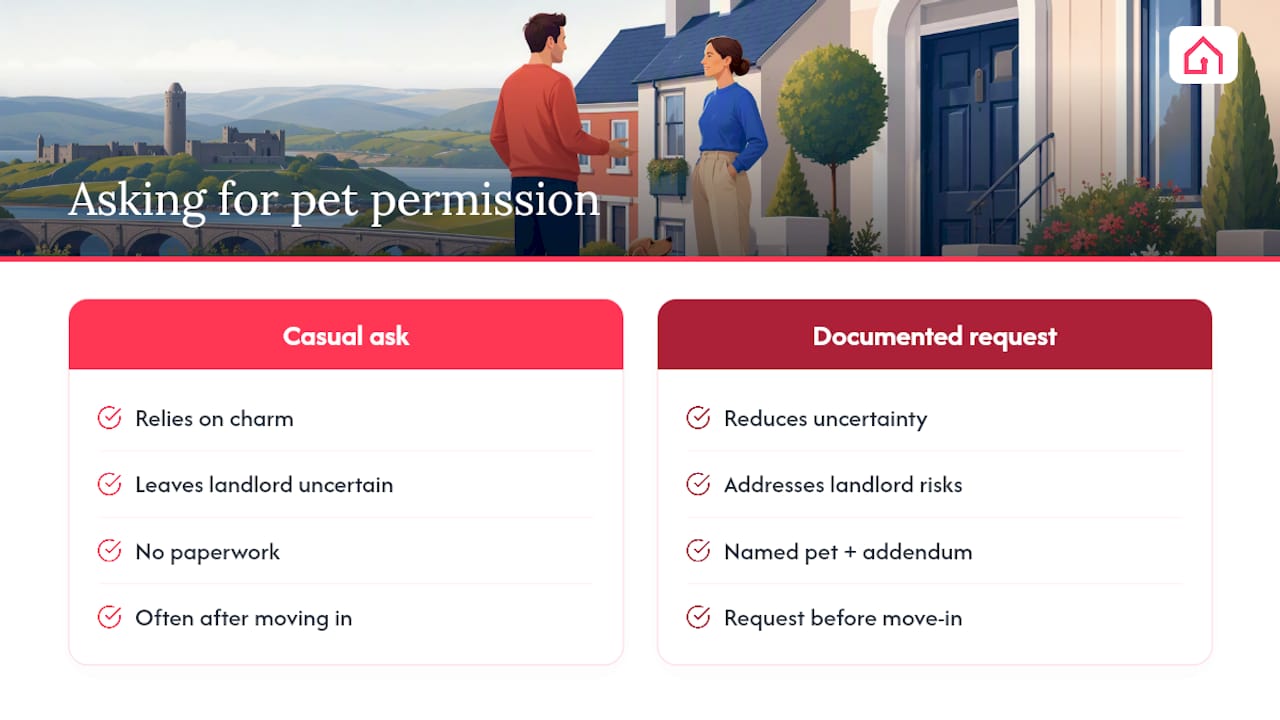
A vague text message asking "would you mind if I got a dog?" rarely lands well. Landlords respond better to a clear, documented request that shows you have thought it through, so treat this like a mini-application rather than a casual favour.
Write, don't just ask verbally. Email or use the messaging system in your tenancy platform so there is a timestamp and a paper trail.
Name the animal specifically. State the breed, size, age, and whether it is house-trained or neutered where relevant.
Attach supporting evidence. Photos of the pet, vet records, proof of neutering, and a reference from a previous landlord if you have one.
Propose a written addendum, not just a verbal yes, covering scope (one named pet only), cleaning standards, liability for damage, and a requirement that you notify the landlord if the pet changes.
Follow up if you get a verbal yes. Ask for it in an email or added clause before the pet moves in. Verbal permission is far harder to prove later if a dispute arises.
A workable addendum sentence might read: "The tenant may keep one [breed/species], currently [age], on the premises, subject to the tenant maintaining the property to a reasonable standard and being liable for any damage directly attributable to the pet." Keep it specific and reasonable. Landlords are more likely to agree to a narrow, well-defined clause than an open-ended one.
Pro Tip:Ask before you bring the pet home, not after. Retrospective requests put the landlord in a corner, and refusal becomes the easy default answer.
Timing matters as much as wording. Requesting permission at application stage, alongside a strong tenant profile, tends to get a faster and more favourable response than raising it once you have already signed the tenancy agreement.
What landlords can lawfully refuse or require
Landlords are not being unreasonable simply because they say no. Several concerns come up repeatedly, and most are entirely legitimate:
Insurance policies that exclude pet-related damage or increase premiums.
Health and safety concerns in shared buildings, particularly around allergies or previous nuisance complaints.
Owners' management company rules that prohibit pets outright, regardless of the landlord's own preference.
A demonstrable history of noise complaints or property damage from pets at the same address.
Where a landlord is open to pets, reasonable conditions might include restricting the number or type of animal, requiring professional cleaning at the end of the tenancy, or asking for proof of pet insurance. What a landlord cannot do is charge a separate pet deposit on top of the standard cap, a point covered in detail below.
Written terms protect both sides. A landlord with a signed addendum has clear grounds to act if damage occurs; a tenant with the same document has proof that permission was granted and on what basis.
Apartments and OMCs: why your landlord's yes might not be enough
If you live in an apartment complex, your landlord agreeing to a pet is only half the picture. Owners' management companies (OMCs) set house rules that apply to the whole building, and many still prohibit pets regardless of what individual landlords think.
Before assuming you are covered, check the following:
Ask your landlord for a copy of the current OMC house rules, not just their own opinion of them.
Get written confirmation from the landlord that a pet is compliant with those rules, not just with their personal lease.
If the rules are silent or ambiguous, consider asking the OMC directly for a written exemption for your specific case.
Ignoring house rules because your landlord said yes is a risk you carry alone. An OMC can still pursue a complaint, and that can escalate into a notice of breach even where your landlord was fully supportive.
Deposits, damage and insurance: the money questions
Deposit law in Ireland is straightforward on this point: the total deposit cannot exceed one month's rent. A landlord cannot add a separate "pet deposit" on top of that figure, no matter how the request is phrased.
At tenancy end, a landlord can claim against the deposit for pet-related damage, but only with evidence, such as photos, an inventory comparison, or repair invoices.
Insurance is worth raising early. Some landlord policies exclude pet damage, and asking a tenant to hold their own pet liability cover is a reasonable middle ground rather than a red flag.
Low-cost mitigations help your case: keep receipts for professional carpet cleaning, and request a written reference confirming your pet has caused no prior issues.
If a dispute arises: evidence, the RTB, and where to get help
Keep dated written permission, photos of the property's condition before move-in, cleaning receipts, and any vet or reference documents together from day one.
The Residential Tenancies Board handles disputes over deposit retention and breach of tenancy terms, and expects clear documentary evidence before mediation or adjudication.
Gov.ie and tenant rights guides outline the formal complaint route step by step.
Local advice charities can help you prepare a case if you are unsure how to present your evidence to the RTB.
How verified applications change the pet-request conversation
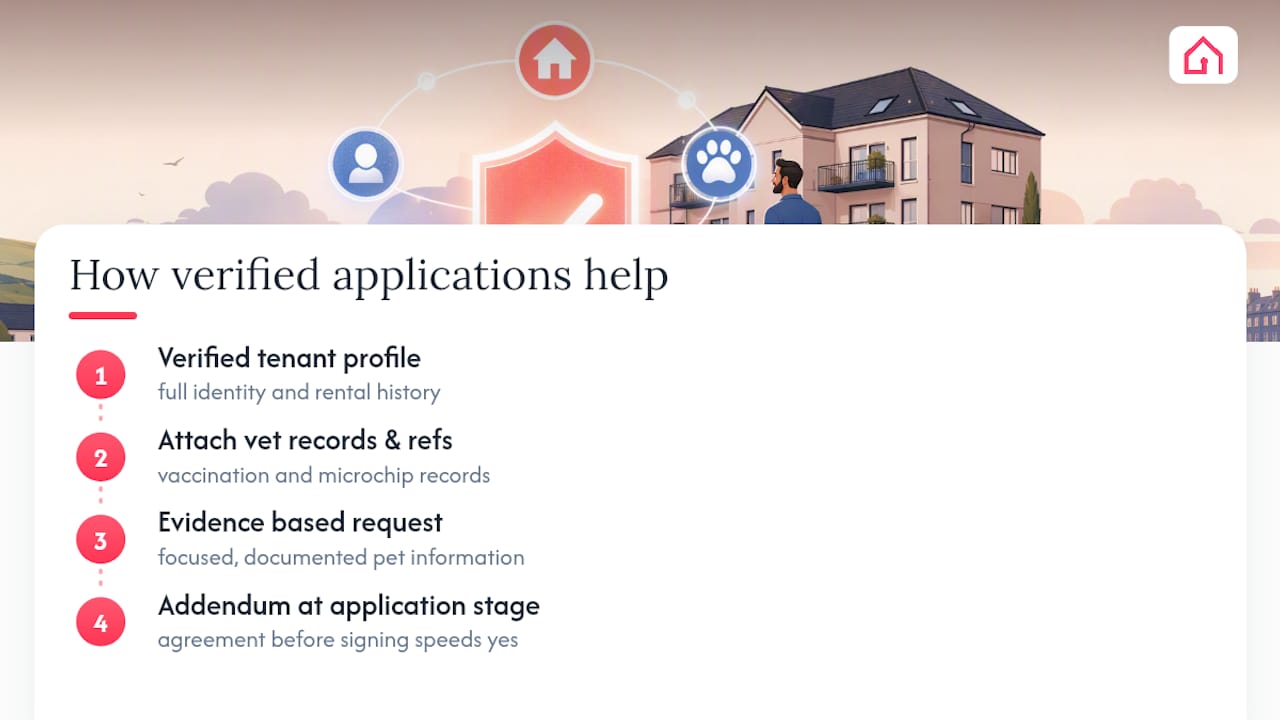
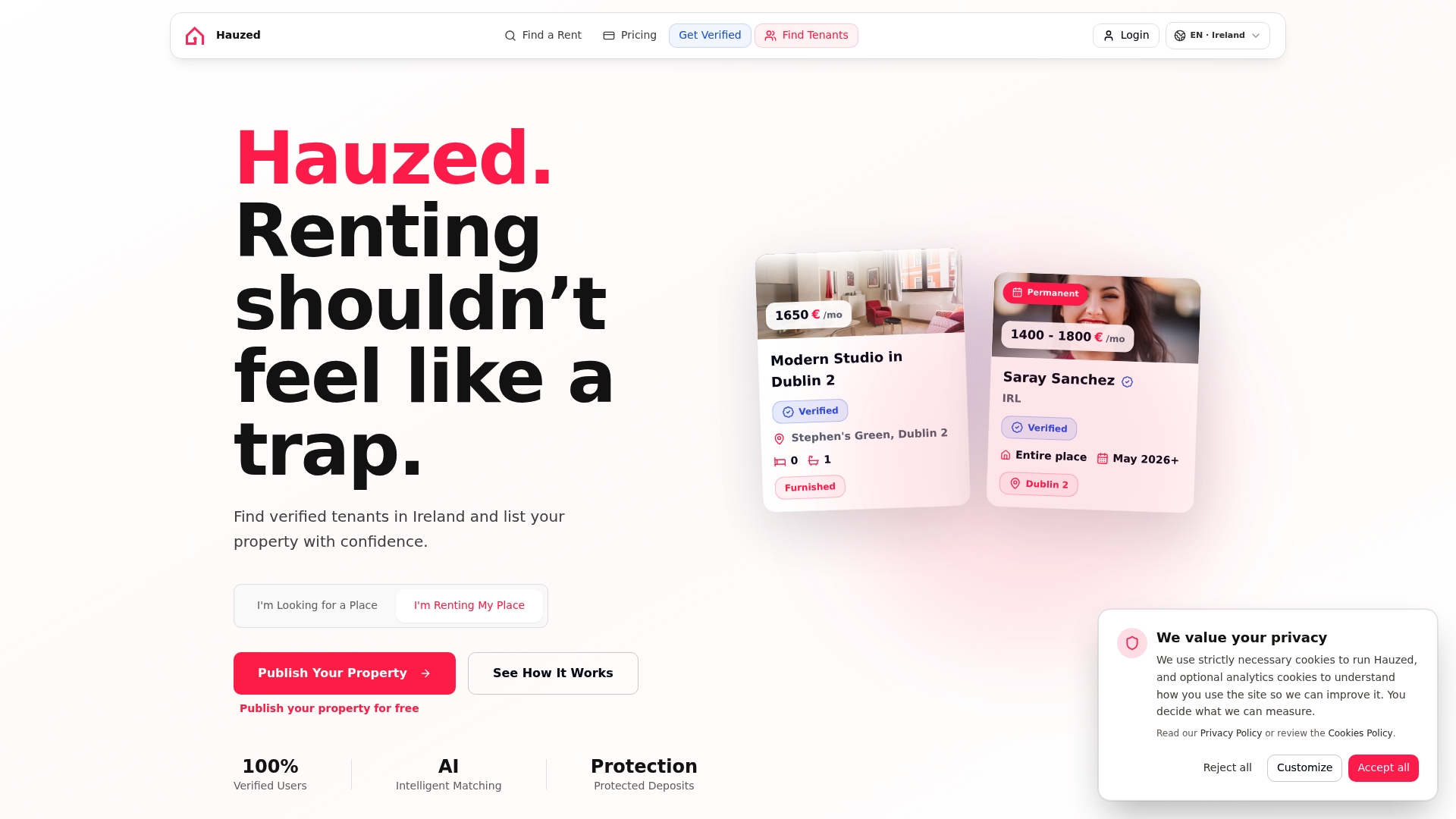
Landlords hesitate over pets mainly because they cannot judge risk from a one-line message. A platform like Hauzed lets tenants build a verified profile, attach vet records or references, and send a focused, evidenced request rather than an anonymous ask. Pairing that profile with a clear pet addendum at application stage, rather than after signing, is exactly the sequencing that tends to get a faster yes.
Why the "just ask nicely" advice misses the point
Most guidance on pets and rentals in Ireland stops at "ask your landlord," as if the outcome depends purely on charm. It does not. It depends on whether you remove the landlord's uncertainty, and uncertainty is what drives refusals, not dislike of animals.
The policy shift toward social and AHB housing is genuinely useful, but treating it as a sign that private rental rules are loosening is a mistake that will cost tenants time and goodwill. Nothing in current law obliges a private landlord to say yes, and no parliamentary answer suggests that is about to change soon.
What actually moves the needle is documentation: a named pet, a written addendum, evidence of past good behaviour, and a request made before you move in rather than after. Tenants who treat a pet request as a mini-application, backed by proof rather than promises, consistently do better than those who simply hope for the best. That is the gap between what most advice says and what actually works.
— Hauzed
Start your search for a pet-friendly rental with a stronger application
Hauzed is the alternative to sending scattered messages and hoping a landlord notices you among dozens of enquiries: build one verified profile, attach your pet's vet records once, and send a focused request instead of chasing replies across five different channels.
Setting up a tenant profile takes minutes. You can verify your identity, upload supporting documents like vet records or a previous landlord reference with proper consent, and send a clear pet request directly to landlords through the platform's chat and request tools. That combination, a verified profile plus documented evidence, is exactly what reduces landlord hesitation in the first place. Create your profile on Hauzed and attach your pet documentation before you send your next enquiry.
Yes. Private landlords have no statutory obligation to allow pets, so refusal is legal unless your tenancy agreement already grants permission.
How do you get around a no-pet policy?
You cannot legally bypass a landlord's refusal, but a strong written request with evidence, references, and a proposed addendum often turns an initial no into a conditional yes.
What are the new rental pet rules in Ireland from 2026?
The main change is a commitment to remove blanket pet bans in social and AHB housing, with a Code of Practice review due in the second half of 2026. It does not currently extend to private rentals.
What is the six-year rule on rental property in Ireland?
This refers to Part 4 tenancy rights, where a tenancy can build up rolling security of tenure over set periods, but it does not create any specific right to keep a pet during that tenancy.
Can a landlord charge a separate pet deposit?
No. Total deposits are capped at one month's rent, and an additional pet deposit on top of that cap is not permitted under Irish tenancy law.