Protect Holding Deposits in Ireland: One Month Max and RTB Limits
2 September 2026
11 min read
Know what to demand and record before you pay: one month deposit limit, two month upfront cap, RTB vs Small Claims, receipts, bank transfers and...
A holding deposit only reserves a property before your tenancy starts, so the Residential Tenancies Board (RTB) has no power to help you get it back if a landlord keeps it unfairly. A security deposit, paid once you move in, is different: it stays your legal property, and under the Residential Tenancies (No. 2) Act 2021, it cannot exceed one month's rent, with total upfront payments capped at two months for tenancies from 9 August 2021. Recover a withheld security deposit through the RTB; recover a withheld holding deposit through the Small Claims Court.
TL;DR:
Holding deposits are not legally protected by the RTB and are subject to dispute in the Small Claims Court if unfairly kept, unlike security deposits.
The maximum combined upfront payment for a tenancy starting after August 9, 2021, is two months' rent, with no more than one month's rent as a security deposit.
Always obtain a signed receipt and confirm who is holding your deposit in writing, paying by bank transfer rather than cash to ensure a record.
Landlords can lawfully withhold a security deposit only for unpaid rent, damages beyond normal wear and tear, or unpaid bills, and must provide evidence for deductions.
Using verified rental platforms like Hauzed reduces deposit risks by providing traceable communication and identity checks on both tenants and landlords.
Holding deposit Ireland: the essential facts before you pay
Before any money changes hands, these are the rules that actually protect you.
A security deposit cannot legally exceed one month's rent, and total upfront costs (deposit plus advance rent) cannot exceed two months' rent for tenancies starting on or after 9 August 2021.
Always get a signed, dated receipt stating the amount, the purpose of the payment, and who received it.
Know who is actually holding your money: the landlord, a letting agent, or a property manager, and get that in writing too.
Security deposit disputes go to the RTB. Holding deposit disputes go to the Small Claims Court, because no tenancy exists yet.
Bank transfer beats cash every time. Cash leaves no trail if a dispute ever reaches a courtroom.
Read the agreement before you pay anything. If it doesn't say how your holding deposit converts into a security deposit, ask for that in writing.
One exception worth flagging: Student Specific Accommodation can carry different upfront payment structures, so check your provider's terms rather than assuming the general rules apply. For the full legal detail, gov.ie's guidance and the RTB's security deposit page are the two references worth bookmarking.
What is a holding deposit and how does it differ from a security deposit?
A holding deposit is a small sum you pay to take a property off the market while paperwork gets sorted. Although some say it is often between €200 and €500 in competitive markets, this figure is not set in law. It's a good-faith gesture, not a tenancy payment, which is exactly why it's risky. A security deposit is different: it's paid once a tenancy actually exists, and it remains your legal property until the landlord proves a lawful reason to keep part of it.
The distinction matters because of jurisdiction. The RTB only has power to intervene once a tenancy has begun, so a holding deposit dispute falls outside its remit entirely.
Picture this: you send €300 to hold a flat you viewed on Tuesday, the landlord accepts a higher offer on Thursday, and now you're chasing money for a tenancy that never existed. That scenario plays out often enough that The Irish Times has documented tenants losing holding deposits with little practical recourse.
Holding deposit: pre-tenancy, RTB has no jurisdiction, recovery route is Small Claims Court.
Security deposit: post-tenancy, RTB jurisdiction applies, tenant retains legal ownership until lawful deduction is proven.
What are the legal limits on deposits and advance rent?
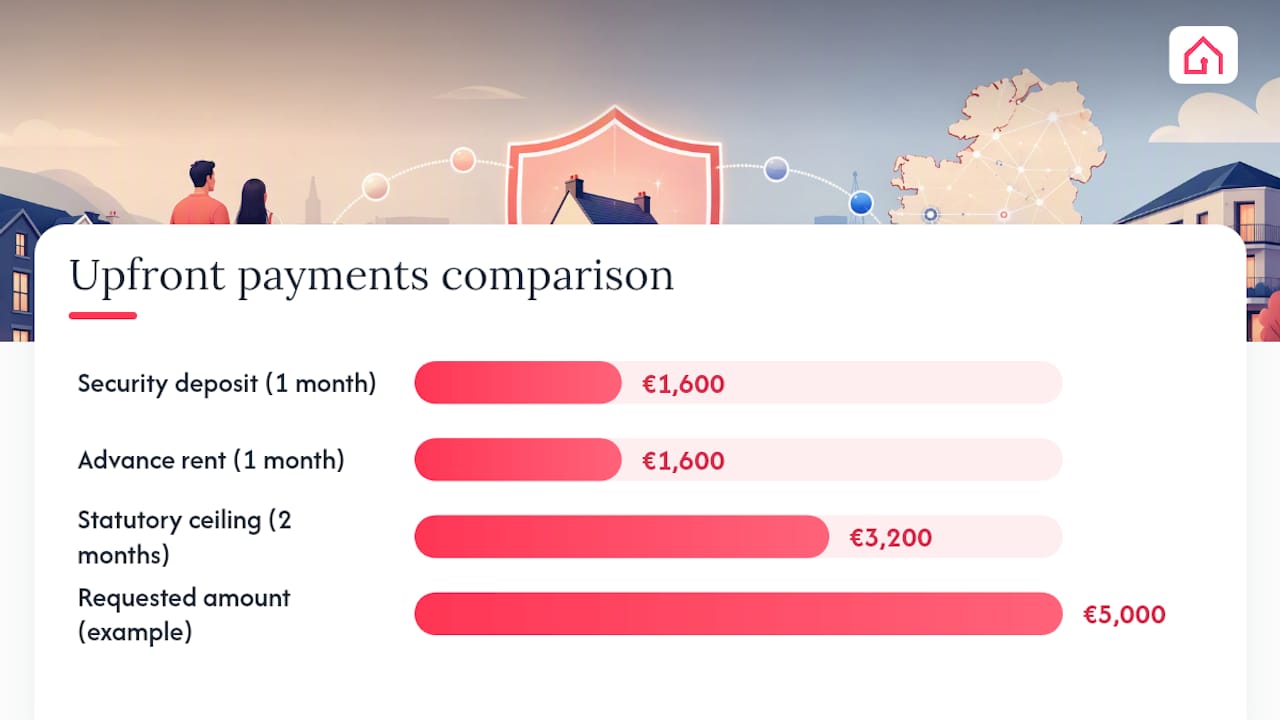
Since 9 August 2021, landlords cannot ask for more than two months' rent upfront under any circumstances covered by the Residential Tenancies (No. 2) Act 2021. That splits into two clear parts: the security deposit itself cannot exceed one month's rent, and advance rent cannot exceed one month's rent. Add them together and you hit the ceiling.
Say your rent is €1,600 a month. A landlord can legally ask for €1,600 as a deposit and €1,600 as advance rent, but nothing beyond that €3,200 total. If someone demands €5,000 upfront "to be safe," that request breaches the statutory cap and you're entitled to push back.
Student Specific Accommodation sits slightly outside the general rule, since some providers structure payments differently under separate arrangements with tenants. It's worth asking your accommodation provider to confirm which framework applies before you commit any money. Outside that exception, the two-month cap is firm, and it applies regardless of how desirable the property is or how many other applicants a landlord claims to have.
Who holds your money, and how do you prove you paid it?
Find out exactly who is holding your payment: the landlord personally, a letting agent, or a management company, because that's who you'll be chasing if things go wrong.
Ask for a signed, dated receipt before you hand over any money, listing the payer's name, the recipient's name, the exact amount, and the stated purpose of the payment.
Pay by bank transfer rather than cash wherever possible, since a bank statement gives you an unarguable timestamped record.
Photograph the property's condition on the day you move in, covering flooring, appliances, walls, and anything already damaged.
Save every message, advert, and email exchanged with the landlord or agent, including the original listing that describes the property and rent.
RTB guidance is explicit that tenants should only pay once fully satisfied with the property and terms, and that a receipt should always follow.
Pro Tip:If a holding deposit is meant to roll into your security deposit, get that written down and ask for a fresh receipt on the day your tenancy starts confirming the transfer. Without that paper trail, proving the money ever converted becomes your word against theirs.
When must a deposit be returned, and what can legally be deducted?
Your deposit remains your property until your landlord proves a lawful reason to withhold some or all of it. There's no fixed statutory return date, but gov.ie guidance is clear that landlords must return deposits promptly once they've had reasonable time to inspect the property, and they must itemise any deduction with supporting evidence.
Lawful deductions are narrower than most tenants assume:
Unpaid rent arrears.
Unpaid utility bills that were in the landlord's name.
Damage beyond normal wear and tear, such as a broken door or stained carpet caused by negligence.
Insufficient notice given when ending the tenancy.
Citizens Information draws a firm line between damage and ordinary wear and tear. Scuffed paint after two years of normal living isn't damage. A cigarette burn in the sofa is. If a landlord tries to charge you for fading curtains or a worn carpet in a long-term tenancy, that claim is weak and worth contesting with your move-in photos as evidence. Our guide to how the deposit return process works in Ireland breaks down realistic timelines in more depth.
What can you do if your deposit gets withheld?
The route you take depends entirely on whether your tenancy had actually started when you paid.
If it was a holding deposit, the RTB cannot assist you, since no tenancy existed. Your route is the Small Claims Court, which handles claims up to €2,000 quickly and cheaply without needing a solicitor.
If it was a security deposit, lodge a dispute with the RTB directly, submitting your signed receipt, move-in photos, and any correspondence about the deduction.
Before escalating either route, send a formal written request asking for an itemised breakdown of any deduction, with evidence such as invoices or repair quotes attached.
Keep a timeline. Note every date: when you paid, when you moved out, when you requested the itemisation, and when (if ever) you received a reply.
Run through this before you transfer a cent to a landlord or agent.
Confirm whether a tenancy agreement actually exists yet. If it doesn't, treat whatever you're paying as a holding deposit and act accordingly.
Get a signed receipt and full contact details for whoever is holding your money.
Take dated photos of the property's condition, ideally on the day you view it and again on the day you move in.
Get written confirmation of how the payment will be treated: rolled into your security deposit, refunded if the tenancy doesn't proceed, or forfeited under specific conditions.
Save copies of every text, email, and advert connected to the property.
Pro Tip:Never pay a holding deposit in cash to someone you've only met once. If a landlord refuses bank transfer and insists on cash, treat that as a warning sign, not a minor inconvenience.
How verified rental workflows reduce deposit risk
Most holding deposit disputes trace back to the same gap: no paper trail, no verified identity on either side, and a payment made in a rush before anyone checked who they were really dealing with. That's the exact failure point Hauzed's workflow is built to close, using verified tenant and landlord profiles, secure document upload with consent, and saved chat histories that preserve exactly what was agreed and when.
None of this guarantees you'll get a tenancy, and verification alone can't force a landlord to act fairly. But when a request, an invitation, and a conversation all sit on one verified record instead of scattered texts and cash handovers, you have far stronger evidence if a payment ever gets disputed.
— Hauzed
Renting through Hauzed instead of an anonymous cash deal
The riskiest part of any holding deposit is the moment you send money to someone you've only exchanged a few messages with, on a listing you can't verify. Hauzed is built to remove that blind spot: tenants build a verified profile once, then use it to send requests and receive invitations through a platform where the landlord's identity has also been checked, with every message and document kept in one traceable record instead of scattered across WhatsApp and cash-in-hand meetups.
Verification doesn't guarantee you'll land the flat, and it doesn't replace the paperwork habits covered above, but it does mean you're negotiating with a real, checked landlord rather than a name on an ad. If you're searching for a home in Dublin or elsewhere in Ireland, browse verified listings on Hauzed and start building your rental profile before your next viewing.
This article is general information, not a substitute for advice from a qualified lawyer. Consult a qualified legal professional about your own circumstances before acting on anything here.
How long can a landlord hold your deposit in Ireland?
There's no fixed number of days written into law, but gov.ie guidance states landlords must return a security deposit promptly once they've had reasonable time to inspect the property, and must itemise any deduction with evidence.
Can a landlord refuse to give a deposit back?
A landlord can only withhold a security deposit for a lawful reason, such as rent arrears, unpaid bills in their name, or damage beyond normal wear and tear, and they must provide proof to justify it; a holding deposit refusal must instead be pursued through the Small Claims Court since the RTB has no jurisdiction over it.
What is the maximum deposit a landlord can charge in Ireland?
For tenancies from 9 August 2021, a security deposit cannot exceed one month's rent, and combined with advance rent, total upfront payments cannot exceed two months' rent under the Residential Tenancies (No. 2) Act 2021.
What happens if a tenant overholds after their tenancy ends?
Overholding, staying beyond the agreed end date without the landlord's consent, can affect a landlord's ability to relet or reclaim the deposit process cleanly, so both sides should agree an exact end date in writing and confirm it before move-out inspections happen.
Does the RTB deal with holding deposit disputes?
No. The RTB only has jurisdiction once a tenancy exists, so a holding deposit paid before signing a lease falls outside its dispute resolution service, and recovery must go through the Small Claims Court instead.